What to Ask Before Signing Up for Medical Weight Loss

April 8, 2026

Patient reviewing a checklist of questions before signing up for medical weight loss treatment

Everyone seems to know someone who dropped 20 pounds in a month on one of the new GLP-1 medications. The before-and-after photos are everywhere. The success stories are compelling. If you have struggled with your weight for years, medical weight loss can feel like the answer you have been waiting for.

Here is the reality: not every clinic offering medical weight loss operates at the same standard. Some are legitimate medical practices with licensed professionals and comprehensive care. Others are essentially retail shops prescribing serious medications with minimal oversight. The difference matters when you are talking about drugs that affect your metabolism, hormones, and overall health. Before you commit to a provider, you need to ask some hard questions. At Body Works in Franklin, TN and Nolensville, TN, we welcome every one of the questions below during a free consultation. If a clinic you are considering does not, that answer is itself an answer.

Do You Actually Qualify for Medical Weight Loss?

This should be the first question any reputable program addresses. Medical weight loss medications are not appropriate for everyone, and a legitimate provider will screen you carefully. The standard criteria: you typically need a BMI of 30 or higher, or a BMI of 27 or higher with weight-related conditions such as type 2 diabetes, hypertension, sleep apnea, or cardiovascular disease. The CDC Adult Obesity Facts confirm that roughly 40% of U.S. adults meet these thresholds, so you are far from alone if a provider determines you qualify. According to the American Association of Clinical Endocrinology, 42.4% of U.S. adults have obesity, so plenty of people meet these thresholds.
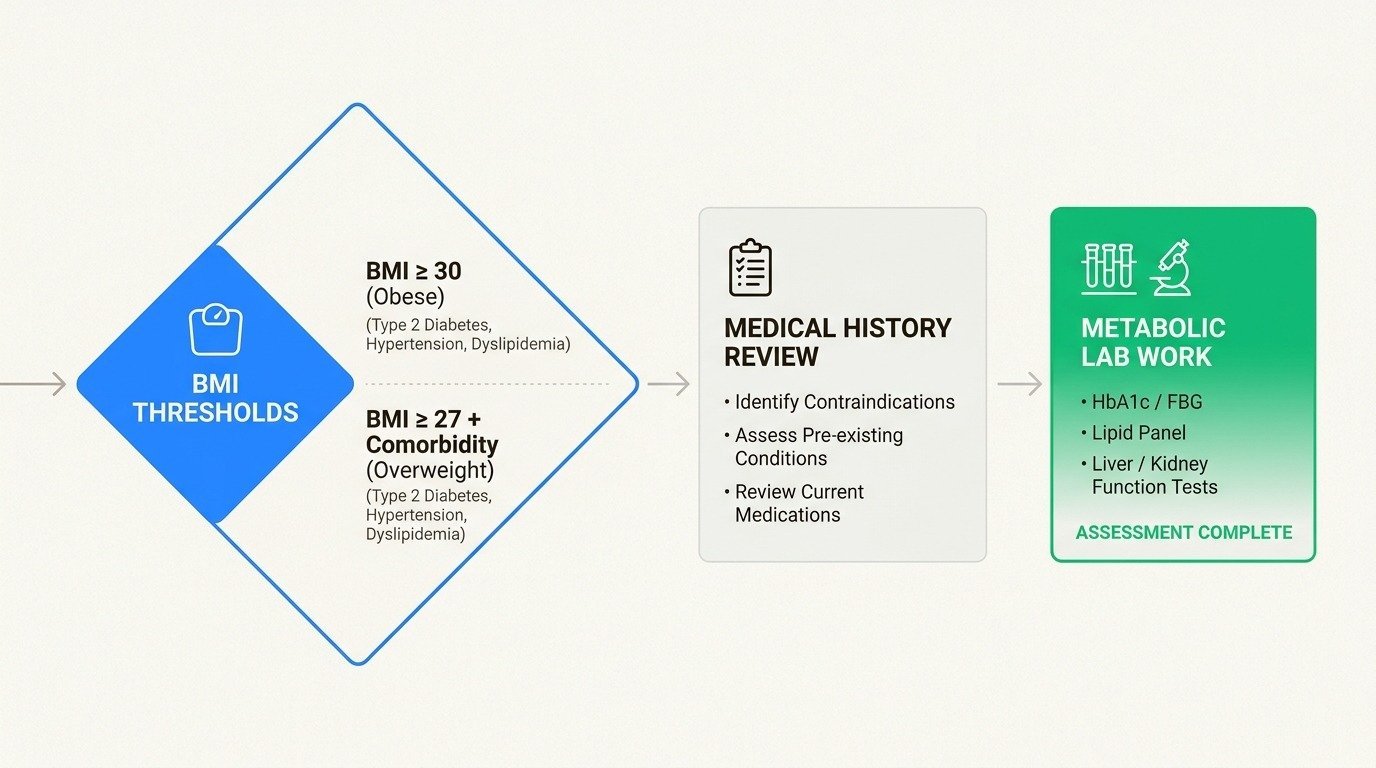
Rigorous screening checklist ensuring medical weight loss is safe and appropriate for each patient

BMI is just a starting point. A thorough program also reviews your medical history, current medications, and any conditions that might make certain weight loss medications unsafe. GLP-1 medications, for example, are not recommended if you have a personal or family history of certain thyroid cancers. If a clinic offers to prescribe weight loss medication without reviewing your health history, running lab work, or discussing your medical conditions, that is a major red flag. Proper screening is not a bureaucratic hurdle, it is how providers keep you safe. A provider who says yes to everyone is not practicing responsibly.

Who Oversees the Program Medically?

In many states, “medical weight loss” clinics can operate with minimal medical oversight. You might speak with a sales consultant rather than an actual healthcare provider. Ask directly: Who will evaluate me? Who prescribes the medications? What are their credentials?

Look for programs overseen by licensed Nurse Practitioners, Registered Nurses, or physicians. These professionals have the training to recognize when weight loss medications might be dangerous, how to manage side effects, and when to adjust treatment. At Body Works, the weight loss program is overseen by licensed Nurse Practitioners and Registered Nurses under owner Justin Williams. When you meet with us, you are meeting with medical professionals who can answer clinical questions, not salespeople working on commission.

What Should Happen at Your Initial Consultation?

A legitimate program starts with a comprehensive evaluation that includes a detailed health history, lab work to check hormones, thyroid function, and metabolic markers, body composition analysis, and a discussion of your goals and what has not worked for you in the past. This takes 45 minutes to an hour. If a clinic promises to get you in and out in 15 minutes with a prescription, you are not getting proper medical care.

The initial consultation is also your chance to assess the provider. Do they listen to your concerns? Do they explain things clearly? Do they seem rushed? Trust your instincts. You will be working with this team for months, so personal fit matters.

Treatment Options a Quality Clinic Should Offer

Medical weight loss is not one-size-fits-all, and the medications available today work differently from one another. A quality program offers multiple options and explains the pros and cons of each.

GLP-1 medications like semaglutide and tirzepatide target hormones that regulate appetite and blood sugar, helping you feel fuller with less food. They are highly effective for many people but come with side effects some patients find difficult during the first weeks. Other options include FDA-approved appetite suppressants, lipotropic injections with B12 and MIC nutrients, and peptide therapy. Some patients also have underlying hormonal imbalances that sabotage weight loss regardless of how strictly they diet: testosterone deficiency in men, thyroid issues, or insulin resistance. A comprehensive program evaluates these factors rather than reaching straight for a prescription. If a clinic only offers one medication or one type of treatment, that suggests a limited perspective on a complex problem.

How Will Your Plan Be Personalized to You?

Be wary of any program that hands every patient the same prescription and meal plan. Your treatment plan should account for your work schedule and daily routine, food preferences and dietary restrictions, exercise history, and your previous weight loss attempts. The plan should evolve as you progress; what works in month one may need adjustment in month three. A good provider monitors your response and adjusts based on results, side effects, and your feedback.

At Body Works, every plan is built from scratch following the principles of sustainable appetite-focused weight loss. A teacher with prediabetes who needs to lose 40 pounds requires a different approach than an executive with stress-related weight gain who needs to lose 20. Also ask how the clinic manages side effects: Do they start with lower doses and titrate up gradually? How quickly can you reach someone if a problem arises? According to the National Institute of Diabetes and Digestive and Kidney Diseases, people using weight management medications lose 3 to 12% more of their starting body weight than those not using medication. Our guide to succeeding on medical weight loss injections walks through the habits that separate strong responders from average ones.

What Happens When You Reach Your Goal?

Here is a statistic that should get your attention: most people who lose weight gain it back. Without a maintenance plan, you are likely to end up right where you started, sometimes heavier than before. Ask any prospective clinic how they handle the transition from active weight loss to maintenance. Do they gradually taper medications, or do you stop cold turkey? Is there a structured maintenance phase with ongoing support?

Some patients need to stay on medication indefinitely to maintain results. Others can transition off with the right support in place. Either way, this should be discussed upfront, not as an afterthought when you are nearing your goal. At Body Works, maintenance planning starts early: the skills and habits you will need for long-term success are built while you are still in the active weight loss phase. A good program also tracks multiple indicators of health improvement beyond the scale: blood pressure, HbA1c, cholesterol, waist circumference, and energy and sleep quality. These markers often improve before significant weight loss shows on the scale, and they are better indicators of lasting health benefit than pounds alone.

Red Flags That Mean You Should Walk Away

Some warning signs are universal. If you encounter any of these, walk away:
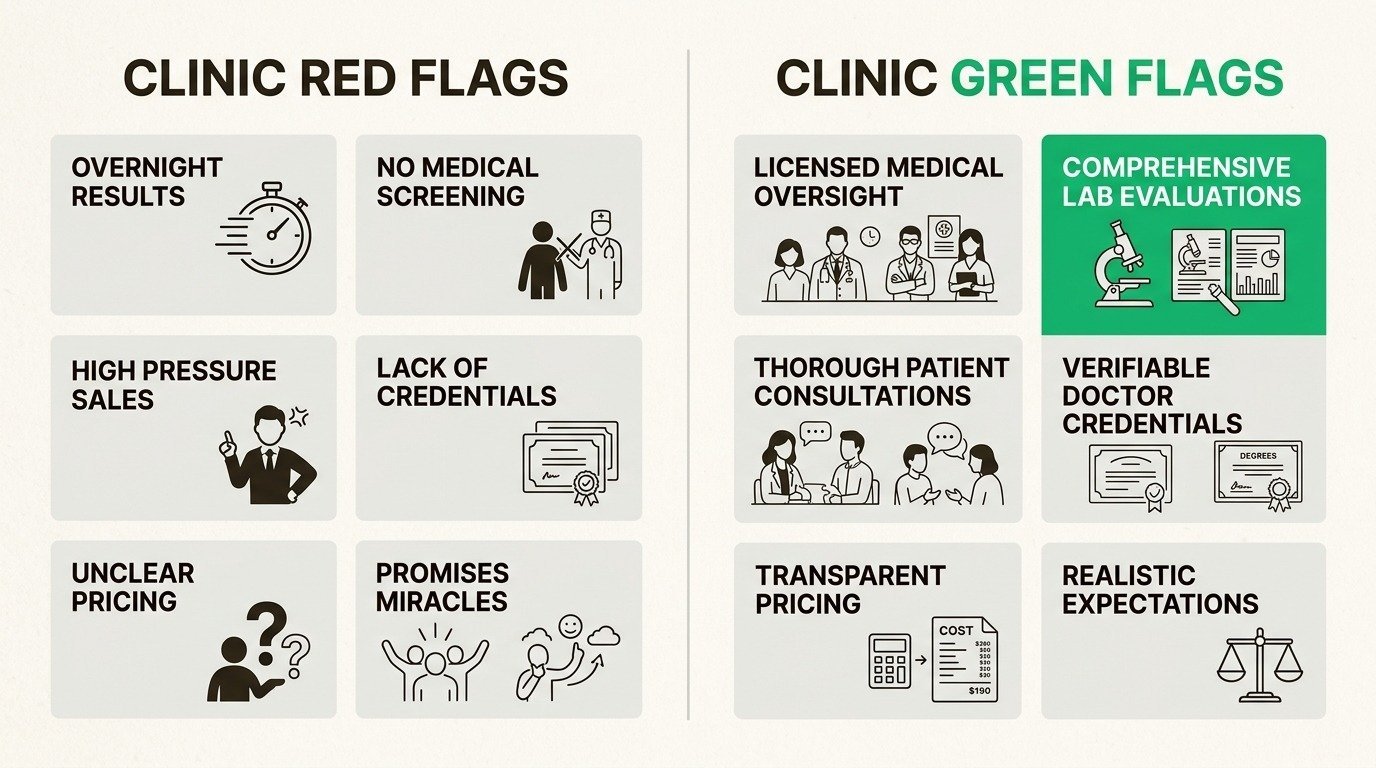
  • Promises of overnight results or claims like “lose 30 pounds in 30 days”
  • No medical exam or lab work required before prescribing medications
  • One-size-fits-all treatment plans with no personalization
  • Pressure to buy expensive supplements or package upgrades
  • Staff who cannot explain how medications work or what the side effects are
  • Before-and-after photos that seem too good to be true
  • Fine print hiding important terms in contracts

Warning signs showing red flag indicators of low quality medical weight loss clinics to avoid

These medications are powerful tools that require skill and judgment to use properly. The STEP 1 trial (Wilding et al., NEJM, 2021) documented an average 14.9% body weight loss with semaglutide 2.4 mg under trial-level medical supervision, which is the standard of care any clinic prescribing these medications should be able to match. A clinic that treats them like casual prescriptions is putting your health at risk. The right program welcomes your questions, explains their approach clearly, and prioritizes your safety over enrollment speed.

Body Works operates medical weight loss programs at both Franklin and Nolensville locations. Our approach is built on licensed medical oversight, personalized treatment plans, and addressing hormones, metabolism, and lifestyle together. Schedule a Free Consultation and ask us these same questions. We will give you honest answers about whether you are a good candidate and what you can realistically expect.

Frequently Asked Questions

Ask who will be overseeing your care medically. If the answer is not a licensed Nurse Practitioner, Registered Nurse, or physician, you are not in a legitimate medical program. You are in a sales operation that happens to have a prescription pad. Medical oversight is the difference between a clinic that protects your health and one that moves you through as quickly as possible.
Not necessarily. While a BMI of 30 or higher is the standard threshold, you may qualify with a BMI of 27 or higher if you have weight-related health conditions like type 2 diabetes, hypertension, or sleep apnea. A proper evaluation will determine your eligibility based on your complete health picture, not just a single number.
The active weight loss phase typically lasts 3 to 6 months, though some patients continue longer depending on their starting point and goals. Maintenance support should continue indefinitely. Be wary of programs that focus only on rapid loss without planning for keeping the weight off. Sustainable results require long-term support built into the plan from the beginning.
Bring a complete list of your current medications and supplements, your medical history including previous weight loss attempts, any recent lab work from the past six months, and a list of questions you want to ask. Being prepared helps your provider create a more effective, personalized plan and gives you time during the visit to get real answers rather than background details.
No. GLP-1 medications are highly effective for many people, but they are not the only option. FDA-approved appetite suppressants, lipotropic injections, peptide therapy, and hormone balancing may all be appropriate depending on your situation. A quality program discusses multiple options and helps you choose the right approach based on your health profile and goals.
Watch for promises of overnight results, no medical screening required, pressure to buy expensive supplements or package upgrades, inability to explain medication side effects, or treatment plans that are identical for every patient. These signs indicate a clinic focused on profit over patient safety. A reputable clinic welcomes scrutiny and answers questions directly. Schedule a Free Consultation at Body Works in Franklin or Nolensville to get straight answers to every one of these questions. Medically reviewed by Dr. Donald Vollmer, MD, Managing Physician, Body Works TN

Medically reviewed by Dr. Donald Vollmer, MD
Managing Physician, Body Works TN

Browse Our Blog