
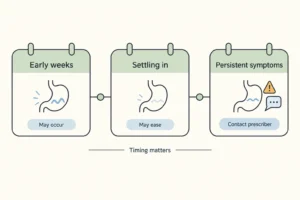
GLP-1 Side Effects by Week: What Is Normal, What Passes, What to Report
A symptom that is completely normal in week two can be a reason to call your prescriber in week fourteen. Nausea right after a dose
A lot of what passes for testosterone replacement therapy in Franklin, TN and nationwide in 2026 is a questionnaire, a card swipe, and a prescription mailed to your door, no exam, no repeat labs, no provider who’s actually looked at your bloodwork twice. That model exists because it’s fast and it’s cheap to run. It also means nobody’s watching your hematocrit, nobody’s asking whether your symptoms actually match a hormonal cause, and nobody’s adjusting your dose based on how you’re actually responding.
Physician-supervised TRT looks different, and slower, on purpose. At Body Works, treatment for men in Franklin, TN and Nolensville, TN starts with a real diagnostic workup and stays supervised through every dose adjustment after that. Here’s what that process actually looks like, start to finish.

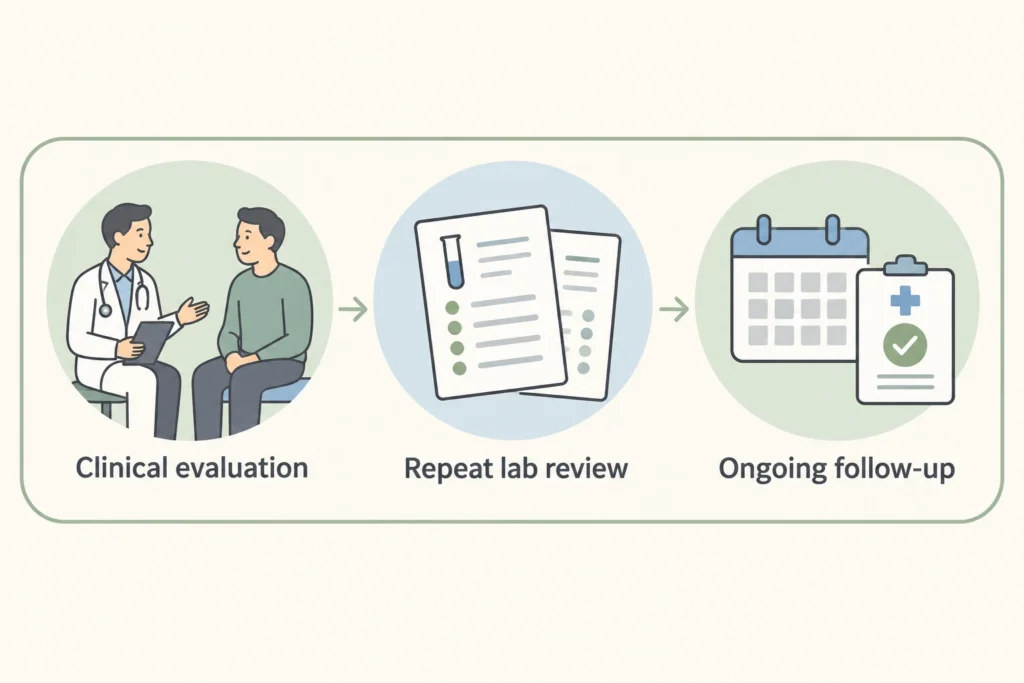
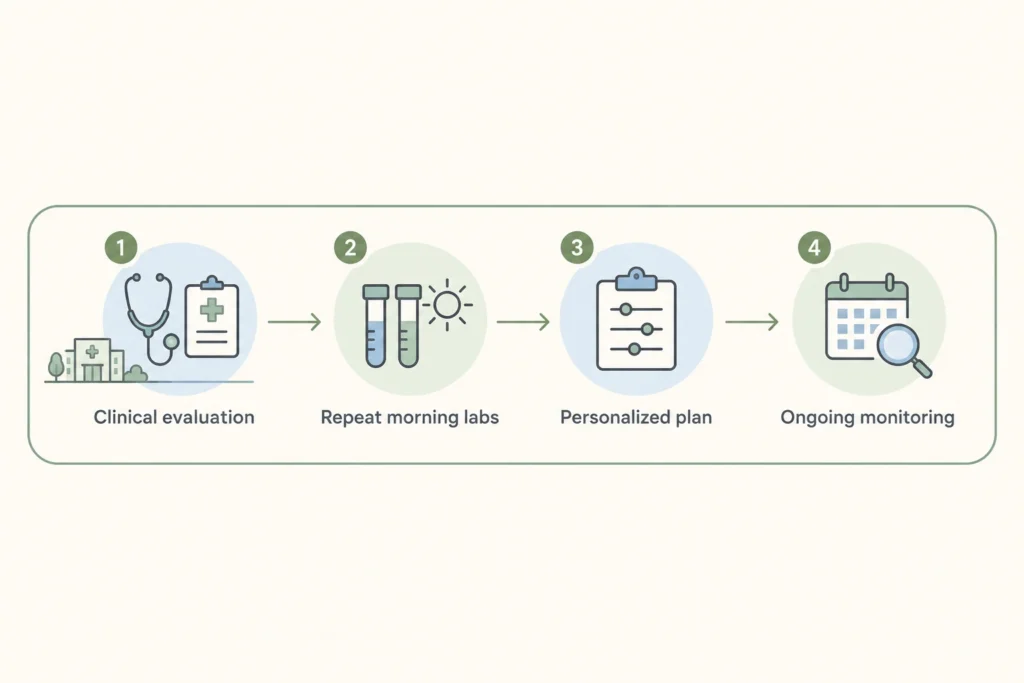
The first visit is a conversation before it’s a blood draw. A provider reviews your symptoms against the pattern clinicians actually screen for, since fatigue, low libido, and mood changes overlap with a dozen other conditions and testosterone testing without a symptom match rarely changes anything useful. The low testosterone symptoms checklist covers the specific pattern that pattern-matches to a hormonal cause versus a lifestyle one.
If your symptoms and history support testing, labs come next, timed correctly. The Endocrine Society’s clinical practice guideline on testosterone therapy calls for a fasting morning draw, confirmed by a second separate measurement, before any diagnosis is made. That two-draw standard is the default at Body Works, not an upsell; a single afternoon test is exactly the kind of shortcut that produces a wrong answer in either direction.
Diagnosis requires both a confirmed low testosterone level and a symptom pattern that matches it, not one or the other. Testosterone levels by age covers why a single “normal” lab result doesn’t always settle the question, particularly for men whose number sits near a lab’s cutoff or whose free testosterone tells a different story than their total testosterone.
Depending on what the labs show, the diagnosis also determines the treatment options on the table. Men with a healthy testicular signal but low pituitary drive sometimes have a genuine alternative to direct testosterone replacement. Enclomiphene vs. TRT walks through that decision for men where fertility is part of the conversation.
Once a diagnosis is confirmed and treatment is the right call, the protocol covers medication, dose, delivery method, and a monitoring schedule built in from day one, not added later if something goes wrong. The Mayo Clinic’s overview of testosterone therapy notes that delivery options include injections, gels, and pellets, each with different dosing rhythms and different tradeoffs a provider should walk through based on your lifestyle and lab response, not a one-size default.
Baseline hematocrit and estradiol are drawn before the first dose, with a recheck built into the calendar at three to six months and annually after that. TRT side effects and how they’re managed covers exactly what that monitoring catches and what happens if a number runs outside the expected range.
Results don’t arrive on day one. Most men notice little change in the first two weeks, a real lift in mood, libido, and energy by four to eight weeks, and measurable changes in strength and body composition around the three-month mark, once levels have stabilized and tissue has had time to respond. The full TRT results timeline breaks down what changes at each checkpoint so you know what’s expected and what’s worth flagging to your provider.
Recent regulatory changes are also worth knowing before you start. Testosterone products carried a boxed cardiovascular warning for years; the FDA removed that warning in February 2025 based on large-scale trial data showing no increase in major cardiac events, while adding a new blood pressure warning across the product class. A physician-supervised protocol accounts for both the updated safety picture and the individual monitoring that still matters.
A prescription is not the hard part of testosterone therapy. Getting the diagnosis right, catching a hematocrit or estradiol trend before it becomes a problem, and adjusting a protocol based on how an individual man actually responds, that’s the part a ten-minute online intake form cannot do. The Cleveland Clinic’s overview of testosterone replacement therapy describes ongoing lab monitoring and dose adjustment as a routine, expected part of treatment, which only works if a provider is actually reviewing results and adjusting course rather than auto-refilling the same dose indefinitely.
This is also where a diagnostic threshold question matters. Specialty guidelines don’t fully agree on where the biochemical cutoff for low testosterone sits; the American Association of Clinical Endocrinologists’ guideline on hypogonadism in adult men has historically used a different threshold than some other specialty frameworks, which means the same lab number can read differently depending on which guideline a provider follows. Working with a provider who treats the lab value and the symptom pattern together, rather than a number in isolation, is what keeps a diagnosis from becoming a guess.
None of this requires a man to become an expert in endocrinology before his first visit. It’s the reason physician supervision exists in the first place: someone trained to weigh these frameworks against your specific labs and symptoms, rather than applying a single fixed cutoff to every man who walks in the door.
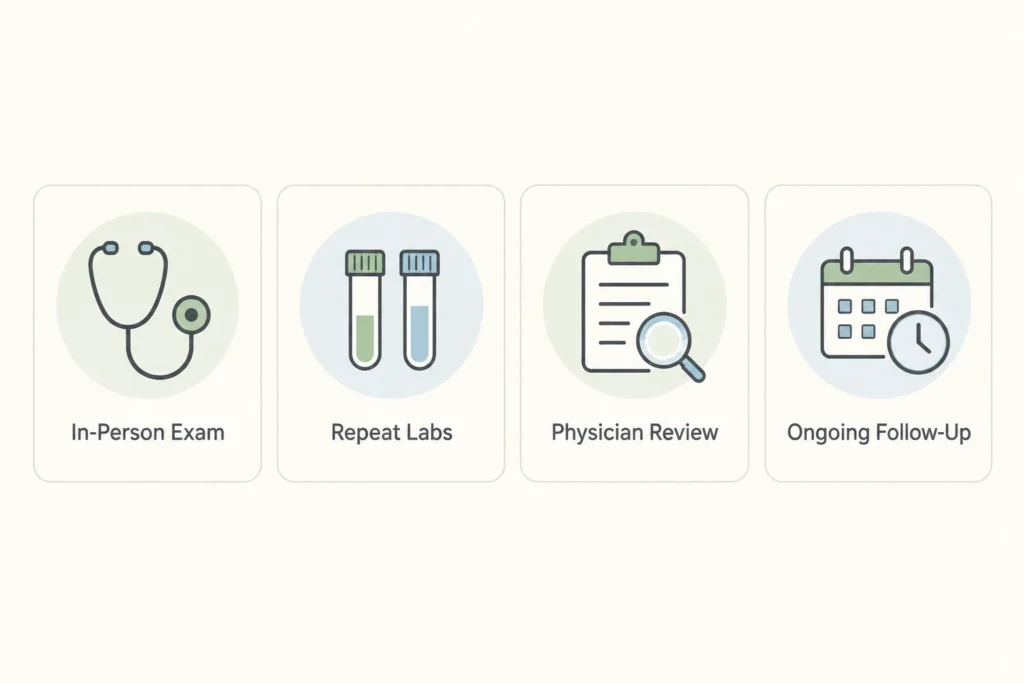
Body Works’ Franklin location, at 1113 Murfreesboro Rd Suite 307, Franklin, TN 37064, offers the same physician-supervised process described above: symptom review, confirmed diagnostic labs, a tailored protocol, and ongoing monitoring. Learn more about TRT at the Franklin location or call (615) 790-2548 to ask questions before booking.
Body Works’ Nolensville location, at 210 Burkitt Commons Ave, Nolensville, TN 37135, runs the identical diagnostic and monitoring process for men closer to that side of Williamson County. Learn more about TRT at the Nolensville location or call (615) 941-1000 with questions ahead of your visit.
Bring any recent lab results, even if they’re from an urgent care visit or a previous provider, along with a specific list of symptoms and how long each has been present. If you’re weighing TRT against a fertility-preserving alternative, come with that priority named upfront, since it changes which labs get ordered on day one rather than after a diagnosis is already set. A current medication list and a rough timeline of when symptoms started are also worth having ready; both shape how a provider reads your first set of labs.
If you’ve already had testosterone checked elsewhere and were told your number was “normal,” bring that result anyway rather than assuming it settles the question. A single number without a repeat draw, without a free testosterone check, and without a symptom conversation attached to it is often an incomplete answer rather than a final one.
Men working with Body Works’ hormone therapy program in Franklin and Nolensville get the same physician-supervised standard regardless of which location is more convenient: confirmed labs before treatment, a real monitoring schedule after it, and a provider who reviews results rather than auto-renewing a prescription.
Schedule a Free Consultation at either location to start with a real conversation, not a questionnaire.
Medically reviewed by Dr. Donald Vollmer, MD
Managing Physician, Body Works TN
A symptom that is completely normal in week two can be a reason to call your prescriber in week fourteen. Nausea right after a dose

All three of these show up in the same conversation, usually because someone read that they all “boost growth hormone” and assumed that made them

GLP-1 nausea affects 44% of semaglutide patients and 25% to 29% on tirzepatide, clusters around dose increases, and fades within weeks for most. Smaller meals,

Searching for semaglutide in a town the size of Nolensville turns up a strange gap: national telehealth ads everywhere, but almost nothing about a real

If you have been researching semaglutide for weight loss, you have probably hit the same wall everyone else does: a telehealth app that ships a

The needle is the easy part. Most people who quit a GLP-1 medication early do not quit because of the injection itself, they quit because
See Body Works first in your Google results.