
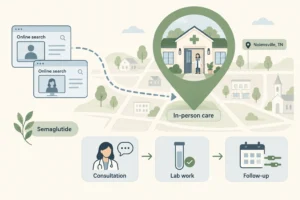
Semaglutide in Nolensville, TN: Availability and How to Start
Searching for semaglutide in a town the size of Nolensville turns up a strange gap: national telehealth ads everywhere, but almost nothing about a real
The number on the scale is dropping faster than it ever has. That is the promise of peptides and GLP-1 weight loss working together, and it is also the trap. When semaglutide or tirzepatide pulls weight off quickly, a meaningful share of what leaves is not fat. It is muscle. And once the fat under the skin is gone, what is left behind can sag in a way no medication addresses on its own.
This is the conversation that does not happen in most weight loss visits. At Body Works in Franklin, TN and Nolensville, TN, patients who are thrilled with their GLP-1 results often arrive with a second set of concerns six months in: they feel weaker, their face looks hollow, and the skin on their arms and abdomen has gone loose. The good news is that the same period of rapid change is when targeted support matters most. Done correctly, with bloodwork and physician oversight, peptide therapy can be paired with GLP-1 medication to defend the two tissues that rapid weight loss puts at risk.
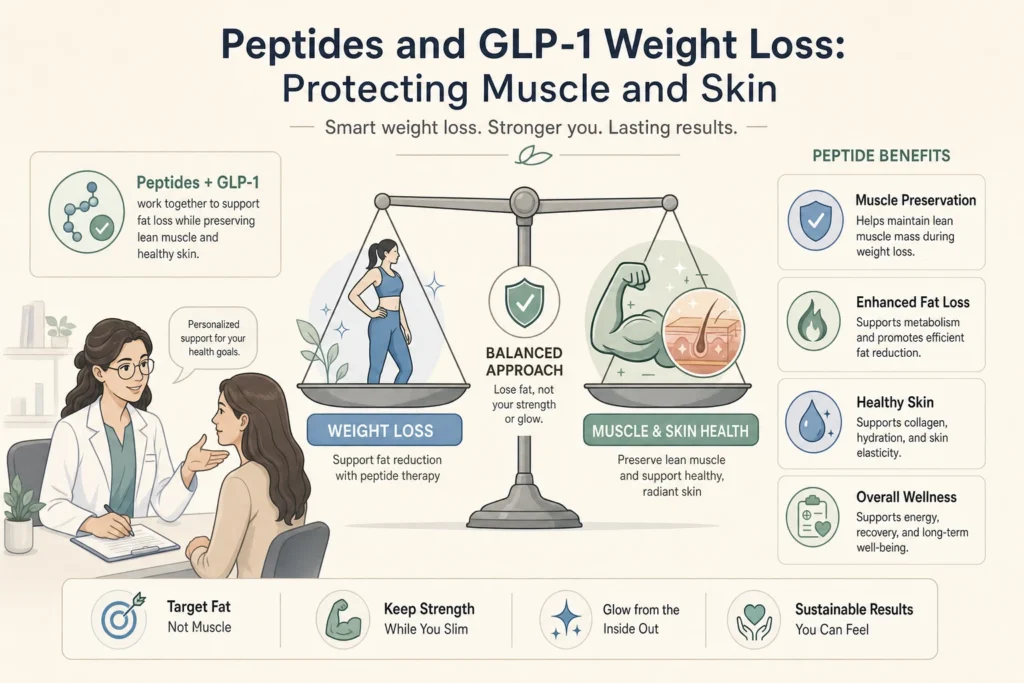
Yes. A consistent finding across the major GLP-1 trials is that roughly a quarter of the total weight lost comes from lean mass, not fat. This is not a flaw unique to these drugs; any rapid weight loss, including dieting and bariatric surgery, takes lean tissue along with fat. The difference is that GLP-1 medications make rapid loss easy, so the lean-mass cost arrives faster and larger in absolute terms.
In the body composition substudy of the STEP 1 trial, participants on semaglutide lost about 15% of body weight, with total fat mass down 19.3% and total lean body mass down 9.7%, meaning roughly 23% of the weight lost was lean tissue, as reported in the STEP 1 body composition analysis in the Journal of the Endocrine Society, 2021. The tirzepatide picture is similar. To understand why these medications work and what they do to the whole body, our explainer on how GLP-1 medications work is a useful starting point.
Across both leading GLP-1 medications, the split lands near 75% fat and 25% lean tissue. In the SURMOUNT-1 body composition analysis, tirzepatide reduced fat mass by 33.9% and lean mass by 10.9%, with about 75% of total loss coming from fat and 25% from lean mass, a ratio reported in the SURMOUNT-1 body composition study in Diabetes, Obesity and Metabolism, 2025. That ratio sounds reassuring until you do the math on a large weight loss: lose 60 pounds, and as much as 15 of them may be lean tissue.
The table below shows how the two medications compare on body composition, drawn from their respective published analyses.
| Body composition measure | Semaglutide (STEP 1) | Tirzepatide (SURMOUNT-1) |
|---|---|---|
| Total body weight change | About -15% | About -22% |
| Fat mass change | -19.3% | -33.9% |
| Lean mass change | -9.7% | -10.9% |
| Share of loss from lean tissue | About 23% | About 25% |
They can, and they are the foundation that any peptide protocol builds on, never replaces. Resistance training is the single most reliable defense against lean-mass loss during weight reduction, and adequate protein is its necessary partner. A review of GLP-1 therapy and exercise concluded that resistance training, more than aerobic exercise, blunts lean body mass loss during weight-loss diets, and that pairing it with higher protein intake mitigates muscle loss, as discussed in a 2025 review in Frontiers in Clinical Diabetes and Healthcare.
The practical problem is that GLP-1 medications suppress appetite so effectively that many people undereat protein without noticing. A case series of patients who preserved or even gained lean tissue on semaglutide or tirzepatide credited deliberate resistance training several days a week alongside protein intake near or above 1.2 grams per kilogram of body weight, documented in a 2025 case series in SAGE Open Medical Case Reports. Peptides enter the picture only after these basics are in place. For the full framework on losing weight without losing the gains, see our guide to losing weight and keeping it off.
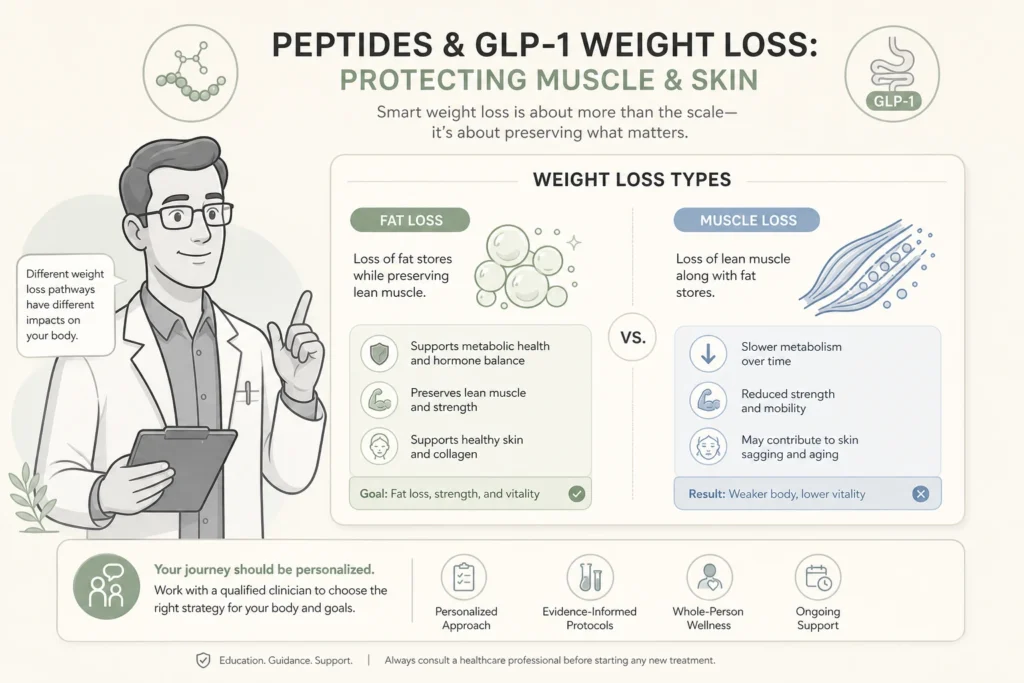
Growth hormone releasing peptides such as CJC-1295 and ipamorelin work by prompting your own pituitary to release growth hormone in its natural pulsing rhythm, which supports lean tissue and recovery rather than replacing a hormone outright. In healthy adults, a single dose of CJC-1295 produced a 2- to 10-fold rise in growth hormone and a 1.5- to 3-fold rise in IGF-1 lasting more than a week, reported in a 2006 study in the Journal of Clinical Endocrinology and Metabolism.
BPC-157 is used in a different role. It is studied for soft-tissue and tendon recovery, which matters when someone ramps up resistance training during a calorie deficit and asks more of joints that are carrying less cushioning. Neither peptide is a substitute for training and protein; they are tools that may help the body hold and rebuild lean tissue while a GLP-1 medication drives fat loss. Our complete guide to peptide therapy covers how these compounds are categorized and prescribed.
Peptides will not erase significant skin laxity, but some may support the skin’s own elasticity during and after weight loss. The copper peptide GHK-Cu is the most studied for this. Across controlled facial studies, GHK-Cu creams improved skin laxity, firmness, and density while reducing fine lines, with the peptide acting by stimulating collagen, elastin, and glycosaminoglycan production, summarized in a 2015 GHK peptide review in BioMed Research International.
Growth hormone releasing peptides may add indirect support by maintaining IGF-1 signaling, which contributes to dermal collagen turnover. Skin response to weight loss is highly individual and depends on age, the amount lost, and how fast it came off, so peptides are best framed as one input among several. We cover the skin side in more depth in our article on GHK-Cu for skin, hair, and collagen, and skin-tightening options live within our aesthetics services.
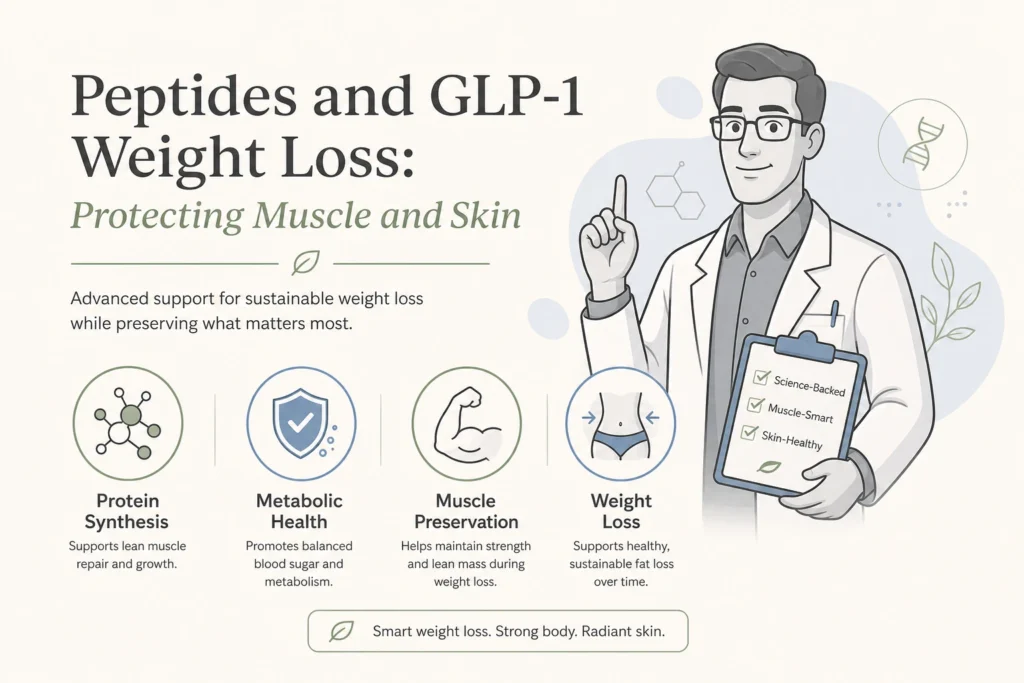
Combining peptides with a GLP-1 medication changes two hormonal systems at once, and that is not a do-it-yourself project. Growth hormone pathways interact with blood sugar and IGF-1, both of which deserve monitoring, and growth hormone products themselves are approved only for specific medical conditions and carry explicit glucose-monitoring warnings, as set out in the FDA prescribing label for somatropin (Norditropin).
Responsible peptide therapy alongside GLP-1 treatment starts with baseline bloodwork, includes follow-up labs, and uses physician-supervised, pharmacy-sourced compounds rather than gray-market products. The point is not just safety; it is making sure the protocol is actually doing what you think it is. That oversight is the difference between a strategy and a gamble.
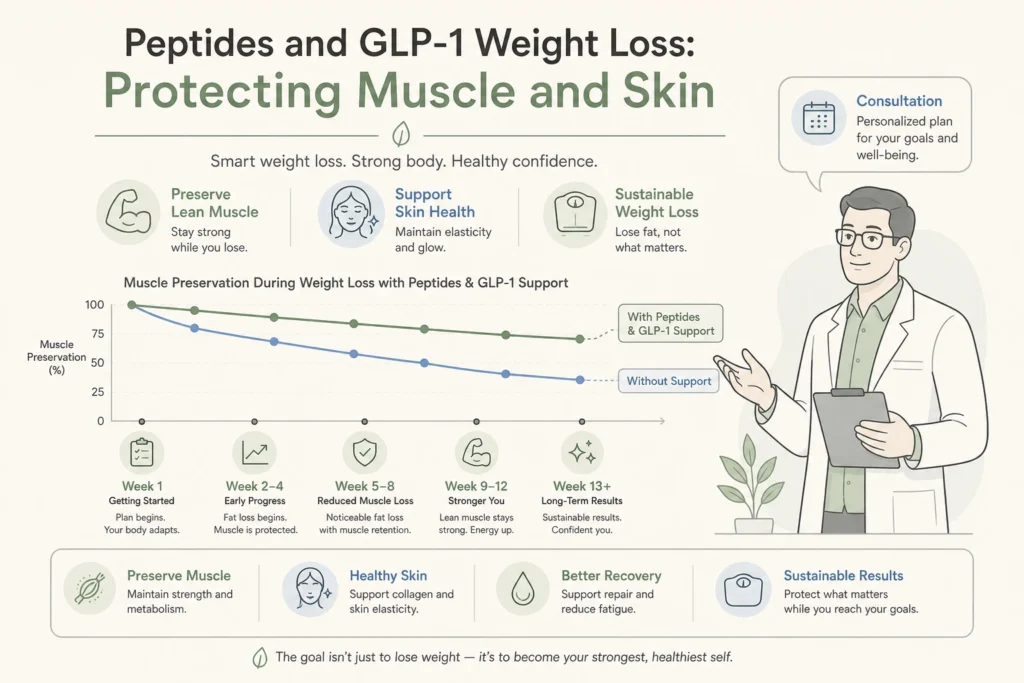
The smartest time to think about muscle and skin is before they are lost, not after. If you are starting or already on a GLP-1 medication, pairing it with a structured plan for protein, resistance training, and, where appropriate, peptide support gives you a far better chance of keeping the strength and skin quality you want. The team at Body Works builds these plans around your labs and your goals, not a template, and our medical weight loss program is designed to address body composition, not just the scale.
Care is available in both Franklin and Nolensville, with the same physician-led approach to peptide therapy and weight management at each location. Schedule a Free Consultation to find out whether combining peptides with your weight loss plan makes sense for your situation.
Our full medical weight loss program is available at both the weight loss clinic in Franklin and weight loss clinic in Nolensville.
Medically reviewed by Dr. Donald Vollmer, MD
Managing Physician, Body Works TN
Searching for semaglutide in a town the size of Nolensville turns up a strange gap: national telehealth ads everywhere, but almost nothing about a real

If you have been researching semaglutide for weight loss, you have probably hit the same wall everyone else does: a telehealth app that ships a
The needle is the easy part. Most people who quit a GLP-1 medication early do not quit because of the injection itself, they quit because
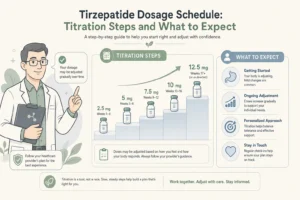
Patients starting tirzepatide often expect the first injection to feel like the start of real treatment. It isn’t. The 2.5 mg starting dose is a
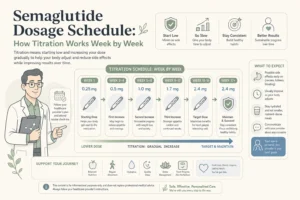
The dose on a semaglutide prescription rarely matches the dose a patient ends up taking, and that gap confuses people every week. Someone reads that
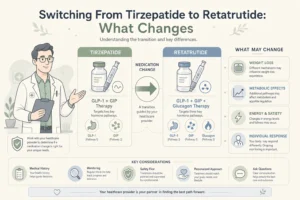
Switching from tirzepatide to retatrutide is a supervised medication change, not a milligram match. Retatrutide (GLP-3) adds the glucagon receptor and produced 24.2% weight loss
See Body Works first in your Google results.