
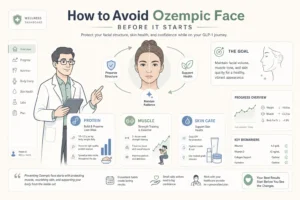
How to Avoid Ozempic Face Before It Starts
You can lower your odds of the gaunt, sunken look people call Ozempic face. Here is how pacing, protein, muscle, and skin care protect your
Yes, in most cases the hollow look people call “Ozempic face” is reversible, and it is rarely permanent. The gaunt cheeks and deeper folds that show up during fast weight loss come mostly from lost facial fat and thinner support under the skin, not from the medication damaging your face. When facial volume comes back, whether through weight regain, a slower pace, or treatments that restore volume, the look softens. How fully it reverses depends on your age, how fast you lost weight, and how much elasticity your skin still has.
This guide is the treatment and reversal lane in our larger set of guides on the physical changes that come with GLP-1 treatment. It explains, in plain terms, what dermal fillers, biostimulators, and collagen support can and cannot do for a face that has lost volume.
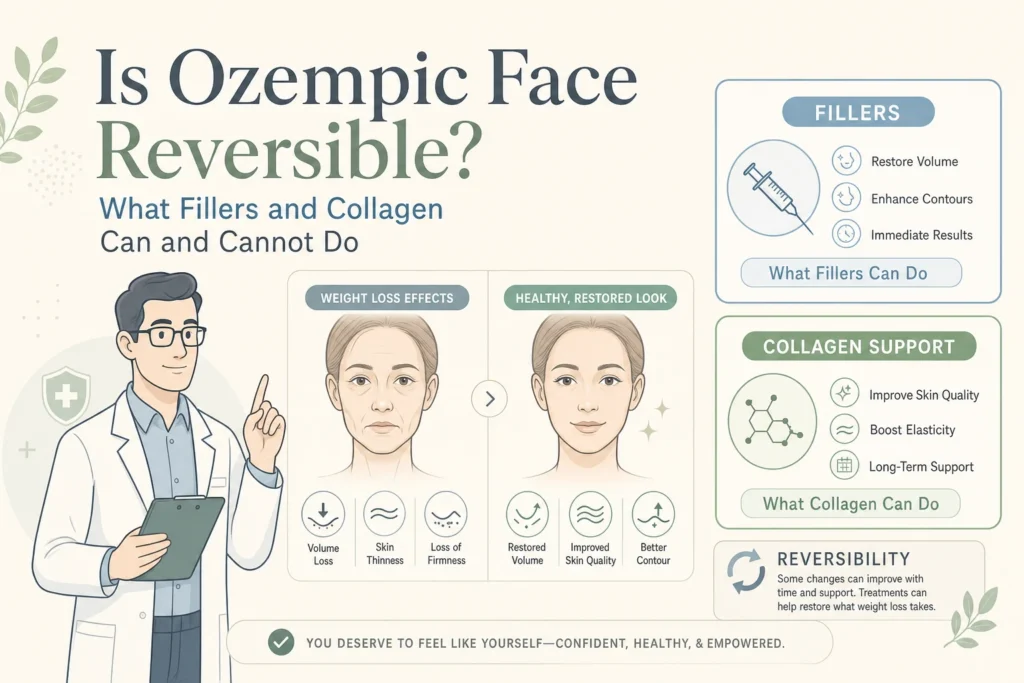
For most people, yes. “Ozempic face” is a nickname for facial volume loss that follows rapid weight reduction, and it behaves like volume loss from any cause. The fat pads that cushion the cheeks, temples, and area around the mouth shrink as total body fat drops, so the face reads as older, flatter, or more tired. Because this is a volume problem rather than a wound, restoring volume improves the appearance.
The face has distinct fat compartments that give it a youthful, rounded shape, and these compartments lose size and shift as we lose weight or age. A review of facial aging in a 2020 review in the Aesthetic Surgery Journal, indexed on PubMed Central, describes how deflation and descent of these fat compartments drive the hollow, sunken look that patients want to correct. Because the mechanism is deflation, adding volume back is a direct fix, which is why the change is usually reversible rather than fixed.
The hollow look comes from three separate changes, and telling them apart matters because each responds to a different approach. The first is volume loss, meaning the fat that plumps the cheeks and temples has shrunk. The second is skin laxity, meaning the skin that once wrapped a fuller face now has extra slack. The third is skin quality, meaning fine lines, thinning, and a loss of the bounce that younger skin has.
Weight lost quickly tends to hit the face harder because the body pulls from fat stores everywhere, including the delicate compartments in the face. Age adds to this because collagen and elastin, the proteins that keep skin firm and springy, decline over time. A 2022 review of aging skin in Biogerontology, indexed on PubMed Central notes that collagen density falls as we age and existing collagen breaks down, which reduces the skin’s ability to snap back over a smaller frame. So one face may look hollow mostly from lost fat, while another looks loose mostly from skin that no longer fits.
No, facial volume loss from weight loss is not usually permanent. The medication is not scarring or destroying facial tissue, so there is no permanent structural damage driving the change. If you regain some weight, facial fullness often returns on its own. If you stay at your new weight, the volume that left with the fat will not come back by itself, but it can be restored or rebuilt with treatment.
The honest caveat is skin. Fat can be replaced, but skin that has been stretched and then left with less to fill may not fully retighten, especially with age or after very large or very fast weight loss. That is why some people see their face bounce back nicely while others are left with lingering looseness. The volume side is highly reversible. The skin-tightening side is more variable, which is a separate topic we cover in our guide to non-surgical skin tightening options after weight loss.
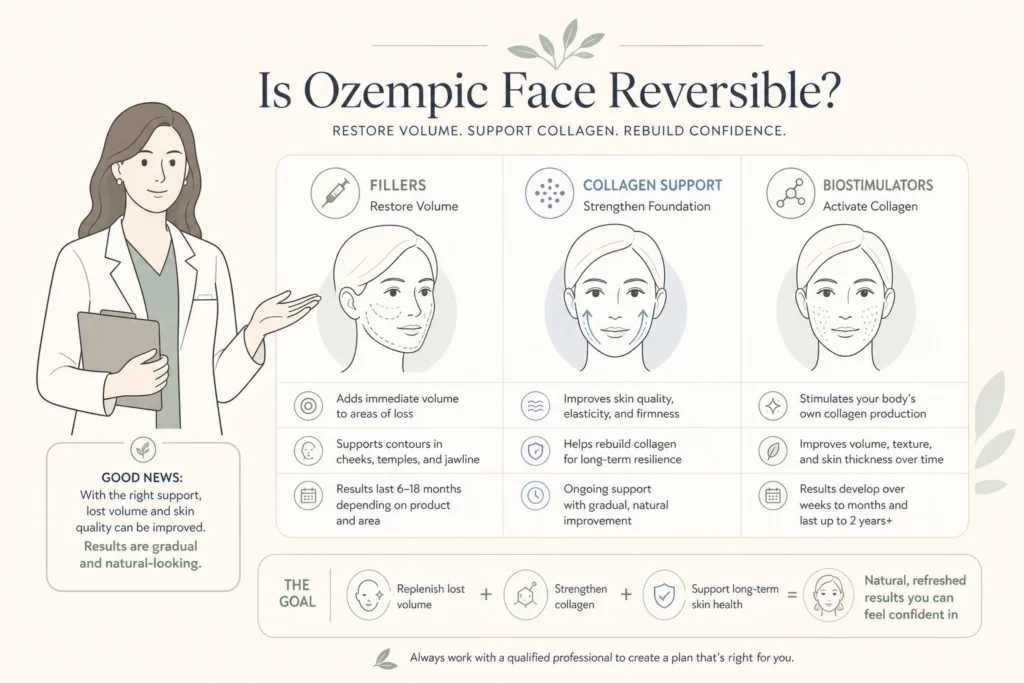
Dermal fillers are gel-like materials placed under the skin to add volume where fat has been lost. For “Ozempic face,” their strength is restoring fullness to hollow cheeks, temples, and the area around the mouth, which can quickly soften a gaunt appearance. Filler-type treatments are well suited to a volume problem because they physically replace what deflated.
What fillers cannot do is tighten loose skin or improve skin quality. If your main issue is extra skin slack rather than lost volume, adding filler can help fill the space but will not shrink the skin envelope, and overfilling to chase tightness looks unnatural. Fillers also do not stop future volume loss, and results are temporary because the body gradually absorbs the material. The Cleveland Clinic describes dermal fillers as a temporary way to restore lost volume and smooth folds, with results that fade over months and require maintenance. That’s the honest frame: fillers restore volume well, do not tighten skin, and do not last forever.
Biostimulators are a different category of injectable that works by prompting your own body to build collagen over time, rather than adding volume instantly. Instead of filling a hollow the day of treatment, they encourage gradual thickening and firming across several weeks, which can improve both subtle volume and skin quality. The tradeoff is patience, since results build slowly and usually need a series of sessions.
Collagen support outside of injections works on the skin-quality side of the problem. This includes in-office treatments that stimulate collagen and at-home habits like sun protection, adequate protein, and consistent skincare. None of these rebuild a lost fat pad, so they aren’t a substitute for volume restoration when the face is truly hollow. What they can do is help the skin that remains look healthier, which matters most when skin quality, not deep volume, is the main complaint.
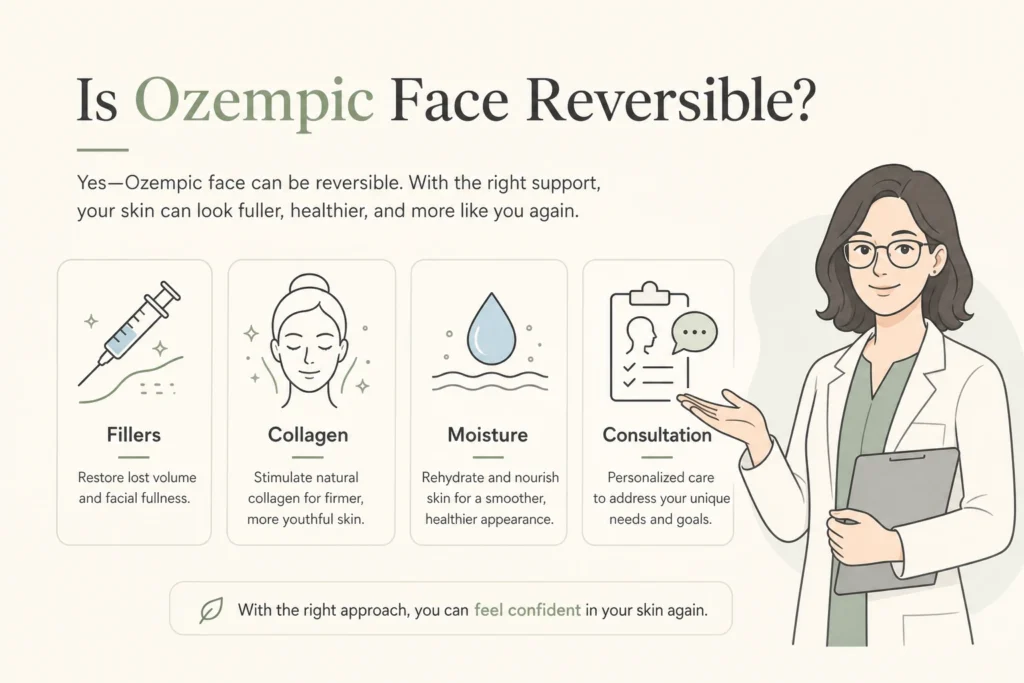
The most useful thing you can do before any treatment is figure out which of the three problems you actually have, because the wrong tool for the wrong problem wastes money. The table below matches each concern to what volume-restoring filler-type treatments address, what they do not, and what non-injectable support can add. Use it as a conversation starter, not a prescription, since a trained provider needs to look at your face to tell you what is really driving the change.
| Concern | What filler-type treatments address | What they do not do | Non-injectable support |
|---|---|---|---|
| Volume loss (hollow cheeks, temples, sunken look) | Restore fullness by replacing lost volume directly | Do not tighten loose skin or stop future volume loss | Weight stabilization, adequate protein, collagen-supporting nutrition |
| Skin laxity (loose, sagging skin) | Fill some space, giving a mildly smoother look | Do not shrink the skin envelope or truly tighten | Collagen-building in-office treatments, plus strength and weight maintenance |
| Skin quality (fine lines, thinning, dullness) | Little direct effect, though biostimulators may help gradually | Do not resurface skin or repair sun damage | Sun protection, not smoking, skincare, collagen-supporting habits |
Several non-injectable steps genuinely help, and they’re the foundation whether or not you ever choose a treatment. Stabilizing your weight and avoiding repeated large swings keeps facial fat from disappearing again. Prioritizing protein and broader nutrition gives your body the raw materials for collagen and helps preserve muscle and healthy tissue during weight loss, which we cover in our guide on how to avoid Ozempic face before it starts.
Daily sun protection is one of the highest-value habits, because ultraviolet exposure is a leading driver of collagen breakdown. Not smoking, staying hydrated, and a consistent skincare routine also support the skin you have. These steps will not refill a deeply hollow cheek, but they slow further loss and improve skin quality. What we see in patients at Body Works is that the people happiest with their results treated their weight loss and their skin as one connected plan, not two.
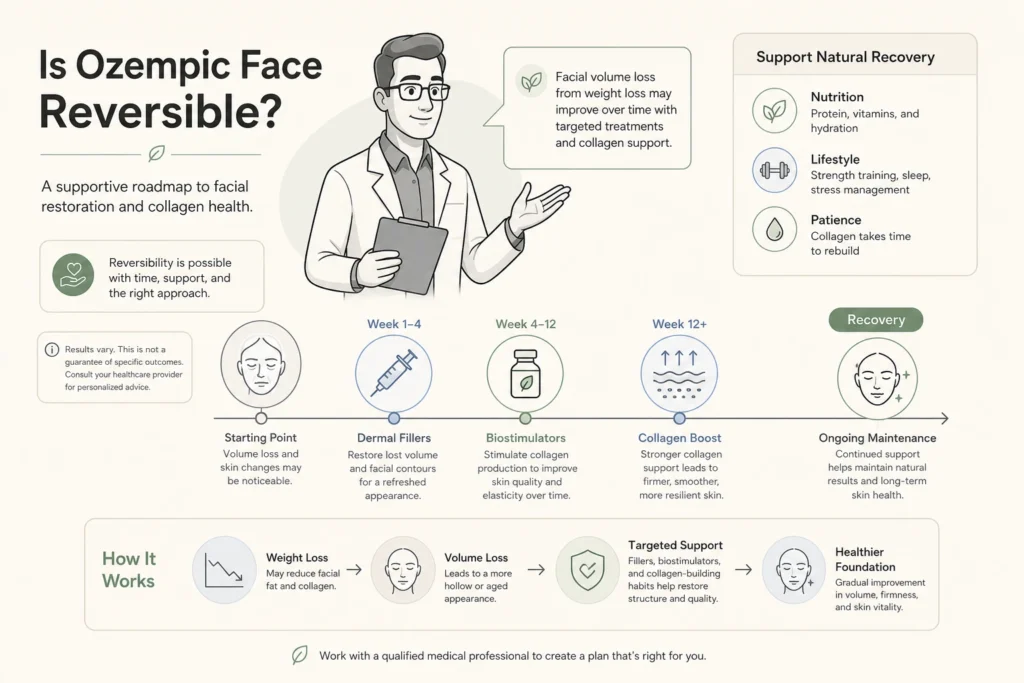
The right choice depends on which concern is dominant, your age and skin elasticity, and your goals, and that is genuinely hard to judge from a mirror or an article. A face that is hollow but has firm skin may do beautifully with volume restoration. A face with significant looseness may need a skin-focused plan instead, or on top of it. Only an in-person evaluation can sort volume loss from laxity from skin quality and match each to the approach that fits. If you want to understand the underlying cause first, start with our overview of the causes and treatment of Ozempic face.
Because the same clinic that manages your weight loss also understands what the weight loss is doing to your face, that’s the natural place to have this conversation. If you want an honest, personalized read on what fillers, biostimulators, or collagen support could do for your face, our medical aesthetics services team can help. Body Works cares for patients through medically supervised weight loss at our Franklin and Nolensville, TN offices, so the same team that guides your weight loss can guide what comes next for your face. Schedule a Free Consultation to evaluate your options in person.
Medically reviewed by Dr. Donald Vollmer, MD
Managing Physician, Body Works TN
You can lower your odds of the gaunt, sunken look people call Ozempic face. Here is how pacing, protein, muscle, and skin care protect your
Constipation affects 24% of semaglutide patients and up to 17% on tirzepatide. This guide gives the daily targets that prevent it: 22 to 34 grams

Ozempic face is the hollow, aged look some people notice after rapid weight loss. Here is why it happens, who is most at risk, and

When Tennessee investigators tested counterfeit weight loss vials seized in Medina, one was mostly water. That was the good outcome. The dangers of buying peptides
Rapid weight loss changes more than the number on the scale. Here is why the glutes, breasts, and arms often change shape on GLP-1 medications,
NAD+ therapy is marketed as a longevity reset for energy, focus, and healthy aging. This guide separates what the science on NAD therapy actually supports
See Body Works first in your Google results.