
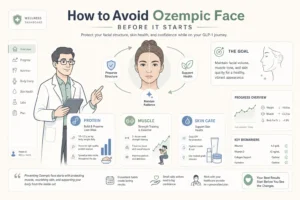
How to Avoid Ozempic Face Before It Starts
You can lower your odds of the gaunt, sunken look people call Ozempic face. Here is how pacing, protein, muscle, and skin care protect your
Skin tightening after weight loss is possible without surgery for many people, especially when the loose skin is mild to moderate. Non-surgical treatments work by heating or stimulating the deeper layers of skin so the body builds new collagen and elastin over time. They will not remove large folds of hanging skin the way a surgical procedure can, but they can firm, smooth, and improve skin quality when the change is not severe. The right option depends on how loose your skin is, where it sits on your body, and what you want the result to look like.
If you have lost a significant amount of weight on a medical program, some skin change is expected. That is part of everything that changes during medical weight loss, and it is one of the most common questions we hear from patients at the Franklin, TN and Nolensville, TN offices. This guide compares the main non-surgical skin tightening options so you can walk into a consultation knowing the questions to ask.
According to the Cleveland Clinic, radiofrequency skin tightening uses energy to heat tissue below the surface, which triggers collagen production and gradual firming over several weeks to months (Cleveland Clinic, radiofrequency skin tightening). Results are subtle and build slowly, which is why realistic expectations matter more than the name of any single device.
Skin gets loose after weight loss because it was stretched to cover a larger body and cannot always snap back once the fat underneath is gone. Skin stretches with the help of two proteins, collagen and elastin. When weight comes off quickly, or when a lot of weight is lost, the skin has less time and less structural support to contract. Age, genetics, sun damage, smoking history, and how long the extra weight was carried all affect how much the skin rebounds.
Rapid loss on GLP-1 medications such as semaglutide and tirzepatide can make this more noticeable, since the fat volume drops faster than skin can adapt. A histological study in the journal Obesity Surgery found that massive weight loss is linked to thinner, less dense collagen and damage to the skin’s elastic fiber network, which helps explain why skin does not always contract after a large loss (2024 study in Obesity Surgery). Understanding the cause helps set expectations, because no treatment can fully restore skin that has lost most of its elastic support. For more on the underlying causes, see our guide to loose skin after weight loss.
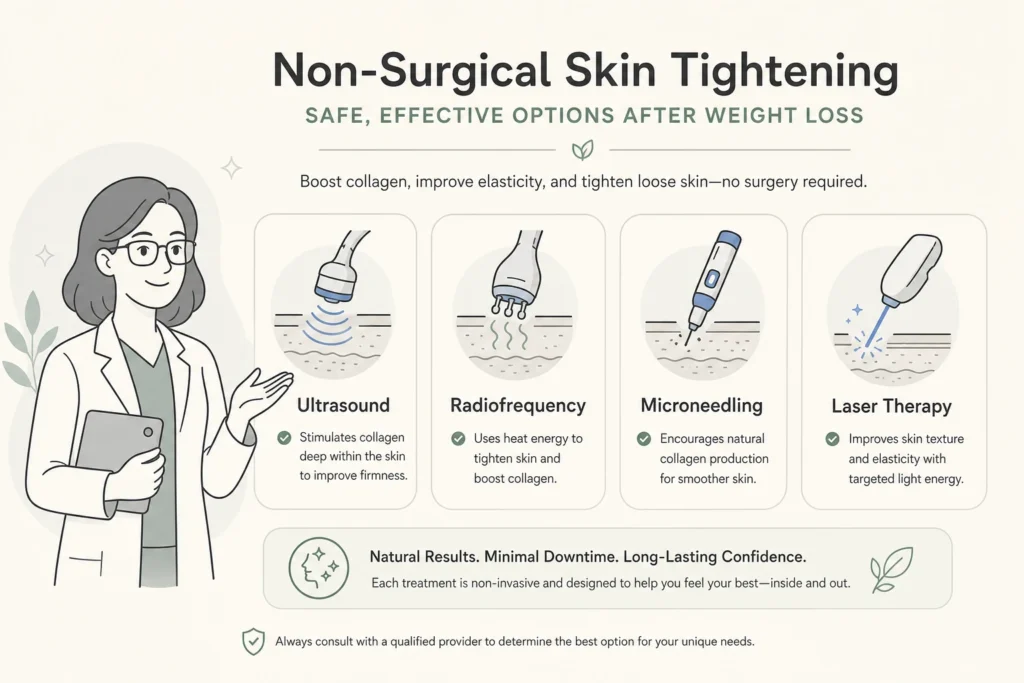
Non-surgical skin tightening is any treatment that firms skin without cutting or removing tissue. Instead of excising skin, these approaches deliver controlled energy or biological signals into the deeper layers to prompt the body to remodel its own collagen. Because the effect relies on your body’s healing response, results appear gradually and are best suited to mild or moderate laxity rather than large amounts of hanging skin.
The main categories fall into a few groups: radiofrequency treatments, microneedling-based approaches, ultrasound-based tightening, laser resurfacing, injectable biostimulation, and clinical peptide support. Each targets skin quality in a slightly different way, and they are sometimes combined. None of them substitute for surgery when the skin change is severe, and a good provider will tell you plainly when a non-surgical route is unlikely to give you the result you want.
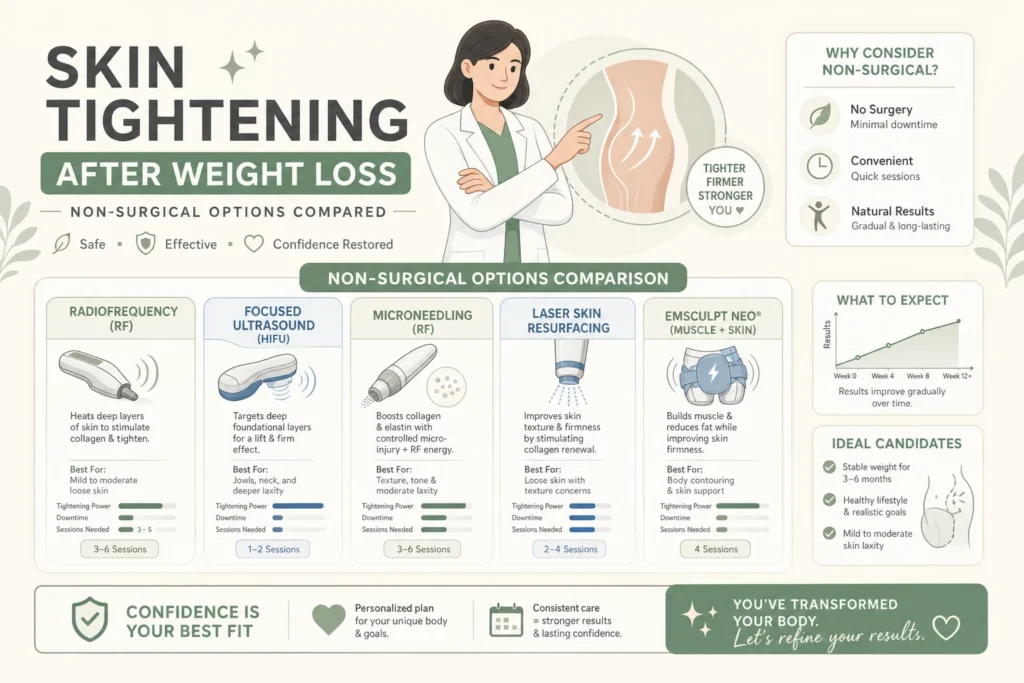
The main options differ in how they reach the deeper skin, who they suit best, and how much time they ask of you. Energy-based treatments like radiofrequency and ultrasound heat tissue to stimulate collagen, microneedling creates tiny controlled injuries that trigger repair, laser resurfacing works on surface texture and tone, and biological approaches like biostimulation and peptides support the skin’s own rebuilding. The table below compares these categories in general terms. It isn’t a menu of what any one clinic offers, and the right mix is a conversation, not a default.
| Approach category | How it works | Best suited for | Typical commitment | Evidence grade |
|---|---|---|---|---|
| Radiofrequency treatments | Heat deep skin layers to contract existing collagen and stimulate new collagen | Mild to moderate laxity on the face, neck, arms, or abdomen | A short series with results that build over months | Moderate, supported by clinical reviews |
| Microneedling-based approaches | Tiny controlled punctures trigger a repair response, sometimes paired with radiofrequency | Skin texture, mild laxity, and general skin quality | A series spaced weeks apart | Moderate for texture, emerging for laxity |
| Ultrasound-based tightening | Focused ultrasound heats targeted depths to lift and firm | Mild laxity on the face and neck | Often a single session with gradual results | Moderate, supported by clinical reviews |
| Laser resurfacing | Light energy removes or heats surface layers to improve tone and stimulate collagen | Skin tone, fine lines, and mild crepiness more than heavy laxity | Varies by depth, with recovery time for stronger settings | Moderate for tone and texture |
| Injectable biostimulation | Injected materials prompt the skin to produce its own collagen over time | Volume support and gradual firming in select areas | Staged sessions with slow, cumulative change | Emerging, provider dependent |
| Clinical peptide support | Signaling compounds used under medical supervision to support skin and tissue quality | An adjunct to other care, not a standalone fix | Ongoing, medically guided | Emerging, individualized |
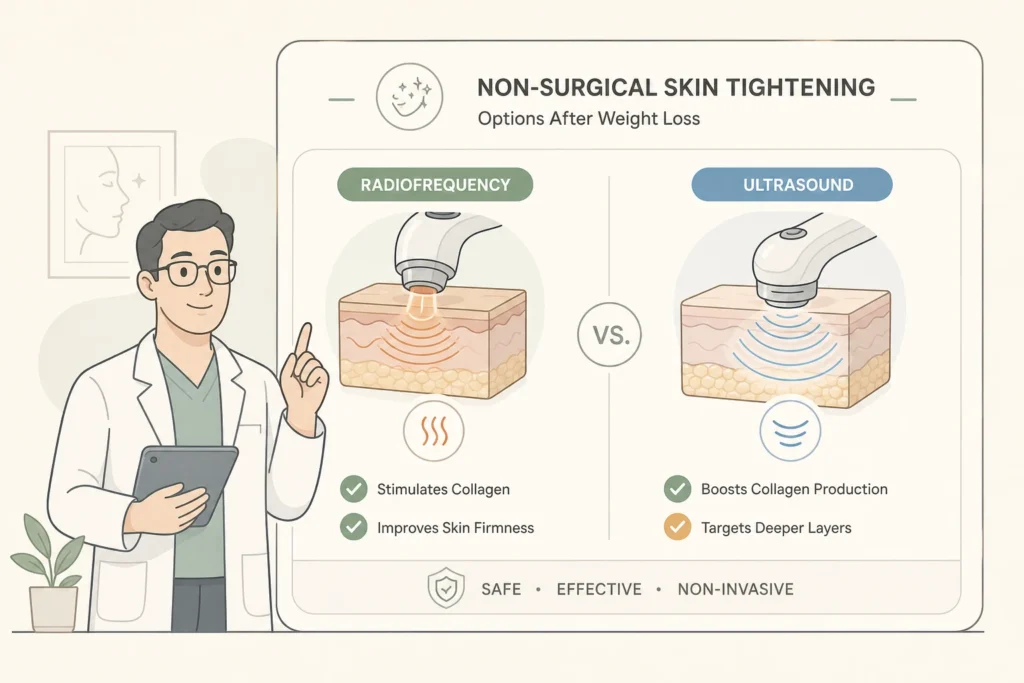
Energy-based treatments work best for mild to moderate looseness and modest improvement rather than dramatic change. Radiofrequency and ultrasound both heat the skin’s deeper layers to a temperature that prompts collagen to contract and rebuild. In clinical reviews, these methods show measurable but gradual firming, with most people seeing the fullest effect two to six months after treatment as new collagen matures.
A systematic review of radiofrequency treatments found them generally safe and associated with measurable improvement in skin laxity and firmness, with high patient satisfaction when expectations were set for gradual rather than surgical results (2025 systematic review in Aesthetic Surgery Journal Open Forum). The takeaway is consistent across the research: energy-based options can genuinely firm skin, but they refine what you have rather than remove excess. If your skin loss is severe, a provider may tell you honestly that these will underdeliver.
Peptides and biostimulation work from the inside to support the skin’s own rebuilding rather than heating it from a device. Injectable biostimulators prompt collagen production in treated areas over a series of sessions, and certain clinical peptides are used under medical supervision to support skin and tissue quality as part of a broader plan. These are supportive tools, not standalone cures for loose skin, and they are usually most useful alongside other approaches and good nutrition.
Because the evidence here is still developing and highly individual, these options belong in a supervised setting where dosing and candidacy are matched to you. If you want to understand how these compounds differ from the collagen creams sold online, our explainer on peptides for skin breaks down what clinical peptide therapy can and cannot do. Before reaching for any treatment, it is also worth reviewing what you can do on your own, which we cover in our guide to tightening skin after weight loss naturally.
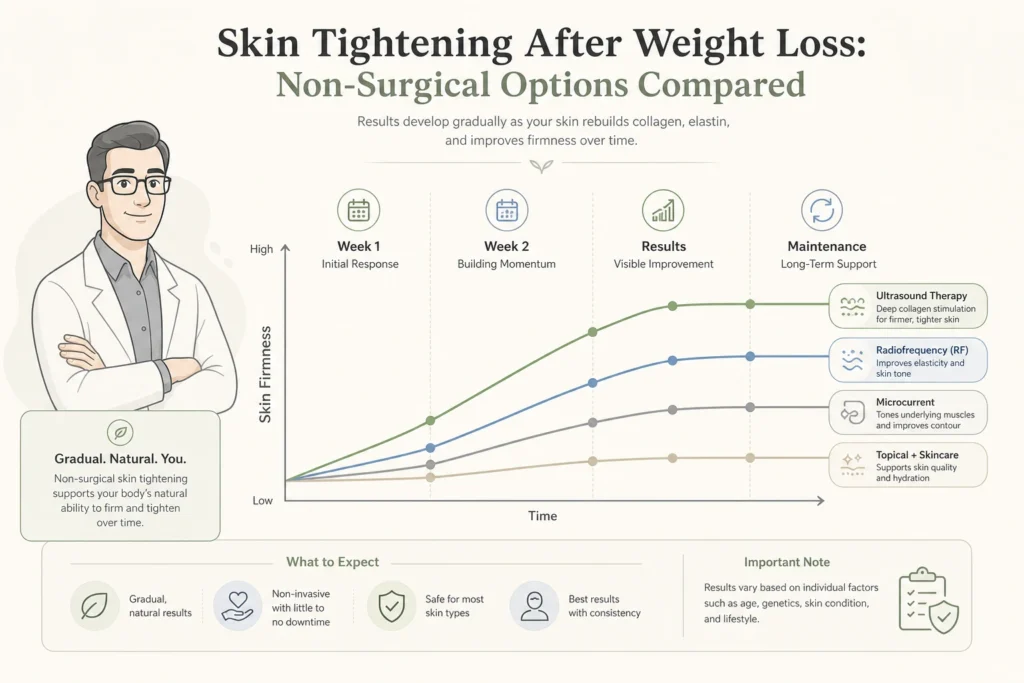
You choose the right treatment by matching the option to how loose your skin is, where it sits on your body, and what result you realistically want. Severity is the biggest factor. Mild crepey skin and modest laxity respond well to energy-based and biological approaches, while large folds of hanging skin often need a surgical opinion. Location matters too, since a treatment that suits the face may not be the best fit for the abdomen or arms.
The honest part is that no single treatment wins for everyone, and many people do best with a combination chosen for their skin. This is where a provider who also manages your weight loss adds value, because the team adjusting your medication understands how fast the change happened and what your tissue can support. The clinic that guides your weight loss is a natural place to talk through what the loss is doing to your skin. Exploring your aesthetic treatment options alongside your medical weight loss program keeps the plan connected instead of piecemeal. In our experience with patients at Body Works, the people who are happiest set expectations early and let the collagen response build over months.
Medically reviewed by Dr. Donald Vollmer, MD
Managing Physician, Body Works TN
You can lower your odds of the gaunt, sunken look people call Ozempic face. Here is how pacing, protein, muscle, and skin care protect your
Constipation affects 24% of semaglutide patients and up to 17% on tirzepatide. This guide gives the daily targets that prevent it: 22 to 34 grams
Ozempic face is the hollow, aged look some people notice after rapid weight loss. Here is why it happens, who is most at risk, and

When Tennessee investigators tested counterfeit weight loss vials seized in Medina, one was mostly water. That was the good outcome. The dangers of buying peptides
Rapid weight loss changes more than the number on the scale. Here is why the glutes, breasts, and arms often change shape on GLP-1 medications,
NAD+ therapy is marketed as a longevity reset for energy, focus, and healthy aging. This guide separates what the science on NAD therapy actually supports
See Body Works first in your Google results.