


GLP-1 Side Effects by Week: What Is Normal, What Passes, What to Report

October 12, 2026

A symptom that is completely normal in week two can be a reason to call your prescriber in week fourteen. Nausea right after a dose increase is expected. The same nausea, unchanged, six weeks after your last increase is not, and treating every GLP-1 side effect as equally routine is how patients miss the ones that actually need attention.

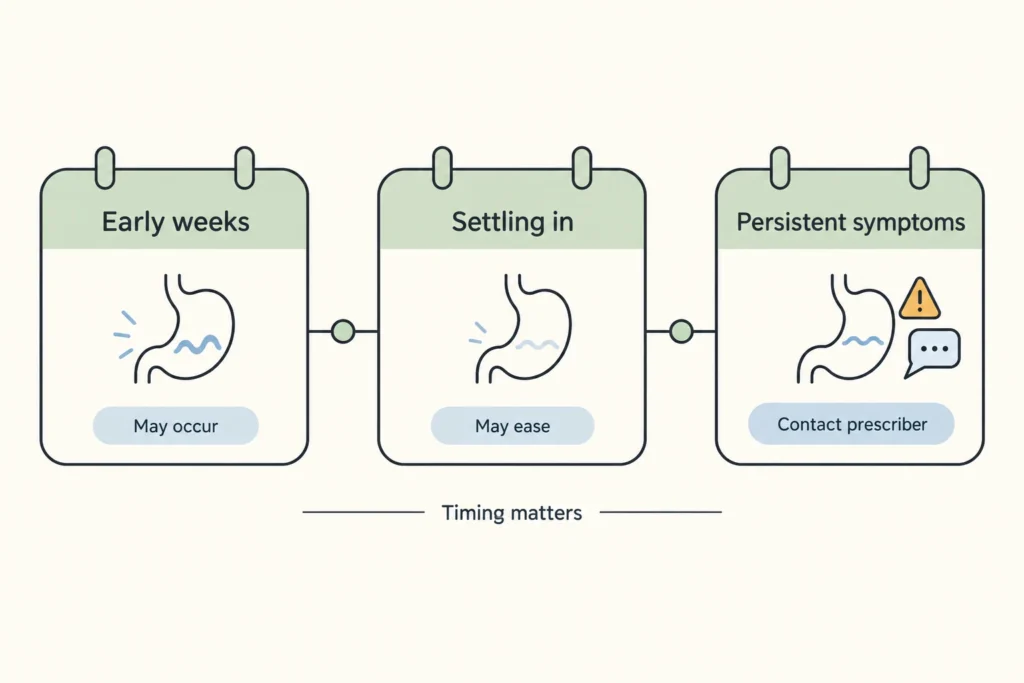
GLP-1 side effects follow the dose, not the calendar: they cluster in the days after each increase, fade before the next one, and mean something different depending on where you are in titration. Semaglutide, tirzepatide, and retatrutide all share this pattern even though their exact rates differ. Body Works physicians in Franklin, TN and Nolensville, TN use that pattern, not just the symptom itself, to tell routine from concerning.

Illustration of GLP-1 Side Effects by Week: What Is Normal, What Passes, What to Report in a modern medical wellness setting

What Is Normal in the First Four Weeks?

Mild nausea, reduced appetite, and occasional loose stool are the most common early effects, and they usually show up within the first few days of the starting dose. The FDA-approved semaglutide label reports nausea in 44% of patients during the trial period, most heavily concentrated in the early weeks, against 16% on placebo.

These effects exist because the medication is intentionally slowing digestion and quieting appetite signals, the mechanism doing exactly what it’s supposed to do. Most patients notice symptoms easing within a week of a dose increase, well before the next one arrives a month later. Full details on what to expect at this stage, and how the schedule is built to minimize it, are in our semaglutide dosage schedule guide.

What Changes During Weeks 5 Through 16?

Each dose increase brings a brief return of symptoms, usually milder than the first time, followed by another period of adjustment. Constipation tends to become more prominent in this window as appetite and food volume drop further, appearing in 24% of semaglutide patients per the FDA label, and in 11% to 17% of tirzepatide patients depending on dose according to its own FDA-approved prescribing information.

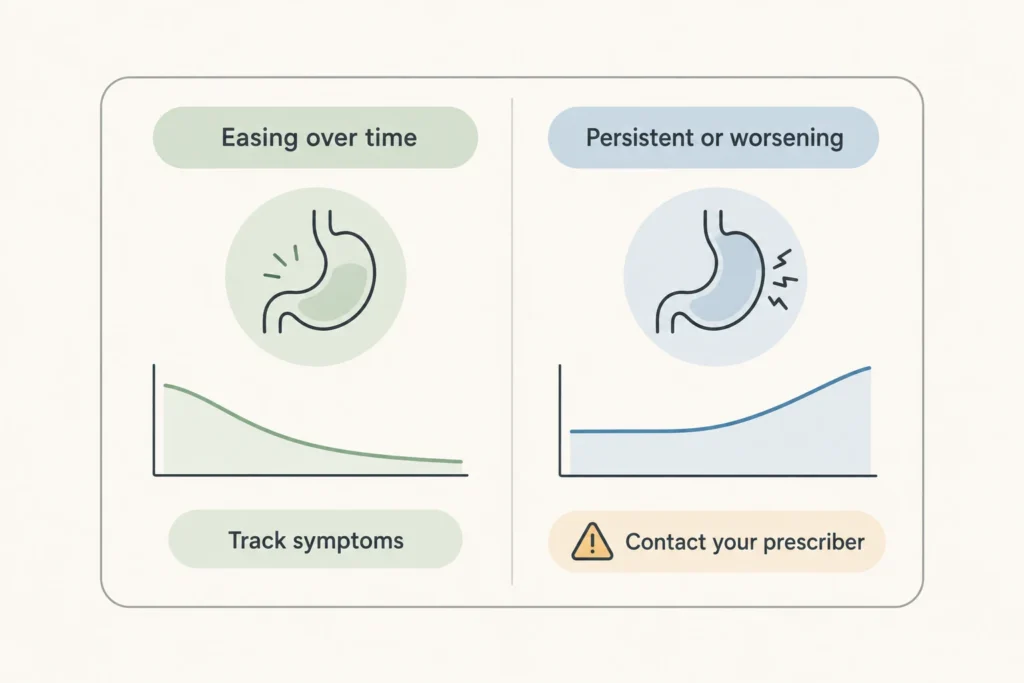
This is also when patients most often ask whether something is wrong because a side effect they’d stopped noticing came back. A returning symptom right after a scheduled dose increase is expected and typically settles within a week or two. The same symptom appearing with no dose change behind it is the pattern that deserves a closer look, covered in the red-flag section below.

Do Semaglutide Side Effects Differ From Tirzepatide's?

Yes, modestly. Semaglutide side effects run somewhat higher for nausea, 44% versus 25% to 29% for tirzepatide depending on dose, while tirzepatide’s dual GLP-1/GIP mechanism produces a comparable or lower gastrointestinal burden at equivalent points in titration. In the STEP 1 trial published in the New England Journal of Medicine, gastrointestinal events were the most common reason for discontinuation, at under 5% of participants. The SURMOUNT-1 trial reported a similarly low discontinuation rate for tirzepatide.

Neither medication’s side-effect profile predicts how well it will work for a given patient. Some people tolerate semaglutide with almost no symptoms and struggle more with tirzepatide, and the reverse happens just as often. Our tirzepatide dosage schedule guide covers what to expect at each of its six possible dose steps.

Supporting illustration for GLP-1 Side Effects by Week: What Is Normal, What Passes, What to Report in a modern medical wellness setting

What About Retatrutide Side Effects?

Retatrutide’s side-effect pattern looks similar to the other two but is documented in trial data only, since it does not yet have an FDA label. In its phase 2 trial published in the New England Journal of Medicine, gastrointestinal events were the most common adverse effect and were clearly dose related, with a lower starting dose reducing their frequency, the same titration logic that governs semaglutide and tirzepatide.

Because retatrutide is a triple agonist acting on GLP-1, GIP, and glucagon receptors, sometimes nicknamed “GLP-3,” its side-effect profile is being watched closely as more patients start it. The pattern so far tracks the same week-by-week logic as the other two medications rather than introducing anything new.

Supporting illustration for GLP-1 Side Effects by Week: What Is Normal, What Passes, What to Report in a modern medical wellness setting

Do Side Effects Change Once You Reach a Maintenance Dose?

Yes, for most patients they drop off sharply once titration ends. The bulk of GLP-1 side effects cluster around the weeks immediately following an increase, so once you stop climbing and settle into a maintenance dose, the body has no new adjustment to make and most gastrointestinal symptoms fade to occasional rather than routine.

What tends to persist longer term is less about the medication’s direct action and more about lifestyle habits that interact with it. Alcohol is a common one patients ask about after they’ve been stable for a few months, since drinking on an empty, slower-emptying stomach can intensify nausea or lower blood sugar in ways that feel different from before starting treatment. Our guide to alcohol and GLP-1 medications covers what actually changes and how to handle it.

Supporting illustration for GLP-1 Side Effects by Week: What Is Normal, What Passes, What to Report in a modern medical wellness setting

What Symptoms Mean You Should Call Your Provider the Same Day?

Severe or persistent abdominal pain, an inability to keep fluids down for more than a day, yellowing of the skin or eyes, or a rapid heartbeat with dizziness are not routine GLP-1 side effects at any week of treatment, whether you are in your first month or your twelfth. Both FDA labels carry warnings for acute pancreatitis and gallbladder disease, and the tirzepatide label separately warns that acute kidney injury has occurred, most often in patients already vomiting or having diarrhea and unable to stay hydrated.

These symptoms warrant a same-day call regardless of how far along you are in titration or how mild your previous side effects have been. A dose increase does not raise the risk of these specific complications in a way that makes them more “expected” later in treatment, and waiting to see if they pass on their own is the wrong instinct for this particular list of symptoms, even for a patient who has otherwise tolerated the medication well for months. If nausea specifically is what’s driving concern, our guide to GLP-1 nausea and stomach side effects covers the full timeline, and constipation is addressed in our fiber and protein guide. Hair thinning, a later and less discussed effect, is covered separately in GLP-1 hair loss.

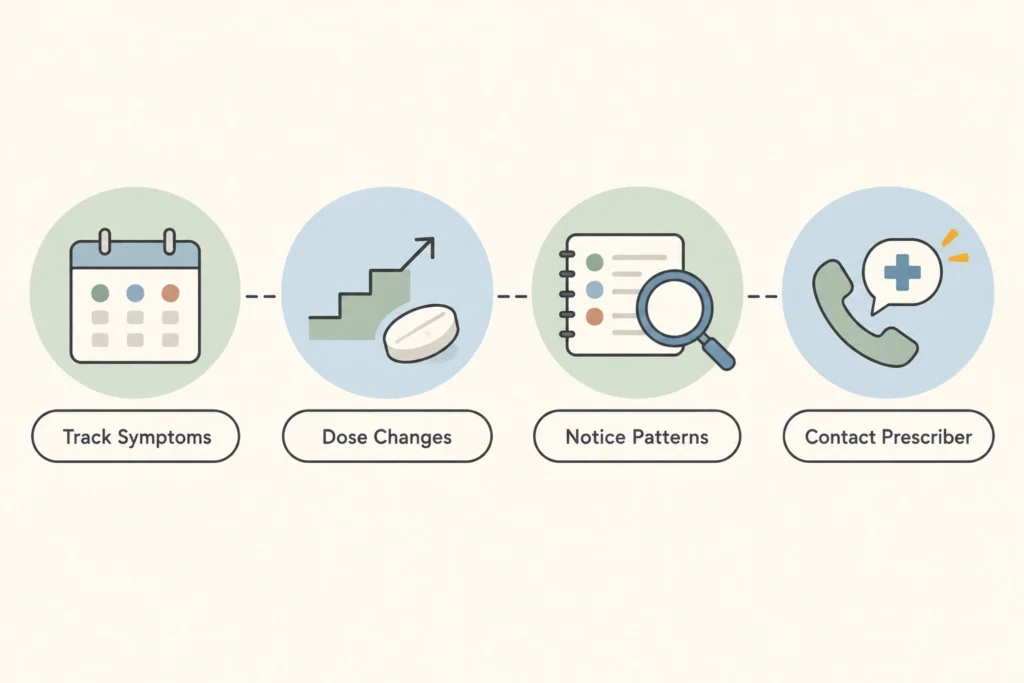
The most useful question our clinical team asks a patient reporting a symptom isn’t just what it is, it’s when it started relative to the last dose change and whether anything else changed around the same time, like travel, a new medication, or a skipped meal. That single detail usually separates an expected adjustment from something that needs a closer look, and it’s why Body Works reviews titration timing at every follow-up rather than treating each visit as a blank slate.

If a symptom doesn’t fit the expected pattern, or you’re not sure whether what you’re feeling is routine, our physician-supervised teams in Franklin and Nolensville can help you sort it out quickly. Schedule a Free Consultation to get started.

Frequently Asked Questions

Most early side effects ease within a week of starting or increasing a dose, then largely settle until the next scheduled increase. Symptoms that persist unchanged for more than two weeks without a recent dose change are worth discussing with your prescriber.
Trial data suggests the opposite trend for nausea, with tirzepatide running somewhat lower than semaglutide at comparable points in titration, though individual response varies. Neither medication is uniformly easier to tolerate for every patient.
A normal side effect tracks with a recent dose increase and improves within one to two weeks. A red flag, severe abdominal pain, inability to keep fluids down, or yellowing skin or eyes, shows up regardless of timing and needs same-day medical attention rather than a wait-and-see approach.
No. Side-effect monitoring and adjustment are part of a supervised GLP-1 program at Body Works, a cash-pay clinic with payment plans and HSA and FSA eligibility. A free consultation covers program pricing alongside a personalized plan.
Our Franklin office on Murfreesboro Road and our Nolensville office at Burkitt Commons both manage semaglutide, tirzepatide, and retatrutide patients under physician supervision, including side-effect triage by phone between visits. Patients from Brentwood, Spring Hill, Cool Springs, and across Williamson County use whichever office is closer.

Medically reviewed by Dr. Donald Vollmer, MD
Managing Physician, Body Works TN

Browse Our Blog

See Body Works first in your Google results.

Add as a preferred source on Google