

TRT Side Effects and How They Are Managed: Hematocrit, Estrogen, Injection Sites
Ask ten men about TRT side effects and you’ll hear ten different fears, most of them wrong. Shrinking testicles, aggression, hair loss, none of these
A 42-year-old man gets his testosterone checked, and the lab report comes back with a single word next to the number: “normal.” He still feels flat, still can’t build muscle the way he used to, still falls asleep on the couch at 8:30. So which is it: is 42 just an age where you feel like this, or is the lab wrong?
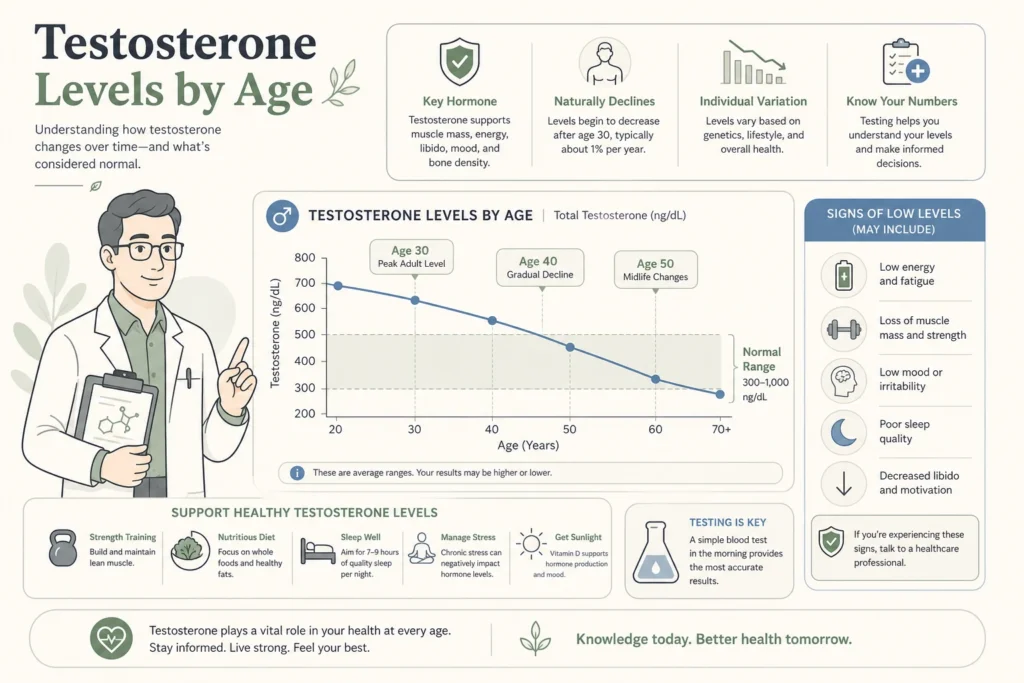
Neither. The lab isn’t wrong, but the word “normal” is doing more work than it should, and understanding testosterone levels by age is where the real answer starts. Most labs run one reference range for every adult man, whether he’s 24 or 74, because there’s no widely adopted, age-adjusted standard in routine clinical use. A result inside that range confirms your testosterone isn’t in free fall; it doesn’t confirm the number is right for you. Testosterone declines gradually across adulthood, so a level that would flag a 25-year-old as low can sit comfortably “in range” for a 60-year-old and still be too low for him to feel well.
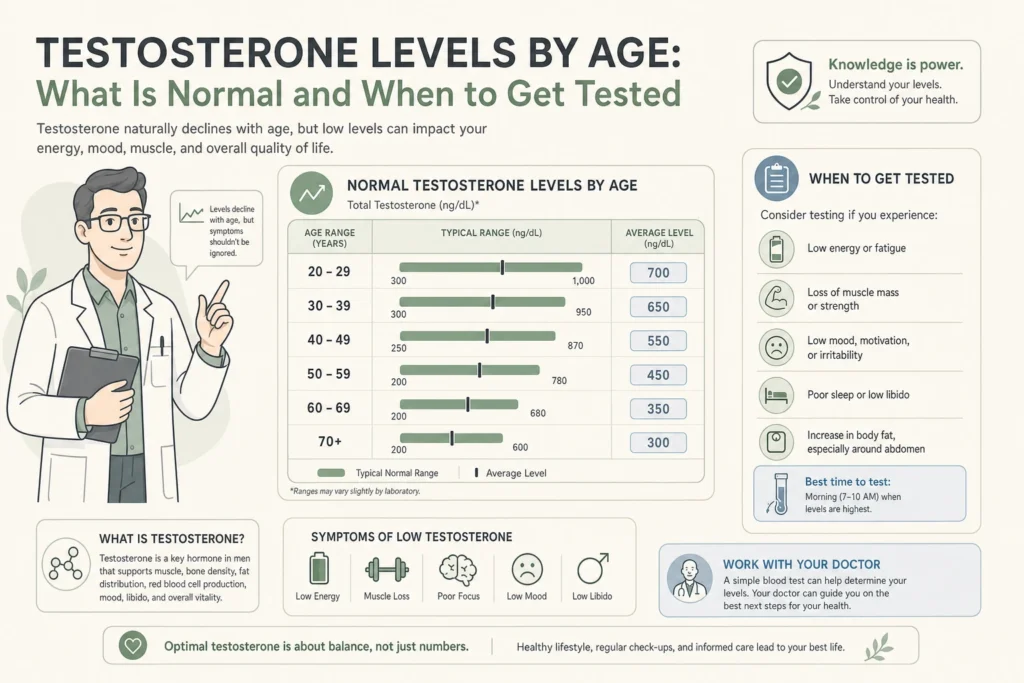
The only rigorously age-anchored reference range in the medical literature covers healthy, nonobese men between 19 and 39. A harmonized analysis of nearly 9,100 men across four cohort studies in the United States and Europe established that range at 264 to 916 ng/dL for total testosterone, using the 2.5th to 97.5th percentile band. That is the number to know if you are asking what “normal” means for a man in his 20s or 30s: a harmonized reference range for testosterone levels across four cohort studies, published in the Journal of Clinical Endocrinology and Metabolism.
No equivalent harmonized range exists for men in their 40s, 50s, and beyond, which is precisely why most labs don’t publish one. Testosterone trends downward with age, documented in a landmark longitudinal analysis of nearly 900 men followed for years at a time, but the decline is gradual and highly individual rather than stepwise by decade: longitudinal data from the Baltimore Longitudinal Study of Aging. A 55-year-old with a level that would be low for a 25-year-old is not automatically diagnosable with hypogonadism just because he’s older; age lowers the average, but it doesn’t create a separate “normal” for him to be measured against.
Because building an age-adjusted range requires a large, carefully screened population at every decade of life, and that dataset largely doesn’t exist outside research studies. The Mayo Clinic’s overview of testosterone therapy makes the same point directly to patients: reference ranges vary from lab to lab, and the number printed on your result depends on which assay and which population that specific lab used to build its range, not on a universal medical standard.
This is why two men with the identical lab number can get different answers from different clinicians. One lab’s “low” cutoff might be 300 ng/dL; another’s might be 264 ng/dL. Neither lab is wrong, but a level of 280 ng/dL reads as low on the first and normal on the second. This is also why a single test, on its own, rarely settles anything.
Any result near a lab’s low cutoff, or any result that doesn’t match how you feel, is worth confirming before drawing conclusions. The Endocrine Society’s clinical practice guideline on testosterone therapy in men with hypogonadism is explicit on this point: diagnosis requires both consistent symptoms and a low total testosterone confirmed by a second, separate morning fasting draw, not one number pulled at 2 p.m. after lunch. Testosterone follows a daily rhythm and peaks in the early morning, so an afternoon draw can understate a man’s real level regardless of what’s actually going on.
Free testosterone, the small fraction not bound to carrier proteins, adds another layer. A man whose sex hormone-binding globulin runs high can post a normal total testosterone number while his free, usable testosterone runs low. The Cleveland Clinic’s explainer on the testosterone test covers this distinction and why a free testosterone measurement sometimes changes the picture a total testosterone number alone can’t show.
At Body Works, no testosterone therapy protocol starts from a single number. The standard we follow, consistent with the Endocrine Society guideline, is two morning fasting draws before anything is prescribed, because one low result could be a bad morning and one normal result could be a lab with a wide range. Franklin and Nolensville-area men who come in describing symptoms but carrying a “normal” printout from an urgent care panel are not unusual; a repeat draw, timed correctly and read against symptoms rather than a single cutoff, is often what actually changes the plan.
That two-draw standard exists because testosterone testing gets treated too casually elsewhere. A number without context, without a repeat, and without a symptom conversation is a data point, not a diagnosis. This is the part of the process most direct-to-consumer testosterone platforms skip, because a single draw is cheaper and faster; it is also the part most likely to produce a wrong answer.
Fatigue, low libido, loss of muscle mass, mood changes, and poor sleep are the symptoms that should prompt a test in the first place, since testing without symptoms rarely changes management. If several of these sound familiar, the low testosterone symptoms checklist for men over 35 walks through the specific pattern clinicians look for before ordering labs.
For men who are found to have low testosterone from reduced pituitary signaling rather than testicular failure, the treatment conversation includes an alternative to direct testosterone replacement. Enclomiphene vs. TRT covers how that option works and who is actually a candidate for it.
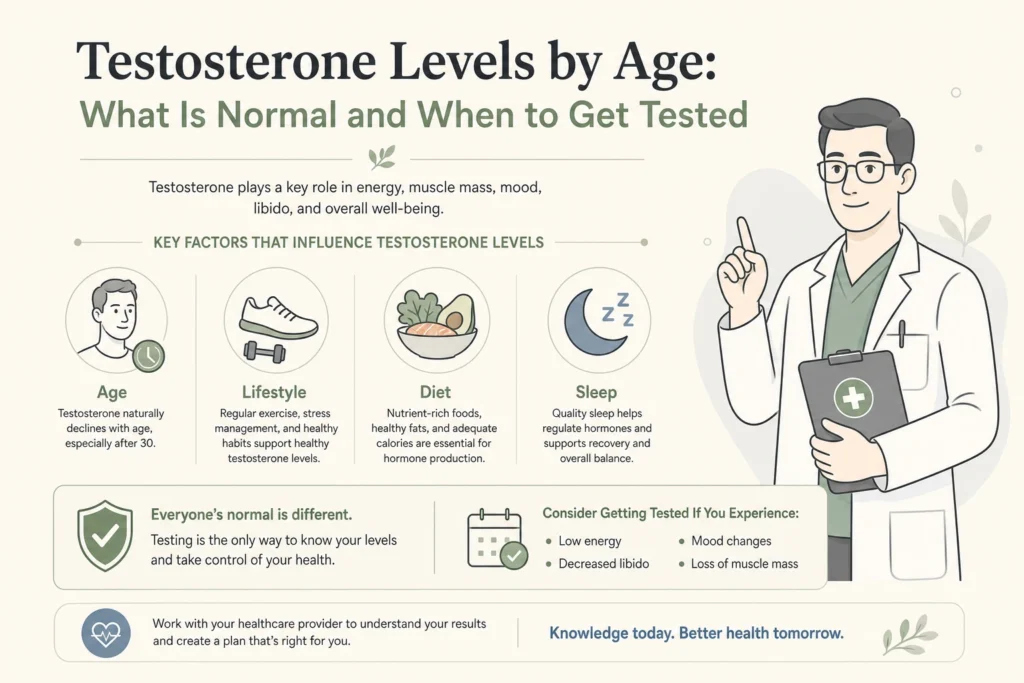
| Life stage | What the evidence shows | Source |
|---|---|---|
| Healthy men, ages 19 to 39 | Harmonized range of 264 to 916 ng/dL total testosterone (2.5th to 97.5th percentile) | JCEM harmonized cohort study, 2017 (cited above) |
| 40s | No separate harmonized range published; most labs apply the same adult reference range used for younger men | Mayo Clinic, testosterone therapy overview (cited above) |
| 50s and 60s | Gradual downward trend documented across a multi-year longitudinal cohort; decline is individual, not fixed by decade | Baltimore Longitudinal Study of Aging, JCEM 2001 (cited above) |
| 70s and older | Same downward trend continues; wide overlap with younger decades means age alone cannot diagnose low testosterone | Endocrine Society clinical practice guideline (cited above) |
Read the table for the trend, not a target. No published guideline sets a separate “normal” cutoff for each decade of life. What matters clinically is whether a specific man’s confirmed, morning-fasting total testosterone is low relative to his lab’s range and whether that number lines up with symptoms he can name.
If you’re in Franklin, TN or Nolensville, TN and your last testosterone panel left you with more questions than answers, a proper diagnostic workup is the next step, not another blood draw at random. Body Works builds every testosterone replacement therapy plan on confirmed labs and a real symptom conversation, and every plan stays physician-supervised from the first draw through ongoing monitoring. What physician-supervised treatment looks like at Body Works walks through the full process for men considering care at either location.
Schedule a Free Consultation and bring your most recent lab results, or start with a fresh, correctly timed panel if you don’t have one. Either way, you’ll leave with a real answer instead of a single word next to a number.
Medically reviewed by Dr. Donald Vollmer, MD
Managing Physician, Body Works TN
Ask ten men about TRT side effects and you’ll hear ten different fears, most of them wrong. Shrinking testicles, aggression, hair loss, none of these
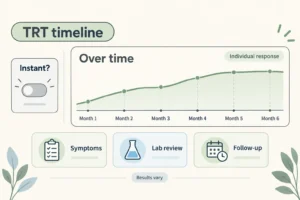
Most men expect testosterone therapy to feel like flipping a switch. It doesn’t, and a realistic TRT results timeline looks nothing like the overnight transformation
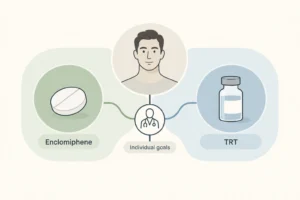
Two men walk into the same clinic with nearly identical lab results: both have low testosterone, both are in their late 30s, both still want

He’s 38, sleeping seven hours a night, still hitting the gym three times a week, and he still feels like he’s dragging a weighted sled

A lot of what passes for testosterone replacement therapy in Franklin, TN and nationwide in 2026 is a questionnaire, a card swipe, and a prescription
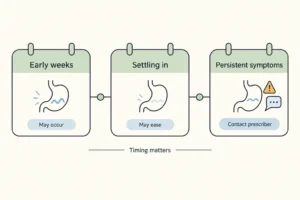
A symptom that is completely normal in week two can be a reason to call your prescriber in week fourteen. Nausea right after a dose
See Body Works first in your Google results.