
How to Avoid Ozempic Face Before It Starts
You can lower your odds of the gaunt, sunken look people call Ozempic face. Here is how pacing, protein, muscle, and skin care protect your
When Tennessee investigators tested the counterfeit weight loss vials they seized from a house in Medina, one of them turned out to be mostly water. That was the good outcome.
The bad outcome is playing out in Melbourne, where doctors have now hospitalized seven patients with acute liver damage after they injected a weight loss peptide bought outside the medical system. One of them, a 32 year old woman profiled by ABC News Australia, took two injections four days apart. She was in acute liver failure within a week and six months later was still on steroids and still unable to work.
The dangers of buying peptides online come down to one problem that no amount of research on your part can solve: you cannot verify what is in the vial. Not the molecule, not the dose, not the sterility. Everything else people argue about, whether a given peptide works, what the studies show, which protocol is best, sits downstream of that single unanswerable question. This is what patients at Franklin, TN and Nolensville, TN ask about most often once they start looking at online sellers, and it deserves a direct answer.
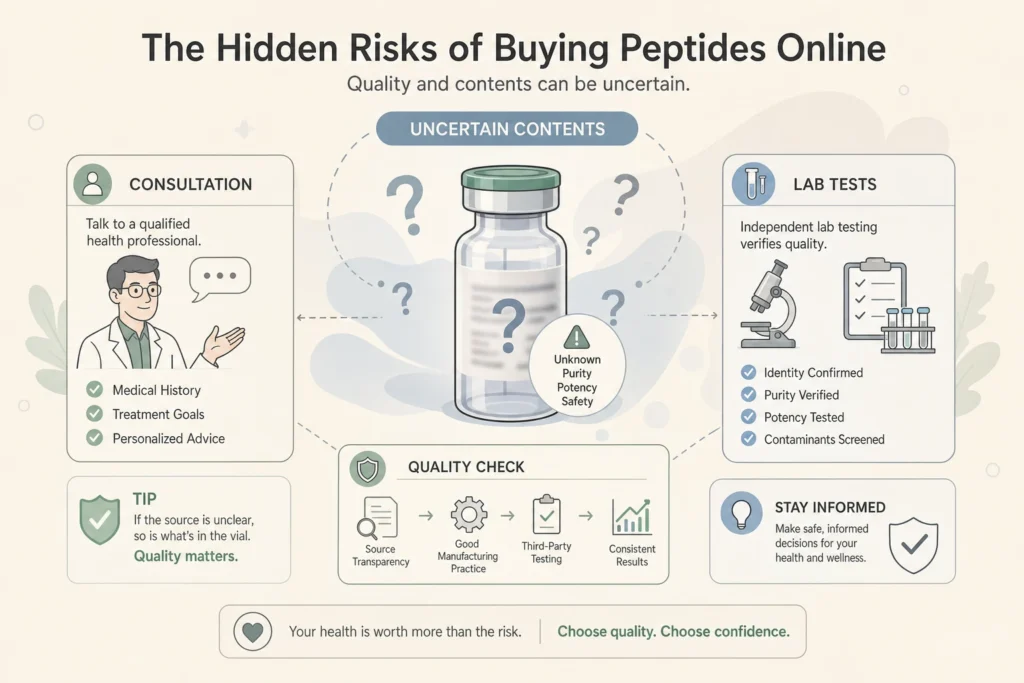
Frequently, not what the label claims. The chief medical advisor of Australia’s Therapeutic Goods Administration called black market retatrutide a counterfeit product and said there were no good batches, and the liver transplant specialist treating the Melbourne patients put it more plainly: the retatrutide being sold is not the retatrutide in clinical trials.
The December 2024 seizure in Medina is the closest documented example. Investigators took more than 300 vials of counterfeit weight loss injectables out of a single home, one sample tested as mostly water, and the accused seller had allegedly been supplying two med spas in this state. Buyers reported rashes and injection site pain.
The FDA’s own position, stated in its statement on unapproved GLP-1 drugs used for weight loss, is that counterfeit drugs “claim to be authentic, but could contain the wrong ingredients, contain too little, too much or no active ingredient at all or other harmful ingredients, and are illegal.” That is not a theoretical risk profile. It is a description of what has repeatedly been found inside vials people already injected.
No. It is a liability shield for the seller, and the FDA has said so directly, twice, to two different companies within ten weeks.
In a March 2026 warning letter to a peptide seller marketing retatrutide and tirzepatide, the agency wrote that despite labeling the products “Research Use Only,” evidence from the company’s own website established they were intended as drugs for human use. The same letter noted that injectable products “bypass some of the body’s key defenses against toxins and microorganisms that can lead to serious and life-threatening conditions.” A June 2026 warning letter to a different company selling gonadorelin used nearly identical reasoning.
Two enforcement letters, ten weeks apart, written by different reviewers about different compounds, applying the same legal theory. That is a standing FDA position on the category, not an isolated finding. The phrase on the bottle changes the seller’s exposure. It changes nothing about what happens inside your body.
Because a multi dose vial and a syringe ask an untrained person to do unit conversion correctly, every time, alone. The markings blur between units, milligrams, and milliliters, and the consequences of a decimal error are immediate.
The FDA has documented dosing errors with compounded semaglutide in multiple dose vials in which patients administered five to 20 times the intended dose. Some sought medical attention, some required hospitalization, and reported adverse events included acute pancreatitis and gallstones. The agency noted that most reports involved patients who were unfamiliar with how to measure the intended dose using a syringe.
This risk is entirely separate from whether the product is authentic. A perfectly legitimate molecule, measured wrong at a kitchen counter, produces a hospital visit. It is the single most preventable harm in this category, and supervision is what prevents it. If you are currently measuring your own doses out of a vial you bought online, that is the one thing worth changing this week, and a free consultation is enough to start.
The published case reports are worth reading before ordering anything. Melanotan II, a tanning peptide widely sold online, has generated a documented trail of serious harm in the medical literature.
One patient injected six times the suggested starting dose and was admitted to intensive care, with muscle breakdown driving his CPK to 17,773 IU/L. In another case, a 45 year old man developed a renal infarction affecting roughly half of one kidney after six months of self injection with product obtained illegally online, and still had reduced kidney function and high blood pressure at follow up. A third report describes melanoma diagnosed in a 20 year old woman three months after a short course of self injections.
Note what these cases share. None is a story about a compound failing to work as designed. They are stories about unsupervised people injecting unverified product at self chosen doses, which is the mechanism of injury across this entire category.
Not unless you can trace it, and usually you cannot. A certificate of analysis means something when it names a licensed laboratory, ties to a specific lot, and was obtained by someone other than the seller who profits from the result. An image file on a product page satisfies none of those conditions.
Purity is also only one variable. Sterility, endotoxin load, and storage history appear on no certificate, and those are the failures that put someone in an emergency department rather than simply wasting their money.
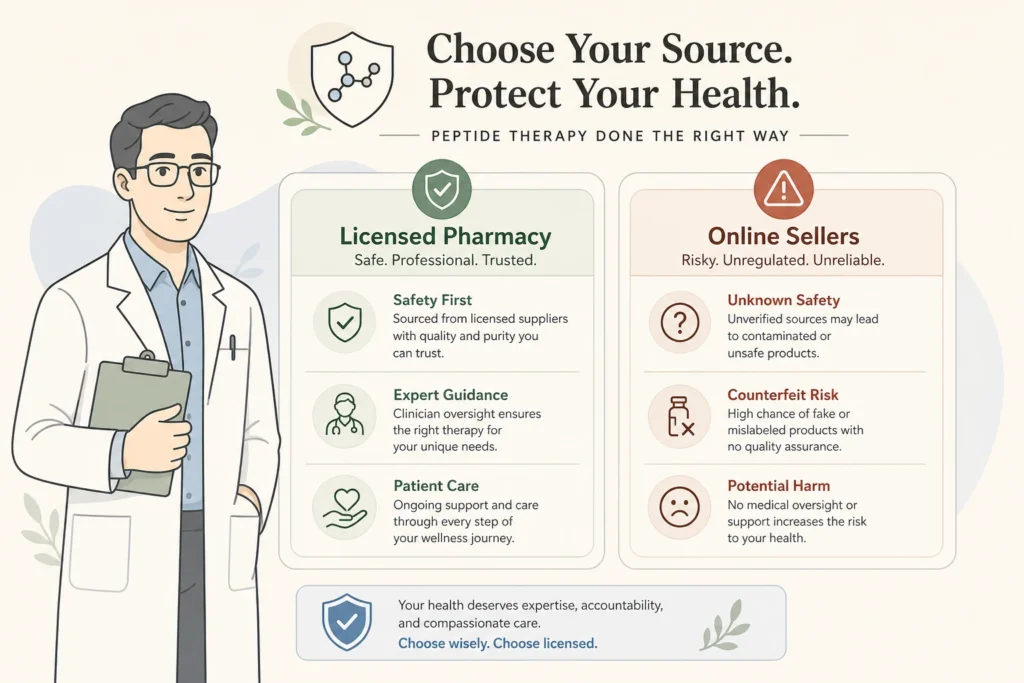
The verification that actually protects you is structural, not documentary. It is a licensed pharmacy accountable to a state board, dispensing against a prescription written for you, with a lot number that traces back through a regulated chain.
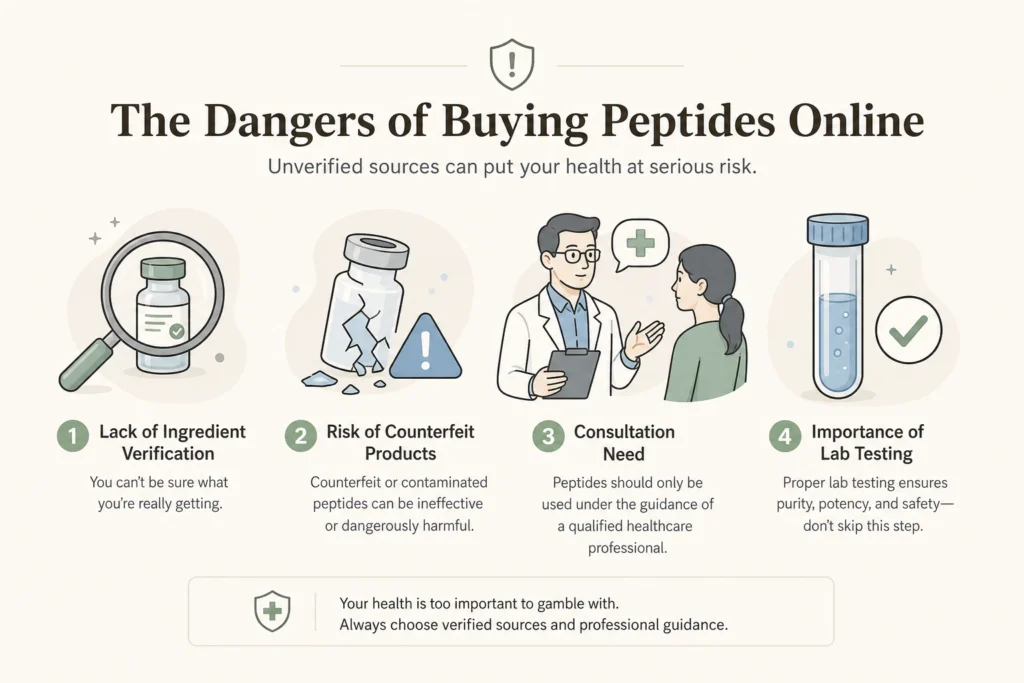
It has four requirements, and each one exists because its absence has hurt someone.
Ask any clinic to walk you through those four points. A practice that cannot name its pharmacy or explain its testing is asking for the same blind trust an anonymous website asks for, just with better furniture. If you want the longer version of that evaluation, we wrote a separate guide on how to vet a peptide therapy provider.
| Factor | Ordered from an online seller | Prescribed and pharmacy dispensed |
|---|---|---|
| Identity of the molecule | Unverifiable. Tested batches have contained no active drug. | Compounded by a licensed pharmacy against a specific order |
| Dose accuracy | You calculate and measure it yourself | Prescribed dose, with instruction and follow up |
| Screening before use | None | History, exam, and lab work first |
| Traceability | None. No lot, no recall path. | Lot number and expiration through a regulated chain |
| If something goes wrong | No one is accountable | A prescriber and a licensed pharmacy answer for it |
Every peptide protocol we ran at our Nolensville office last year followed the same sequence without exception: an evaluation, lab work, a prescription written for a named patient, and a pharmacy that could be verified by phone. Not most of them. All of them. That is the difference the table is describing, and it is the ordinary standard of care, available locally.
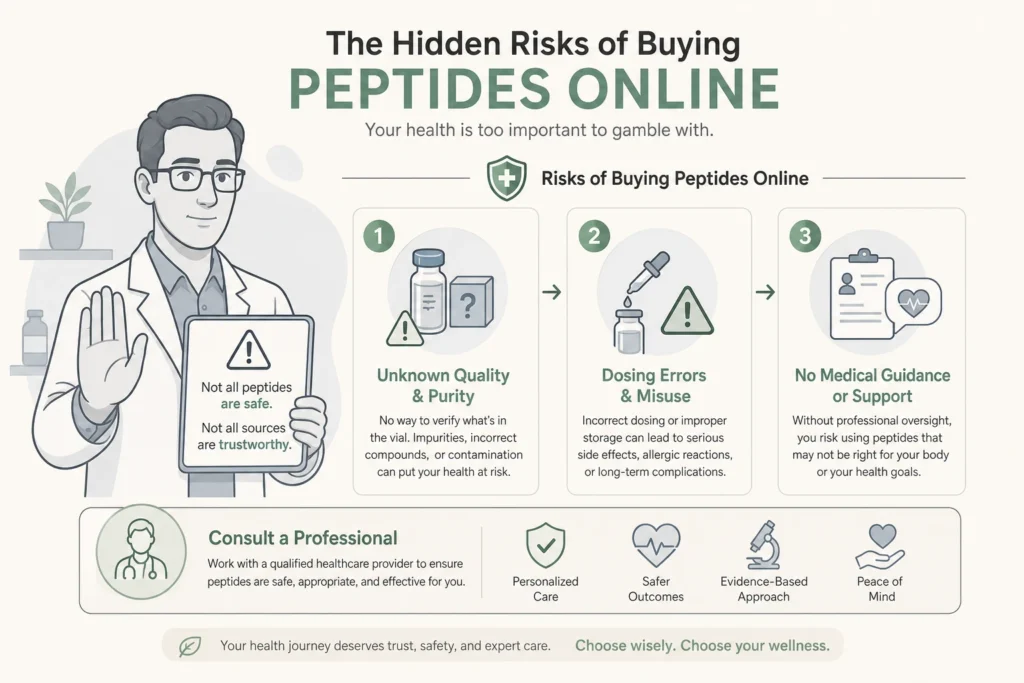
If you are considering peptides, the useful question is not which website has the best reviews. It is whether anyone in the chain is accountable to you. Body Works provides medically supervised peptide therapy at both offices, which means an evaluation, lab work, a prescription written for you, and a pharmacy that can be verified with a phone call.
Bring your questions, including the skeptical ones, and if you have already bought something online, bring the vial and say so. That conversation beats a quiet decision made at 2 a.m. with a browser open. Schedule a Free Consultation at our Franklin or Nolensville office, or call the Franklin office at (615) 790-2548.
Medically reviewed by Dr. Donald Vollmer, MD
Managing Physician, Body Works TN
You can lower your odds of the gaunt, sunken look people call Ozempic face. Here is how pacing, protein, muscle, and skin care protect your
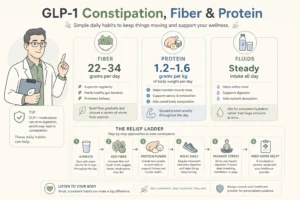
Constipation affects 24% of semaglutide patients and up to 17% on tirzepatide. This guide gives the daily targets that prevent it: 22 to 34 grams

Ozempic face is the hollow, aged look some people notice after rapid weight loss. Here is why it happens, who is most at risk, and
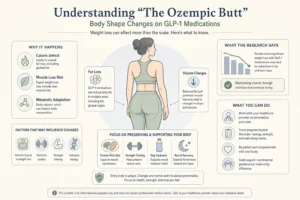
Rapid weight loss changes more than the number on the scale. Here is why the glutes, breasts, and arms often change shape on GLP-1 medications,

NAD+ therapy is marketed as a longevity reset for energy, focus, and healthy aging. This guide separates what the science on NAD therapy actually supports
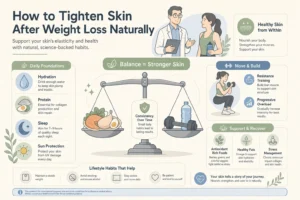
A candid, evidence-based look at what natural methods can and cannot do for loose skin after GLP-1 weight loss, from protein and resistance training to
See Body Works first in your Google results.