

GLP-1 Nausea and Stomach Issues: What Actually Helps

October 2, 2026

The first injection goes fine. The second one too. Then somewhere around the first dose increase, breakfast stops sounding like a good idea and you start wondering whether this is what the next year looks like. In the FDA label for semaglutide, 44% of patients reported nausea. The label does not say when it stops.

GLP-1 nausea is common and, for most people, temporary. It clusters around dose increases and fades as the body adjusts, usually within a few weeks of each step. It happens because these medications slow how fast your stomach empties and change the signals that tell your brain you’re full. Those are the same actions that produce the weight loss, but nausea itself is not proof the medication is working. The dose schedule and what you eat change how it goes, and a short list of symptoms means you call your provider the same day.

Body Works manages semaglutide and tirzepatide patients under physician supervision in Franklin, TN and Nolensville, TN. What follows is the side-effect conversation that belongs before the first injection.

Illustration of GLP-1 Nausea and Stomach Issues: What Actually Helps in a modern medical wellness setting

Why Do GLP-1 Medications Cause Nausea and Stomach Issues?

Because they slow the movement of food out of your stomach and act on the appetite centers in your brain at the same time. Food sits longer and fullness arrives sooner, so a normal meal can feel like too much. The result is the cluster most patients recognize: nausea, a heavy feeling after small meals, burping, reflux, and in some people vomiting or diarrhea.

The numbers are not small. In the FDA prescribing information for semaglutide, nausea was reported by 44% of patients versus 16% on placebo, vomiting by 24% versus 6%, and burping by 7% versus under 1%. Tirzepatide runs lower on nausea at every dose on its label: the FDA label for tirzepatide reports nausea in 25% to 29% of patients across the 5 mg, 10 mg, and 15 mg doses, against 8% on placebo.

GLP-1 nausea is a predictable effect of two things the medication is designed to do, slowing stomach emptying and increasing fullness signals, which is why it sits at the top of both FDA labels’ adverse-reaction tables. The realistic goal is to keep it mild and short.

How Long Does GLP-1 Nausea Last?

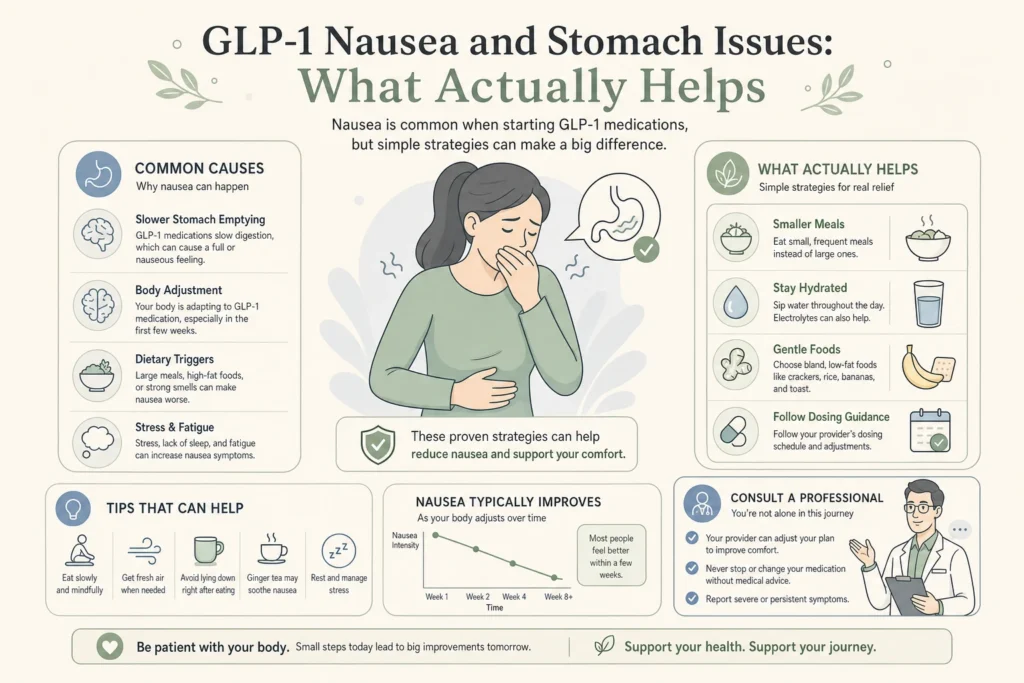
For most patients, days to a few weeks after each dose increase, and then it settles. In the SURMOUNT-1 trial of tirzepatide in the New England Journal of Medicine, gastrointestinal events were the most common side effects, mostly mild to moderate, and occurred primarily during the dose escalation period. The same pattern holds for semaglutide.

The clearest picture comes from a pooled analysis of the STEP 1 to 3 trials published in Diabetes, Obesity and Metabolism, covering 2,117 patients on semaglutide 2.4 mg. It found that 99.5% of gastrointestinal events were non-serious, 98.1% were mild to moderate, and they occurred most often during or shortly after dose escalation. Only 4.3% of patients permanently stopped the medication because of stomach symptoms. Put the other way, fewer than 5 in 100 stopped for that reason.

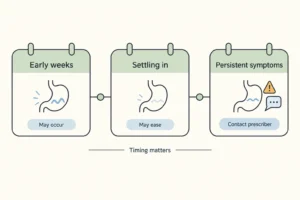
The calendar matters. Nausea that flares in the week after a dose step and eases by the next injection is the expected course. Nausea that persists at a stable dose for several weeks, or worsens, is the signal to slow down or hold the dose.

Nausea Is Not a Sign the Medication Is Working

A common belief is that feeling sick means the dose is “doing something,” and that people who feel fine must be losing less. The evidence says otherwise. In the same pooled STEP analysis, patients who never had a gastrointestinal side effect lost between 9.6% and 17.1% of their body weight, about the same as the 11.4% to 17.7% lost by patients who did. A formal mediation analysis concluded that gastrointestinal side effects contributed little to the weight loss semaglutide produced.

That finding changes the decision you make on a bad week. If nausea drops away at week six and the scale keeps moving, nothing is wrong. If you feel sick and are tempted to push through because you believe it’s the price of results, you’re paying for something that isn’t buying you anything. The weight loss comes from appetite and fullness signaling over months, not from feeling ill. A dose that keeps you comfortable and consistent beats a dose that makes you skip injections.

For the same reason, a lower maintenance dose is a legitimate end point for some patients. The approach to microdosing and maintenance on GLP-1 medications covers how that decision gets made once the initial weight comes off.

Supporting illustration for GLP-1 Nausea and Stomach Issues: What Actually Helps in a modern medical wellness setting

What Can You Do About GLP-1 Nausea Today?

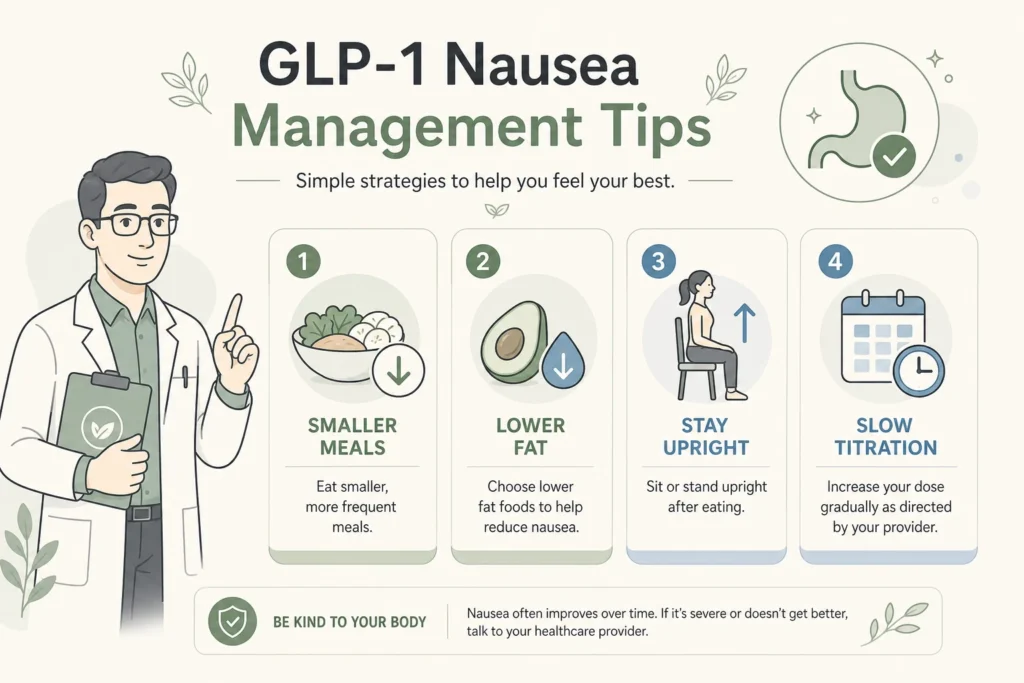
Eat smaller amounts more often and keep drinking. For the first few days after a dose change, keep fat low. A 2025 joint nutrition advisory from four medical societies published in Obesity notes that nausea often occurs in the morning or after long stretches without eating, that skipping meals because of nausea makes it worse, and that vomiting is more likely after large meals. Its advice is a small breakfast followed by small meals every three to four hours, with adequate fluids. Fatty and high-fiber foods are the ones to avoid during the first few days of treatment. Ginger or peppermint tea and acupressure bands are listed as options that can help.

A multidisciplinary expert consensus in the Journal of Clinical Medicine adds the clinical side: how to reach the maintenance dose, what to do when stomach symptoms appear during escalation, and how to minimize nausea, vomiting, diarrhea, and constipation, steps the authors say may keep patients from withdrawing from treatment.

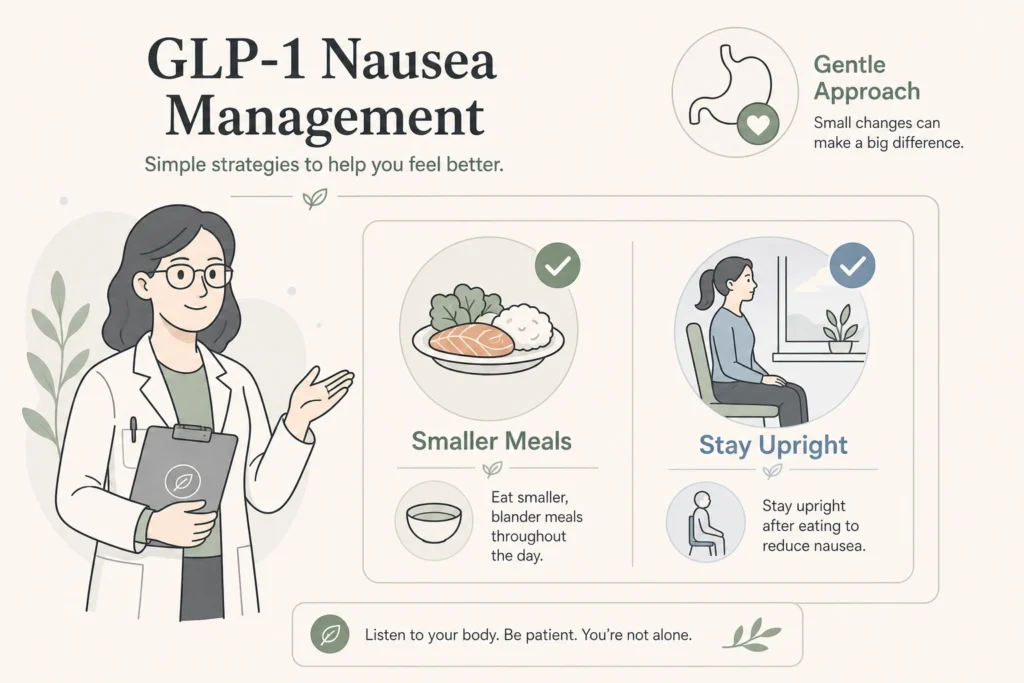
In practice that looks like bland, lower-fat foods on injection day and the day after (toast, rice, eggs, yogurt, lean protein, broth-based soups), with fluids sipped through the day instead of large volumes with meals. Stay upright after eating, since lying down on a full, slow-emptying stomach is the fastest way to turn nausea into reflux. If the first day after each dose is your worst, ask your prescriber about injection timing.

If constipation is the symptom instead, it needs its own plan built around fiber, protein, and fluid. The guide to managing GLP-1 constipation with fiber and protein targets covers that, and the companion article on what to eat on GLP-1 medications covers the food list.

How Does Dose Titration Reduce Stomach Side Effects?

By giving your digestive system weeks to adapt to each level of the medication before the next increase. Semaglutide starts at 0.25 mg weekly for four weeks and steps up through 0.5 mg, 1 mg, and 1.7 mg before reaching the 2.4 mg maintenance dose at week 17, a schedule the label states exists to minimize gastrointestinal adverse reactions. Tirzepatide begins at 2.5 mg and increases in 2.5 mg steps no faster than every four weeks. The tirzepatide label notes that most nausea, vomiting, and diarrhea occurred during dose escalation and decreased over time.

The schedule on the label is a ceiling on speed, not a requirement to climb. A patient who is still queasy at 0.5 mg in week eight does better holding there for another four weeks, the delay the semaglutide label itself suggests, than stepping up on time. The 2025 nutrition advisory notes that trial participants were allowed to stay at a dose for up to eight weeks to let stomach symptoms settle. After a gap, the semaglutide label directs that if more than two consecutive doses are missed, restarting at a lower dose and re-escalating may reduce the stomach symptoms that come with reinitiation.

Titration is the most useful nausea tool the label gives you, and it only works when someone is watching the dose, the symptom, and the calendar together. The tirzepatide dosing guide and the medical weight loss program treat the escalation schedule as a starting point that gets adjusted to the patient.

Side effect (FDA label, versus placebo)Semaglutide 2.4 mgTirzepatide 5 mg to 15 mg
Nausea44% vs 16%25% to 29% vs 8%
Diarrhea30% vs 16%19% to 23% vs 8%
Vomiting24% vs 6%8% to 13% vs 2%
Constipation24% vs 11%11% to 17% vs 5%
Stopped treatment for stomach symptoms4.3% vs 0.7%4.3% at 15 mg vs 0.5%
Supporting illustration for GLP-1 Nausea and Stomach Issues: What Actually Helps in a modern medical wellness setting

Which Stomach Symptoms Mean You Should Call Your Provider?

Ordinary nausea can wait for your next check-in. Pain, dehydration, and vomiting that won’t stop cannot. The MedlinePlus drug guide for semaglutide injection, revised in May 2026, lists nausea, vomiting, diarrhea, stomach pain, constipation, heartburn, and burping as expected side effects to report if they are severe or do not go away. It separates out a shorter list that calls for immediate medical attention:

  • Ongoing pain that begins in the upper left or middle of the stomach and may spread to the back, with or without vomiting, which can signal pancreatitis.
  • Pain in the upper stomach with yellowing of the skin or eyes, fever, or clay-colored stools, which can signal a gallbladder problem.
  • Decreased urination, or swelling of the legs, ankles, or feet.
  • Severe stomach or intestinal problems.

Dehydration is the one that catches people. Both FDA labels warn that acute kidney injury has occurred in patients whose nausea, vomiting, or diarrhea left them dehydrated. If you can’t keep fluids down, or you’re dizzy when you stand, that’s a same-day call, not a wait-and-see. The tirzepatide label also carries postmarketing reports of ileus, a bowel that has stopped moving, so severe abdominal pain with bloating and no bowel movement belongs on the urgent list as well.

Supporting illustration for GLP-1 Nausea and Stomach Issues: What Actually Helps in a modern medical wellness setting

What Side-Effect Support Looks Like in Franklin and Nolensville

In 2025, Body Works guided more than 130 patients through its medical weight loss program at the Nolensville office alone, and the side-effect conversation is built into the first visit. Patients starting semaglutide or tirzepatide leave with written nutrition and symptom guidance. When a patient reports a digestive side effect, the team reviews what they have been eating and drinking and when the symptom began relative to the last dose increase, because those two facts usually point to the fix: a food change, a fluid change, or a slower climb.

If you are considering a GLP-1 medication and want the side effects handled properly, or you’re already on one and feeling worse than you think you should, the Franklin and Nolensville teams can build the plan around you. Schedule a Free Consultation to get started.

Frequently Asked Questions

Usually days to a few weeks after each dose increase, easing before the next step. In the pooled STEP trials, 98% of stomach side effects were mild to moderate and most occurred during or just after escalation. Nausea that persists for weeks at a stable dose is the signal to talk to your prescriber about holding or lowering the dose.
Don’t stop or skip doses on your own. Call your prescriber instead, because holding at the current dose or stepping down is usually the better move and keeps you on schedule. The semaglutide label notes that missing more than two consecutive doses may mean restarting at a lower dose to avoid a return of stomach symptoms.
The FDA labels suggest so: nausea in 25% to 29% of tirzepatide patients versus 44% of semaglutide patients, with vomiting also lower. Those figures come from separate trials with no head-to-head comparison, so treat the gap as a tendency, and remember that both medications are titrated slowly for the same reason.
Side-effect management is included in the program, and pricing depends on the medication and plan you choose. Body Works is a cash-pay clinic with payment plans and HSA and FSA eligibility, and the free consultation is where you get the exact figure along with your titration plan.
The Franklin office on Murfreesboro Road and the Nolensville office at Burkitt Commons both manage semaglutide and tirzepatide patients under physician supervision, including dose adjustments and nutrition support. Patients from Brentwood, Spring Hill, Cool Springs, and across Williamson County use whichever location is closer.

Medically reviewed by Dr. Donald Vollmer, MD
Managing Physician, Body Works TN

Browse Our Blog

See Body Works first in your Google results.

Add as a preferred source on Google