
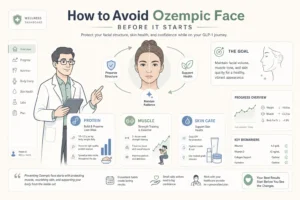
How to Avoid Ozempic Face Before It Starts
You can lower your odds of the gaunt, sunken look people call Ozempic face. Here is how pacing, protein, muscle, and skin care protect your
If you have started losing weight on a GLP-1 medication and your face suddenly looks thinner, more hollow, or older than you expect, you are seeing what people call “Ozempic face.” It is the popular nickname for the gaunt, deflated look that can show up in the cheeks, temples, and under the eyes after fast weight loss. The nickname points at one brand, but the change has nothing to do with any single drug. It comes from losing fat quickly, and it can follow semaglutide, tirzepatide, bariatric surgery, or a crash diet just the same.
The reassuring part is that this is a known, expected change, not a sign that something has gone wrong. Understanding why it happens and what shapes it puts you back in control. At Body Works in Franklin, TN and Nolensville, TN, facial changes are one of the most common concerns weight loss patients raise, and they are usually manageable once you know what you are dealing with. This guide is the anchor for our full picture of body changes after GLP-1 weight loss.
Quick answer: Ozempic face is the hollow, gaunt look that can appear in the cheeks, temples, and under the eyes after rapid weight loss on a GLP-1 medication. It comes from losing facial fat quickly, not from the drug itself, and it is common, expected, and usually manageable.
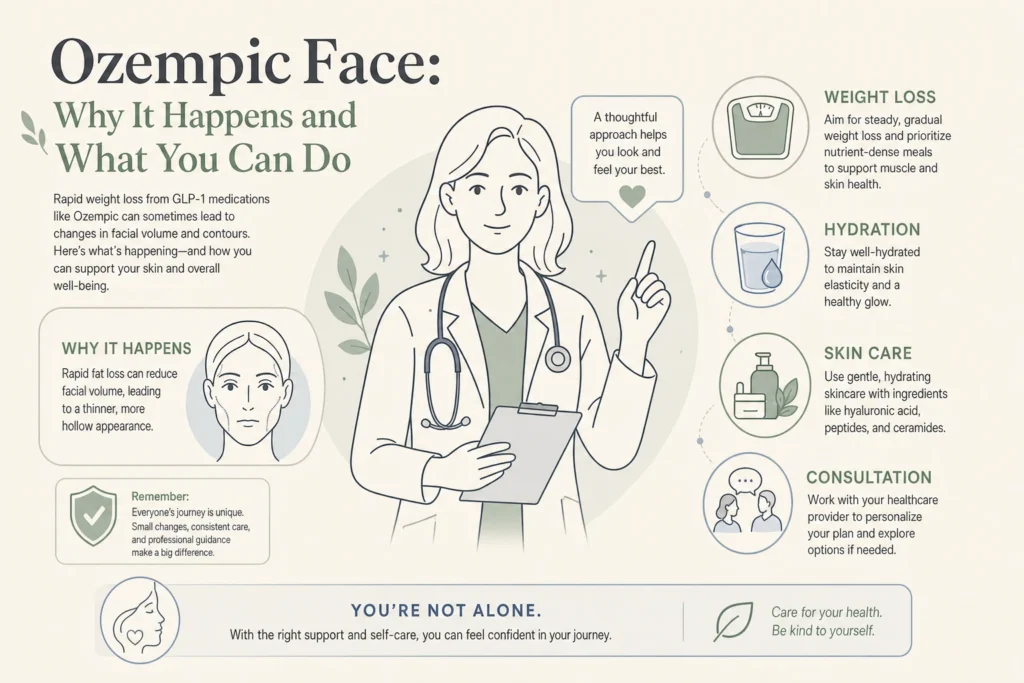
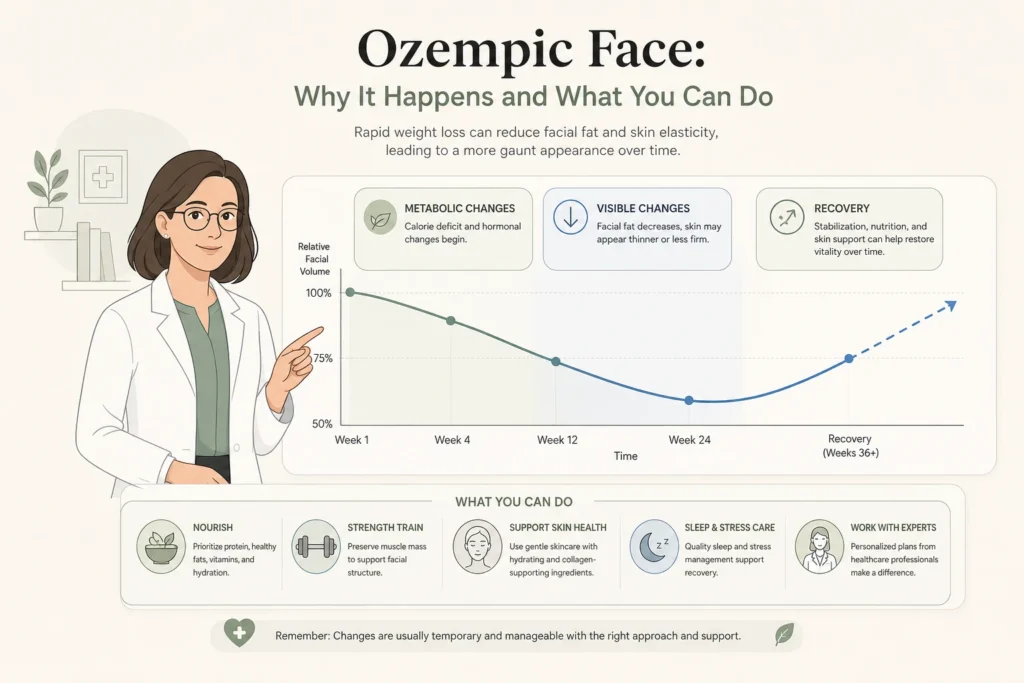
Ozempic face is facial hollowing and mild sagging that appears after rapid weight loss, most visibly in the cheeks, temples, and the areas around the eyes. Your face is padded by small fat compartments that sit under the skin and keep it looking full and smooth. When you lose weight quickly, those pads shrink along with the rest of your body fat, and the skin over them no longer has as much volume to drape across. The result can be a flatter, more drawn look that reads as older, even when the weight loss itself is healthy.
According to the Cleveland Clinic, rapid weight loss removes subcutaneous fat from the face and neck, which causes facial hollowing and sagging skin, and it can make natural aging appear to happen faster (Cleveland Clinic explainer on Ozempic face). That capsule matters because it names the real cause: the fat loss under the skin, not the medication itself.
Ozempic face happens because facial fat, skin elasticity, and the pace of weight loss all move at different speeds. Fat leaves the face along with fat everywhere else, but the skin and the collagen beneath it cannot shrink to match nearly as fast. When the padding disappears in weeks or months instead of years, the skin is left with more surface area than the structure underneath can fill, so it looks loose and hollow.
Three forces drive this. First is fat pad loss: the small superficial fat compartments in the mid-cheek and temples deflate, and the temples in particular tend to lose a large share of their volume. Second is skin elasticity, which depends on collagen and elastin. Rapid weight loss lowers both proteins, so the skin springs back less. Third is pace. A systematic review of soft tissue facial changes after major weight loss found consistent, patterned volume loss across the face, with the superficial fat compartments deflating first (2024 systematic review in PMC). The faster the loss, the less time skin has to adapt.
Ozempic face is a real, documented change, not a social media exaggeration. The nickname is new and a little unfair to one brand, but the underlying event is well established in the medical literature on weight loss and facial aging. Clinicians have described volume loss in the face after major weight change for decades, long before GLP-1 medications were common. What is new is how many people are losing significant weight quickly, which has made the facial version of this change far more visible.
It helps to separate the phenomenon from the fear. Ozempic face is not a disease, a drug side effect in the traditional sense, or a sign that the medication is harming you. It is the predictable cosmetic result of subcutaneous fat leaving the face. Framing it that way keeps it in proportion: it is common, it is understood, and it responds to a mix of prevention and treatment rather than being something you simply have to accept.
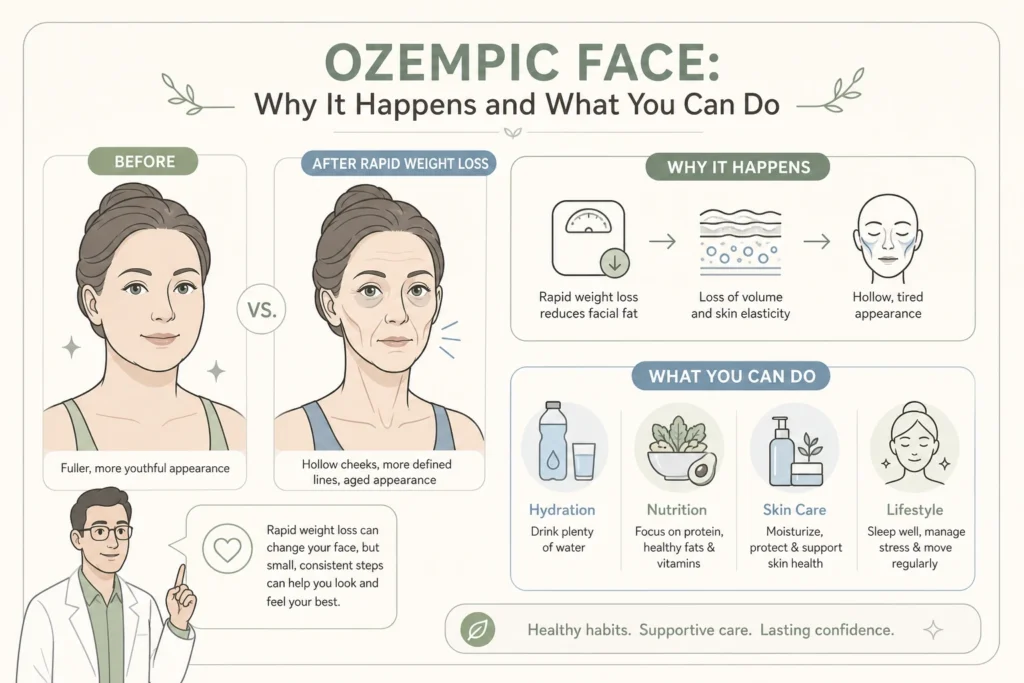
The people most likely to notice Ozempic face are those over 40, those losing a large share of their body weight, and those who start with leaner faces. Age is the strongest factor. Collagen and elastin production fall with each decade, so older skin has less ability to contract and adapt when the volume beneath it drops (2018 review on skin aging in PMC). Someone in their 50s losing 40 pounds will usually see more facial change than someone in their 20s losing the same amount.
The amount and speed of loss matter next. Losing 15 percent or more of your body weight, especially over just a few months, gives skin little time to keep up. Genetics and starting anatomy play a role too. People with naturally slim faces have less fat to spare before hollowing shows, and women often notice the change sooner because female facial fat sits more heavily in the mid-face. None of these traits guarantee Ozempic face, but stacked together they raise the odds.
The signs of Ozempic face are subtle at first and tend to appear in a recognizable pattern. The earliest change is usually flatter cheeks, where the rounded fullness that catches light begins to sink. From there, many people notice hollowing at the temples, a slight shadowing or bagginess under the eyes, and cheekbones or a jawline that look more prominent because there is less padding covering them.
As loss continues, some people see mild sagging along the lower face and jawline, sometimes described as early jowls, along with finer lines that were not obvious when the skin sat over more volume. These changes often show up between losing 10 and 15 percent of your starting weight, which for many falls a few months into treatment. Seeing them side by side is why “Ozempic face before and after” photos are searched so often: the contrast is what makes the shift feel sudden, even though it built gradually. Noticing the signs early is useful, because the earliest window is when prevention has the most room to work.
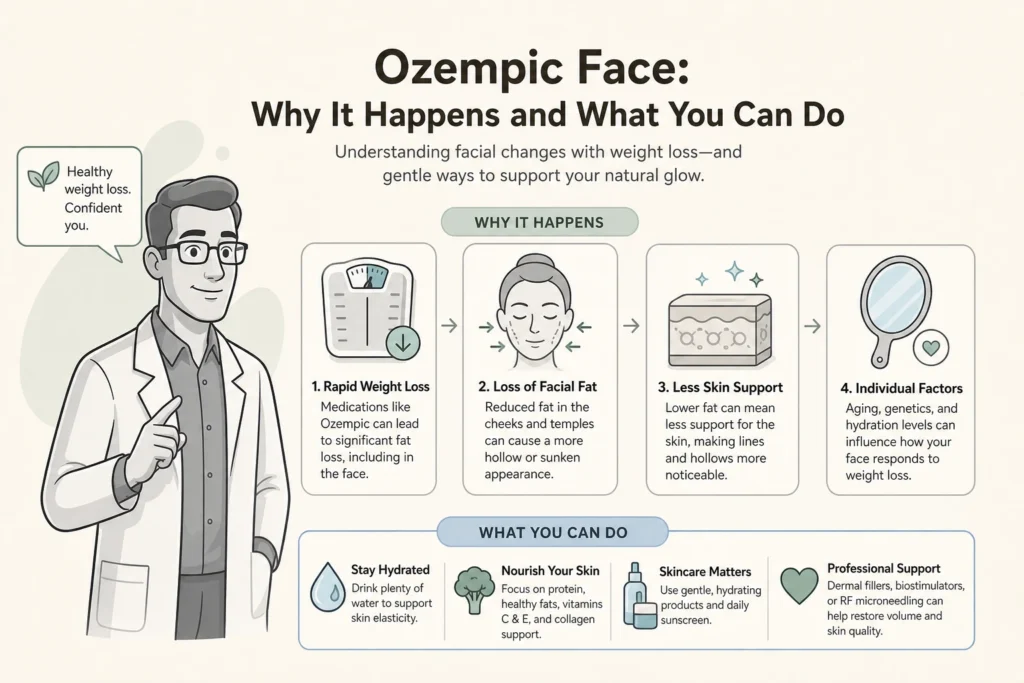
You can lower your risk of Ozempic face, though you cannot always erase it, and prevention starts the day you begin losing weight rather than after the hollowing shows. The core levers are the pace of your weight loss, your protein intake, hydration, and protecting the collagen your skin already has. A steadier rate of loss gives facial skin more time to contract with the shrinking volume beneath it, which is one reason a provider may favor a gradual dosing plan over the fastest possible drop.
Nutrition supports the same goal. Eating enough protein helps preserve the muscle and structural tissue that keep your face and body from looking depleted, and steady hydration keeps skin more supple. There is real depth to each of these habits, and dosing pace in particular is a clinical decision. We cover the full playbook in our guide on how to avoid Ozempic face before it starts, so this section stays at the overview level on purpose.
Ozempic face can often be improved or reversed, and how far you can go depends on how much of the change is lost volume versus loose skin. When the main issue is deflated fat pads, restoring volume tends to bring back a fuller, more rested look. When skin laxity is the bigger driver, the conversation shifts toward tightening the skin itself, which is a different set of options. Most people have some mix of both, so the right plan is rarely one single thing.
Nutrition and skin-supporting habits set the foundation, and some people ask whether supplements help. The honest answer is that the evidence is modest, which we walk through in our review of collagen and supplements for skin during weight loss. For the in-office side, including what volume restoration realistically can and cannot fix, our detailed guide on whether Ozempic face is reversible with fillers and collagen covers the options, timing, and limits. The key point here is that reversal is usually possible to a meaningful degree, and it is a decision to make with a provider who understands both your weight loss and your face.
At Body Works, facial changes are part of the weight loss conversation from the start, not an afterthought once the hollowing appears. What we see in patients is that the people who fare best are the ones who plan for their face while they plan their weight loss, because pace, nutrition, and timing all overlap. The clinic that adjusts your medication is also the right place to talk about what the weight loss is doing to your skin, since both are being managed by the same team looking at the same goals.
That coordination is the whole idea behind our medical weight loss program: steady, supervised progress that protects how you look as much as what the scale says. If you are starting a GLP-1 medication, or you are already partway through and noticing changes in the mirror, the best next step is a conversation. Schedule a Free Consultation at our Franklin or Nolensville offices, and we will talk through your weight loss and your face together. You can also call the Franklin office at (615) 790-2548 or the Nolensville office at (615) 941-1000.
Medically reviewed by Dr. Donald Vollmer, MD
Managing Physician, Body Works TN
You can lower your odds of the gaunt, sunken look people call Ozempic face. Here is how pacing, protein, muscle, and skin care protect your
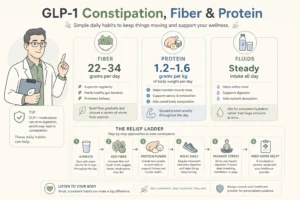
Constipation affects 24% of semaglutide patients and up to 17% on tirzepatide. This guide gives the daily targets that prevent it: 22 to 34 grams
When Tennessee investigators tested counterfeit weight loss vials seized in Medina, one was mostly water. That was the good outcome. The dangers of buying peptides
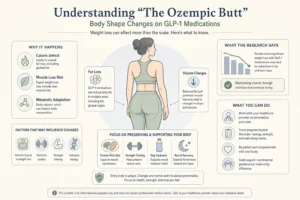
Rapid weight loss changes more than the number on the scale. Here is why the glutes, breasts, and arms often change shape on GLP-1 medications,
NAD+ therapy is marketed as a longevity reset for energy, focus, and healthy aging. This guide separates what the science on NAD therapy actually supports
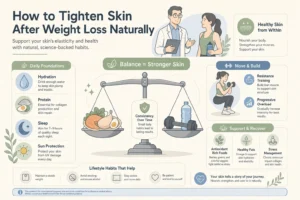
A candid, evidence-based look at what natural methods can and cannot do for loose skin after GLP-1 weight loss, from protein and resistance training to
See Body Works first in your Google results.