
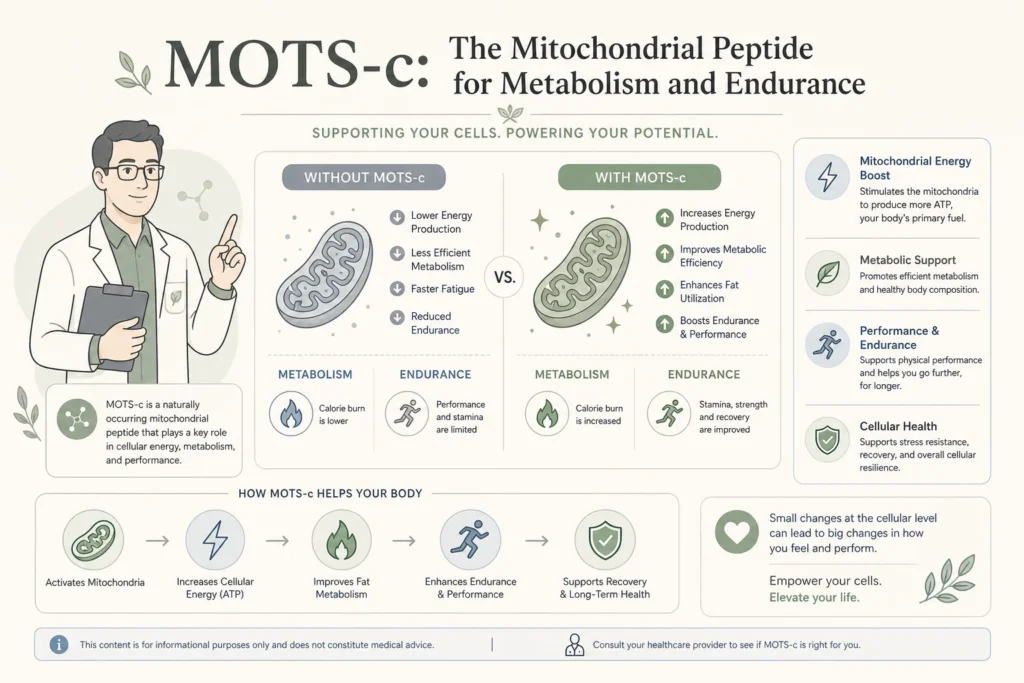


MOTS-c: The Mitochondrial Peptide for Metabolism and Endurance

November 13, 2026

For decades, the DNA inside your mitochondria was treated as a parts list for one job: energy production, nothing else. Then researchers found a 16-amino-acid sequence hiding inside a gene long assumed to only encode a structural RNA component, and it turned out to function as its own signaling hormone. That peptide is MOTS-c, and it is the reason mitochondria are now discussed as an endocrine organ, not just a power plant.

MOTS-c is a mitochondrial-derived peptide that regulates insulin sensitivity, glucose metabolism, and the body’s adaptive response to exercise and metabolic stress. It is produced inside mitochondria, travels to the cell nucleus under stress, and switches on genes involved in antioxidant defense and energy regulation. Research so far is concentrated in animal models and a handful of human observational studies, and while the mechanism is well documented, the “exercise in a vial” framing common online runs well ahead of what has been confirmed in people.

Body Works offers physician-supervised MOTS-c protocols at its Franklin, TN and Nolensville, TN offices. Here is what the peptide does, what the evidence supports, and where it is still catching up to the hype.

Illustration of MOTS-c: The Mitochondrial Peptide for Metabolism and Endurance in a modern medical wellness setting

What Is MOTS-c?

MOTS-c stands for mitochondrial open reading frame of the 12S rRNA type c, a name that describes exactly where it was found: encoded within the mitochondrial gene that makes a piece of ribosomal RNA, a region of the genome that was not expected to code for a functional protein. It is one of a small class of mitochondrial-derived peptides, discovered only in the last two decades, that appear to let mitochondria communicate directly with the rest of the cell, and even the rest of the body, rather than simply generating ATP in isolation.

How Does MOTS-c Work in the Body?

MOTS-c is expressed in response to metabolic stress, including exercise, and once produced it travels out of the mitochondria toward the cell nucleus, where it helps regulate genes tied to antioxidant defense and stress adaptation. A detailed review of its mechanisms describes MOTS-c as acting primarily through the folate cycle and the AICAR-AMPK signaling pathway, a route that directly influences energy metabolism, insulin resistance, and inflammatory response. AMPK is the same cellular fuel gauge that exercise itself activates, which is the biological basis for describing MOTS-c as mimicking some of exercise’s downstream metabolic effects rather than replacing the exercise itself.

A separate mechanistic study confirmed that MOTS-c translocates to the nucleus specifically in response to metabolic stress, where it regulates the expression of genes containing antioxidant response elements, a finding that helped establish mitochondrial-nuclear communication as a real, active signaling pathway rather than a one-way relationship.

Does Exercise Naturally Increase MOTS-c?

Yes, and this is one of the better-documented parts of the research. A study in Nature Communications found that MOTS-c functions as an exercise-induced regulator of age-dependent physical decline and muscle homeostasis, with levels rising in skeletal muscle and blood plasma in response to physical activity. A separate trial measuring the effect of structured aerobic and resistance training in cancer survivors found that a defined exercise program measurably changed circulating MOTS-c levels, adding human data to what had mostly been an animal-model finding.

That relationship, exercise raising MOTS-c naturally, is part of why supplemental MOTS-c is framed as supporting the same pathway the body already uses, rather than introducing something foreign to it. It is not evidence that the peptide substitutes for training.

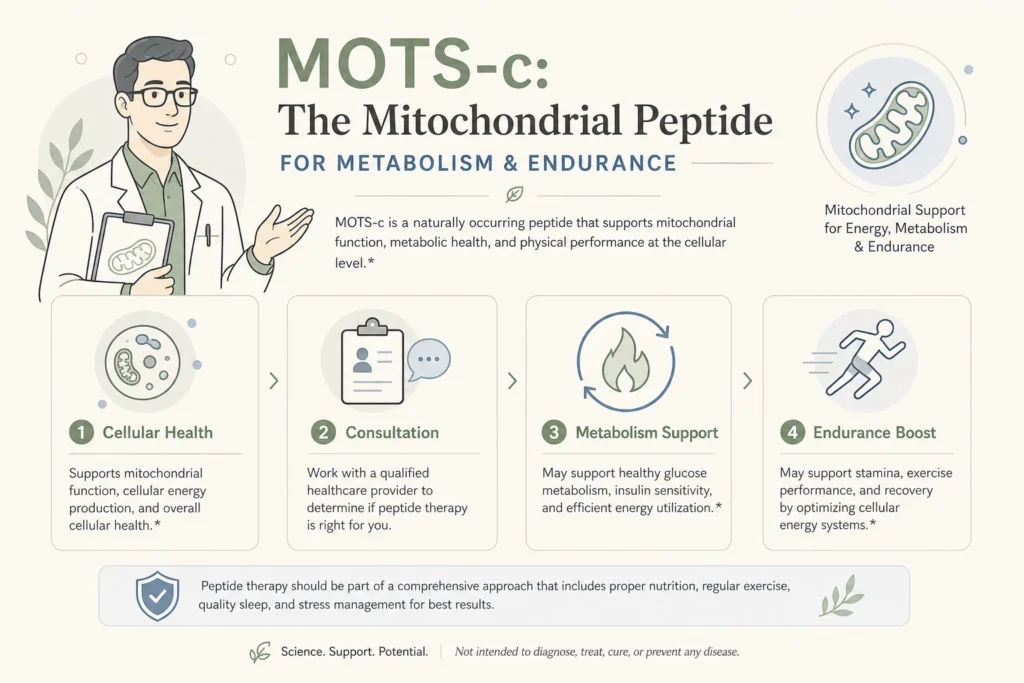
Supporting illustration for MOTS-c: The Mitochondrial Peptide for Metabolism and Endurance in a modern medical wellness setting

What Does the Research Show About Metabolism and Insulin Sensitivity?

The original 2015 discovery paper found that MOTS-c administration prevented diet-induced obesity and insulin resistance in mice and reversed age-related muscle insulin resistance, establishing its core metabolic role. Follow-up work summarized in a dedicated review describes MOTS-c as a regulator of both muscle and fat metabolism, with effects that extend beyond a single tissue type. Across the published animal literature, the consistent findings are improved glucose uptake, better insulin sensitivity, and preserved exercise capacity in aged animals compared to untreated controls.

What is thinner is large-scale, randomized human trial data testing MOTS-c administration itself, as opposed to observing naturally occurring MOTS-c levels in people who exercise. The animal mechanism is credible and well replicated. The leap to “this will do the same thing in a 45-year-old person taking it as a supplement” is the part still being tested.

Is MOTS-c "Exercise in a Vial"?

Not quite, and the honest version of the claim matters more than the catchy one. MOTS-c activates a real signaling pathway that overlaps meaningfully with what exercise does to muscle and fat metabolism, and in aged mice it measurably improved exercise capacity and performance. That is a legitimate, publishable, repeatable finding. It is not the same as saying a MOTS-c injection replaces the cardiovascular training effect, the bone density benefit, or the mental health effect of actually exercising, none of which the peptide is positioned to reproduce on its own.

The more accurate framing, and the one a supervising physician should use, is that MOTS-c may support the metabolic signaling pathway that declines with age and inactivity, working alongside a training program rather than instead of one. Patients who hear “exercise in a vial” and plan to skip the gym are working from marketing language, not from the research.

Supporting illustration for MOTS-c: The Mitochondrial Peptide for Metabolism and Endurance in a modern medical wellness setting

Who Might Consider MOTS-c Peptide Therapy?

Adults dealing with age-related metabolic slowdown, plateaued endurance performance despite consistent training, or insulin resistance identified on bloodwork are the population most discussed in current clinical interest, alongside older adults looking to preserve muscle metabolic function. It is not positioned as a weight-loss shortcut and is not a substitute for addressing diet and activity directly. As with other peptides in this category, it is compounded and available through a licensed compounding pharmacy with a prescription, and a physician should confirm there is a legitimate metabolic goal behind the request before starting.

Supporting illustration for MOTS-c: The Mitochondrial Peptide for Metabolism and Endurance in a modern medical wellness setting

MOTS-c and Metabolic Health in Franklin, TN

The most common question the Franklin team hears about MOTS-c is some version of “will this replace my workouts,” and the honest answer every time is no. The team’s approach treats MOTS-c as one input into an existing training and metabolic plan, not a stand-alone intervention, which mirrors exactly what the exercise-response research supports and the “exercise in a vial” marketing does not. Bloodwork that shows insulin resistance or a stalled endurance plateau despite consistent training are the two most common reasons a MOTS-c conversation starts.

If you are interested in whether MOTS-c fits your metabolic or performance goals, the Franklin and Nolensville teams can review your bloodwork and training history together. Schedule a Free Consultation to get started, or read the complete guide to peptide therapy for how the broader program works.

Frequently Asked Questions

No peptide in this category carries FDA approval as a prescription drug. MOTS-c is available through licensed compounding pharmacies with a prescription, following physician evaluation, the same pathway used for other research peptides discussed on this site.
Cost depends on the length and structure of the protocol, which is set individually based on your metabolic goals and bloodwork. Body Works does not publish fixed pricing online because every plan differs; your consultation includes a specific cost breakdown along with information on payment plans.
MOTS-c is studied primarily for insulin sensitivity and metabolic regulation, not as a weight-loss medication, and it works through a different mechanism than GLP-1 medications. Any effect on body composition would be secondary to its metabolic effects, not a direct appetite-suppressing action.
No. The research shows MOTS-c activates some of the same signaling pathways exercise does, and its measured effects are strongest when studied alongside physical activity, not as a substitute for it. Treat it as support for a training plan, not a replacement for one.
Body Works offers physician-supervised MOTS-c protocols at its Franklin and Nolensville, TN offices, sourced through a licensed compounding pharmacy. A consultation includes bloodwork review and a discussion of your training and metabolic history.
The published animal research shows a favorable safety profile, and human use has not raised significant safety signals in the data available so far, though large-scale human trials are still limited. Physician supervision, appropriate sourcing, and bloodwork monitoring are the standard safeguards for any peptide in this category.

Medically reviewed by Dr. Donald Vollmer, MD
Managing Physician, Body Works TN

Browse Our Blog

See Body Works first in your Google results.

Add as a preferred source on Google