

MOTS-c: The Mitochondrial Peptide for Metabolism and Endurance
For decades, the DNA inside your mitochondria was treated as a parts list for one job: energy production, nothing else. Then researchers found a 16-amino-acid
Search “peptide therapy near me” and the results mix licensed medical clinics with websites selling research-use-only vials to your front door, no prescription, no bloodwork, no physician anywhere in the process. Both show up in the same search results. Only one of them is actually safe.
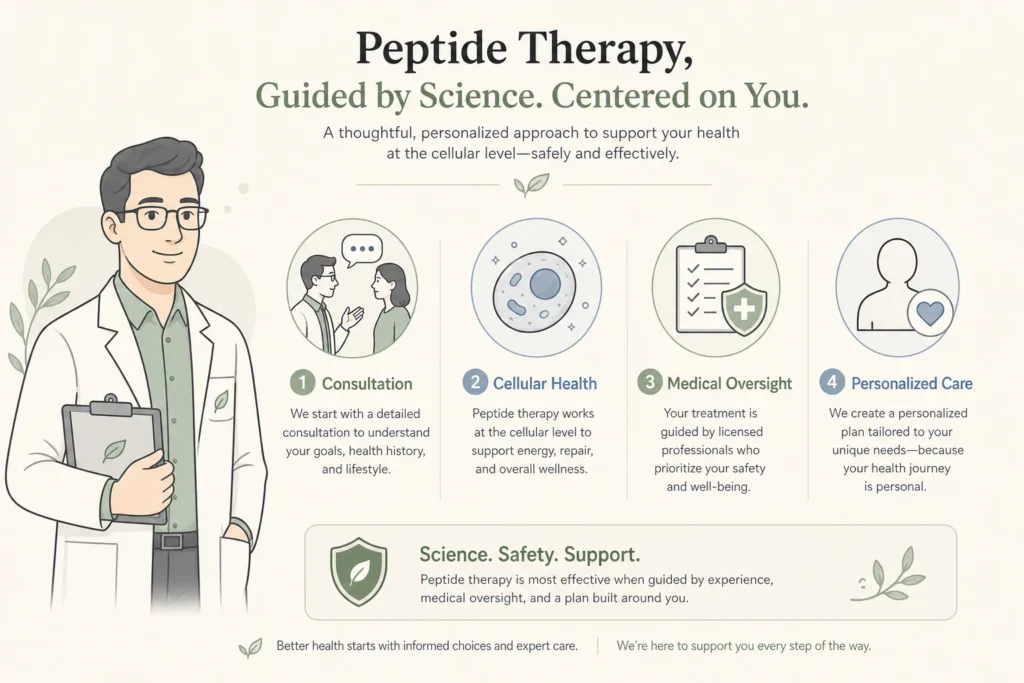
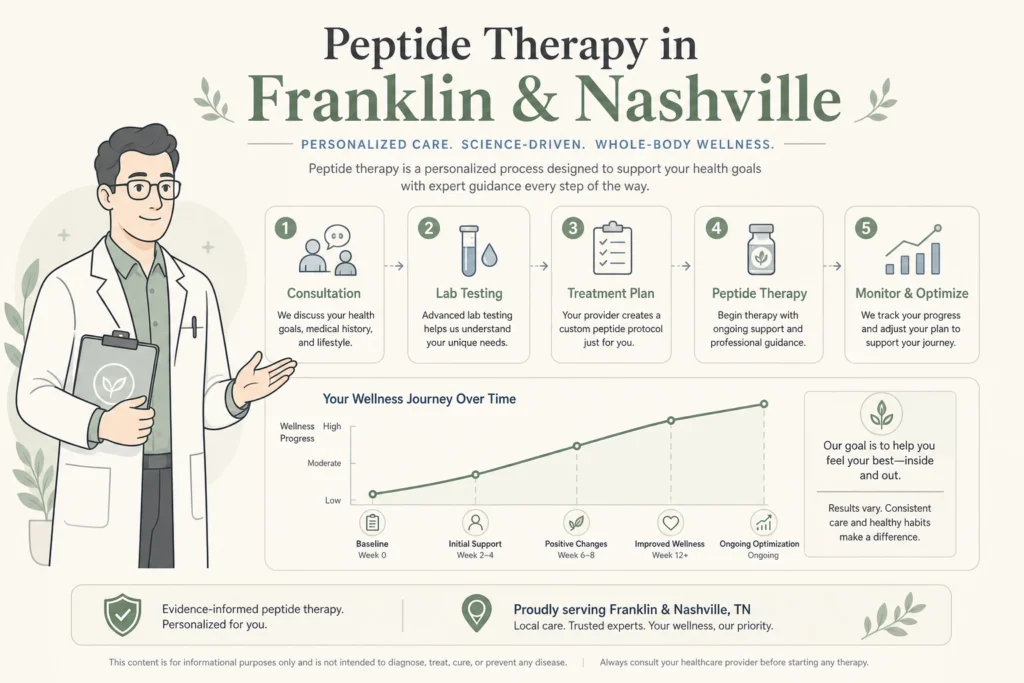
Physician-supervised peptide therapy starts with a consultation, bloodwork, and a review of your health history, not a checkout page. The peptide is prescribed based on your specific goals and lab results, sourced through a licensed 503A compounding pharmacy, and monitored with follow-up bloodwork over the course of treatment. That process, not any single compound, is what actually determines whether peptide therapy is safe.
Body Works runs a physician-supervised peptide therapy program at offices in both Franklin, TN and Nolensville, TN, serving the greater Nashville area. Here is exactly how the program works.
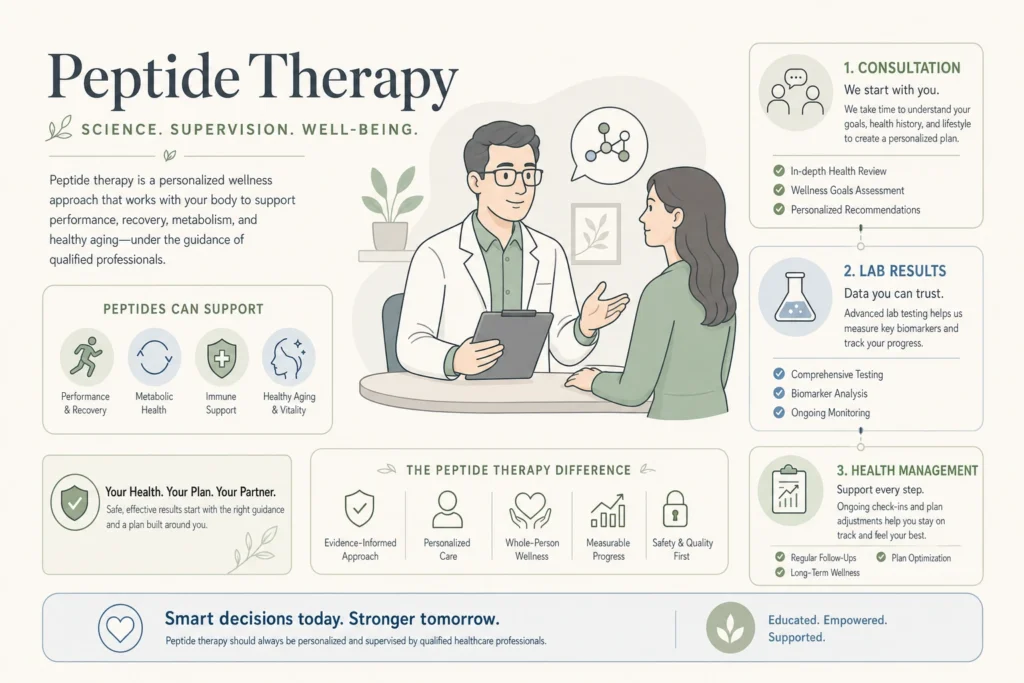
It starts before any peptide is prescribed, with a consultation, a health history review, and bloodwork to confirm there is no contraindication and to establish a baseline for comparison later. A review of regulatory guidelines for therapeutic peptides notes that peptide-based treatments face distinct stability, purity, and formulation challenges compared to small-molecule drugs, which is precisely why sourcing and quality control matter as much as the prescribing decision itself. An unregulated online seller skips every part of this: no bloodwork, no physician evaluation, and no verification of what is actually in the vial.
The Obesity Medicine Association’s position statement on compounded peptides makes the same point from the regulatory side: compounded peptide medications do not undergo the FDA’s premarket review and approval process the way manufactured drugs do, which places the burden of quality assurance on the prescribing physician and the compounding pharmacy they choose to work with, not on a federal approval that does not exist for this category.
A physician reviews your goals, current health, and relevant bloodwork before recommending any specific peptide, which is the opposite of the “pick your compound from a list” model unregulated sellers use. The full walkthrough of the first appointment covers what to bring and what the visit actually looks like. In general, expect a conversation about your specific goal, whether that is injury recovery, metabolic support, or something else, before a peptide is even named.
The program covers the full range of clinically discussed peptide categories: BPC-157 and TB-500 for tissue and injury recovery, PT-141 for low sexual desire, MOTS-c for metabolic and endurance support, and growth-hormone-releasing peptides including ipamorelin, sermorelin, and tesamorelin. The evidence base varies meaningfully across this list, from decades of clinical use in one category to primarily preclinical animal data in another, and a recent review of peptide therapies for musculoskeletal and performance applications makes exactly that point: knowing where a specific peptide sits on that spectrum should shape the conversation, not just its name recognition. The BPC-157 and TB-500 recovery stack and the PT-141 guide cover two of the most requested options in more depth.
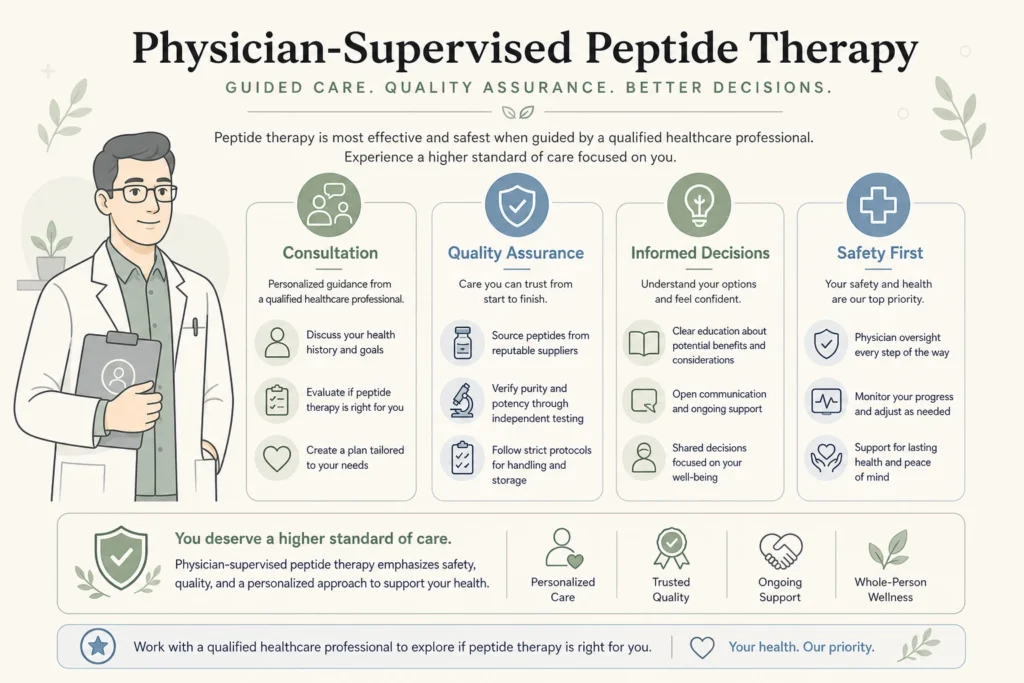
Both offices run the same physician-supervised program, the same sourcing standards, and the same bloodwork-first process, so the choice usually comes down to which location is closer to you. The Franklin office is at 1113 Murfreesboro Rd #307, Franklin, TN 37064, reachable at (615) 790-2548. The Nolensville office is at 210 Burkitt Commons Ave, Nolensville, TN 37135, reachable at (615) 941-1000. Patients commuting from Nashville proper tend to find one or the other more convenient depending on which side of the city they are coming from; either office can review your goals and bloodwork and start the same intake process.
Every peptide is sourced through a licensed compounding pharmacy operating under the FDA’s framework governing 503A compounding pharmacies, which sets requirements around the substances a compounding pharmacy may use and how they must be handled. A broader review of progress in peptide and protein therapeutics notes that these compounds generally offer high specificity and a favorable safety profile compared to small-molecule drugs, with fewer off-target effects, a real advantage of the category, but one that depends entirely on the product actually being what the label says it is. That is the gap unregulated online sellers do not close, and licensed sourcing is the mechanism that closes it.
No bloodwork requirement is the clearest one. If a website lets you add a peptide to a cart and check out without ever speaking to a licensed provider or submitting any lab work, that is not a medical process, regardless of how the product is marketed. A second warning sign is vials labeled “research use only” being sold for personal use, language that exists specifically to sidestep the regulatory requirements that apply to a genuine prescription medication. A third is a seller who cannot name the specific compounding pharmacy the product comes from, or who ships from an address with no connection to a licensed pharmacy at all. Any one of these should end the transaction before it starts.
Follow-up bloodwork and a check-in with your provider at defined points in the protocol, not a one-time prescription with no further contact. The specific labs and timing depend on which peptide is being used and what it is being used for, but the principle is consistent across the program: a peptide that is working, or one that needs adjustment, shows up in the numbers and in how you report feeling, and a physician reviewing both is how a protocol gets refined rather than continued blindly.
Body Works has worked with more than 580 individual clients on peptide protocols at its Franklin office since 2022, and 48 unique clients at the Nolensville office in 2025 alone, a program that has grown specifically because it is built around physician oversight rather than a menu of compounds. Patients driving in from across the greater Nashville area consistently ask the same first question: how is this different from the online sellers. The answer is the process outlined above, bloodwork first, licensed sourcing, and ongoing monitoring, not any single peptide’s marketing claims. The guide to choosing a peptide therapy provider covers the specific questions worth asking before starting anywhere.
If you are looking for physician-supervised peptide therapy near Franklin, Nolensville, or Nashville, the team at either office can review your goals and bloodwork and build a plan. Schedule a Free Consultation to get started, or explore the full peptide therapy program.
Medically reviewed by Dr. Donald Vollmer, MD
Managing Physician, Body Works TN
For decades, the DNA inside your mitochondria was treated as a parts list for one job: energy production, nothing else. Then researchers found a 16-amino-acid
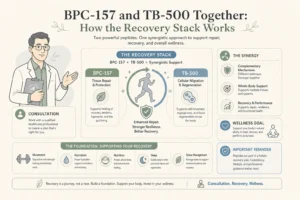
Search “BPC-157 TB-500 stack” and the forums all say the same thing: pair them, because one heals the tissue and the other helps cells get

A single glass of wine that never used to bother anyone can suddenly cause real nausea a few months into semaglutide or tirzepatide treatment. Patients
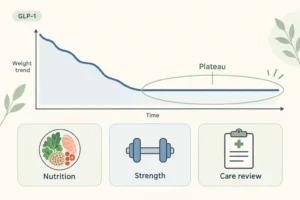
Three months of steady loss, then two weeks of nothing, then a patient calls certain the medication stopped working. It didn’t. A GLP-1 plateau is

Ask ten men about TRT side effects and you’ll hear ten different fears, most of them wrong. Shrinking testicles, aggression, hair loss, none of these
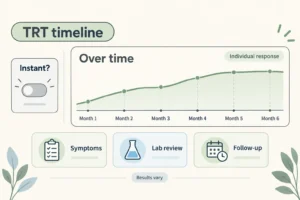
Most men expect testosterone therapy to feel like flipping a switch. It doesn’t, and a realistic TRT results timeline looks nothing like the overnight transformation
See Body Works first in your Google results.