GLP-1 Plateau: Why Weight Loss Stalls and What to Do Next

November 1, 2026

Three months of steady loss, then two weeks of nothing, then a patient calls certain the medication stopped working. It didn’t. A GLP-1 plateau is what happens when the body catches up to the deficit the medication created, and it is one of the most predictable parts of treatment, not a sign of failure.

A weight loss plateau on semaglutide or tirzepatide happens because the body’s energy needs drop as weight drops, appetite drifts back up slightly as it adapts, and at some point the calorie deficit that was driving loss narrows or closes. The medication is still working exactly as designed. What’s changed is the body underneath it. Body Works providers in Nolensville, TN and Franklin, TN treat a plateau as a checkpoint to reassess, not a reason to panic or assume the dose has failed.

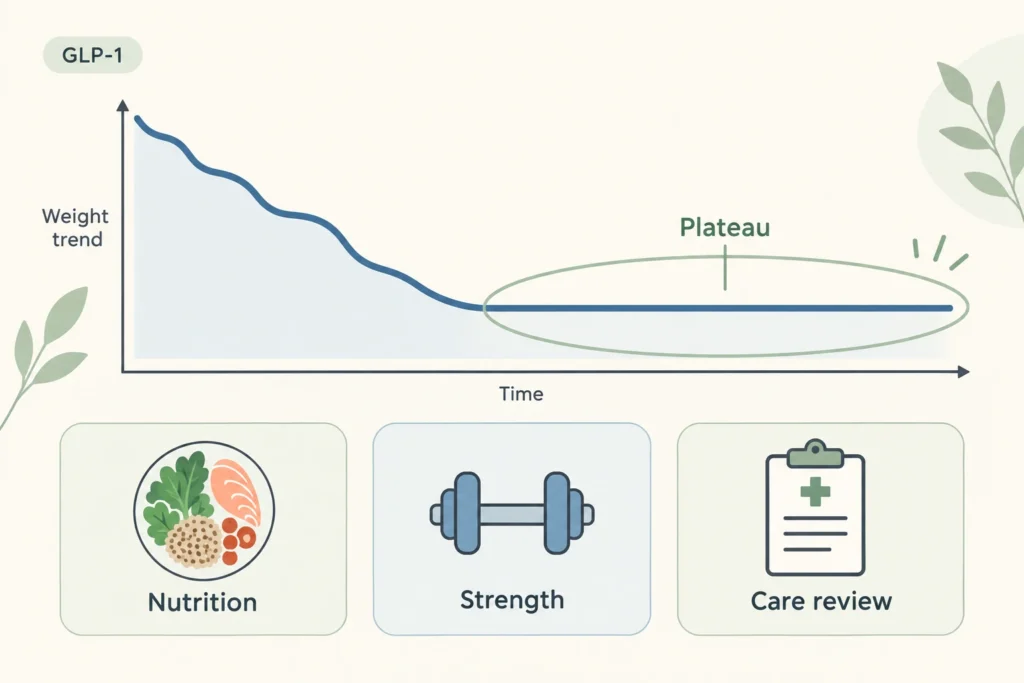
Illustration of GLP-1 Plateau: Why Weight Loss Stalls and What to Do Next in a modern medical wellness setting

Why Does Weight Loss Plateau on a GLP-1 Medication?

Two things happen at once as weight comes off: resting energy expenditure drops because a smaller body needs fewer calories to maintain itself, and appetite signals drift back toward baseline even while the medication is still active. According to a weight-loss plateau explainer from the Mayo Clinic, this metabolic slowdown is a normal, expected response to weight loss of any kind, not something unique to GLP-1 medications, and it means the same intake that once produced a deficit can eventually stop producing one.

Muscle loss makes this worse if it isn’t actively prevented, since muscle tissue burns several times more energy at rest than fat does. Losing muscle alongside fat lowers resting energy expenditure further, which narrows the deficit even faster. The mathematical model behind the NIDDK Body Weight Planner was built to account for this kind of adaptation, showing that the calorie deficit needed to keep losing weight has to grow over time as the body’s baseline energy needs shrink. This is the direct link between plateaus and inadequate protein or strength training, covered in our guide to preventing muscle loss on GLP-1 medications.

There’s also a simpler, shorter-term version of a plateau that isn’t a true stall at all: week-to-week fluctuation from water retention, sodium intake, hormonal cycles, or the timing of a bowel movement relative to weigh-in day. A single week without scale movement, especially right after a period of faster loss, is often this kind of noise rather than a genuine metabolic plateau. Looking at a four-week trend instead of a single week’s number is a simple way to tell the difference before assuming anything has actually changed.

Do the Clinical Trials Show a Plateau Too?

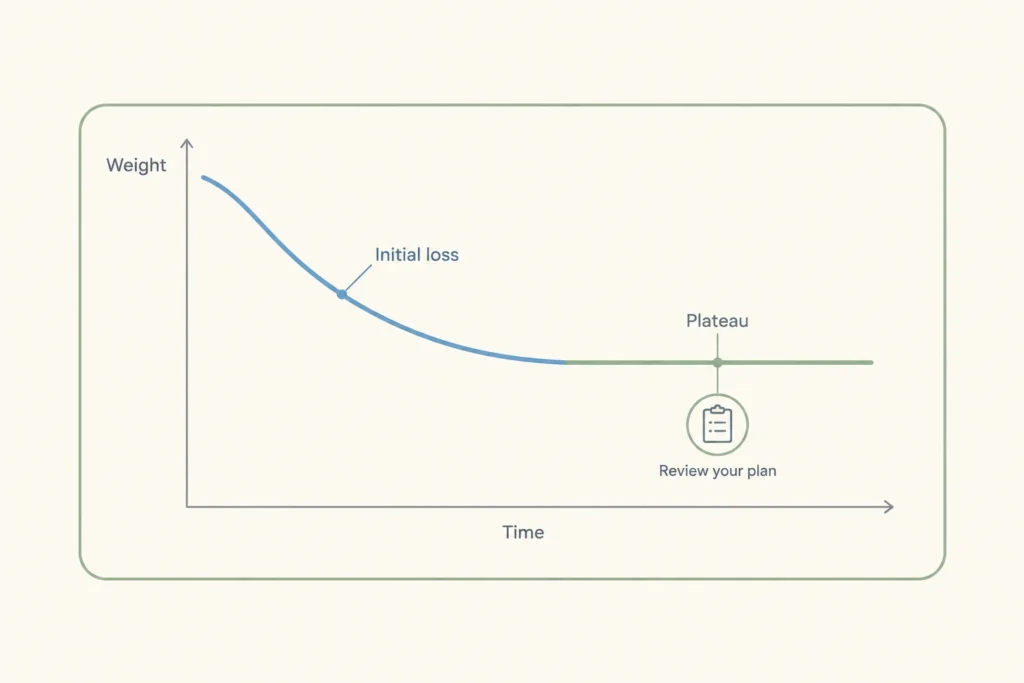
Yes. In the STEP 1 trial published in the New England Journal of Medicine, the rate of weight loss on semaglutide was steepest in the first several months and visibly slowed over the second half of the 68-week study. The SURMOUNT-1 trial shows the same curve shape for tirzepatide across its 72 weeks, with the largest month-to-month drops early and a flatter trend line as the trial went on.

That pattern in the pivotal trials is the same one patients feel in real life. Fast progress comes first, then a visible slowdown that isn’t a malfunction. A plateau appearing after several months of consistent loss isn’t a sign the trial data was wrong about your medication. It’s the trial data, playing out in your own results instead of a published chart.

Supporting illustration for GLP-1 Plateau: Why Weight Loss Stalls and What to Do Next in a modern medical wellness setting

What Should You Check Before Assuming You Have Truly Plateaued?

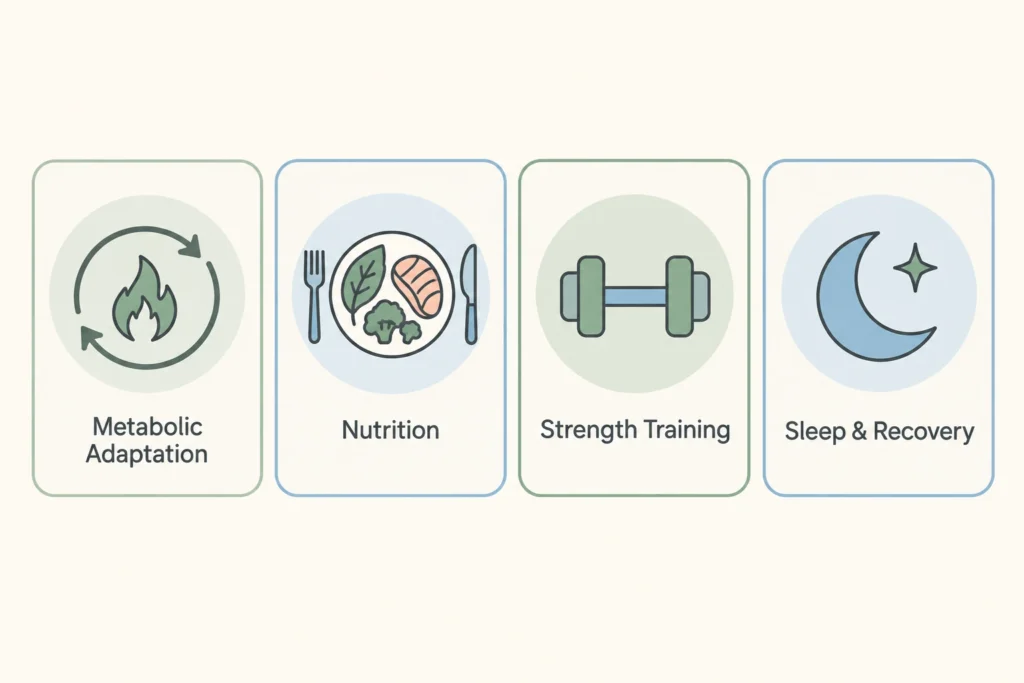
Four things are worth reviewing before concluding the medication has stopped working: whether you are still at a stable dose long enough for it to be fully active, whether protein and strength training have kept pace with the weight lost, whether portion sizes have quietly crept back up as appetite partially returned, and whether injection technique or timing has drifted. Our guides to the semaglutide dosage schedule and tirzepatide dosage schedule cover how long a given dose typically needs before its full effect shows, and injection technique is worth double-checking if site rotation has gotten inconsistent.

Nutrition is the most common overlooked factor. As appetite eases, it becomes easy to drift toward lower-protein, higher-volume foods that feel satisfying without supporting the deficit, a shift that happens gradually enough that most patients don’t notice it happening in real time. Our guide to what to eat on GLP-1 medications covers the adjustments that matter most once the early, dramatic appetite suppression settles into something more moderate.

Sleep and stress are the two factors patients ask about least and that our team checks most. Poor sleep raises the hormone that drives hunger and lowers the one that signals fullness, working directly against a GLP-1 medication’s mechanism even when food choices haven’t changed at all. Chronic stress has a similar, slower effect through cortisol. Neither shows up on a food log, which is exactly why they’re easy to miss when troubleshooting a stall.

Supporting illustration for GLP-1 Plateau: Why Weight Loss Stalls and What to Do Next in a modern medical wellness setting

What Are the Actual Options for Breaking a Plateau?

If the four checks above don’t explain it, three options remain: increasing the current medication’s dose if room remains on its titration ladder, adding structured strength training to protect and rebuild the metabolic cost of muscle, or discussing a switch to a medication with a different or stronger mechanism. Retatrutide, a triple GLP-1/GIP/glucagon agonist sometimes nicknamed “GLP-3,” produced continued weight loss through 48 weeks in its phase 2 trial published in the New England Journal of Medicine, and is one option patients ask about when they’ve plateaued on a dual or single-mechanism medication.

A switch isn’t the first move for most patients, and it isn’t always the right one. Our guide to switching from tirzepatide to retatrutide covers when that conversation actually makes sense, and retatrutide therapy is available at Body Works for patients whose prescriber determines it’s appropriate. For many patients, the dose room left on their current medication or a closer look at protein and training closes the gap without switching anything.

The plateau conversation our providers have most often isn’t about changing the medication. It’s about which of the four checks got missed three months earlier without anyone noticing at the time. A plateau at month four looks different from a plateau at month ten, and treating them the same is how patients end up switching medications that were never actually the problem.

Whether your weight loss has stalled for two weeks or two months, our physician-supervised teams at Body Works in Franklin and Nolensville can review your dose, your labs, and your plan to figure out what’s actually happening. Schedule a Free Consultation to get started.

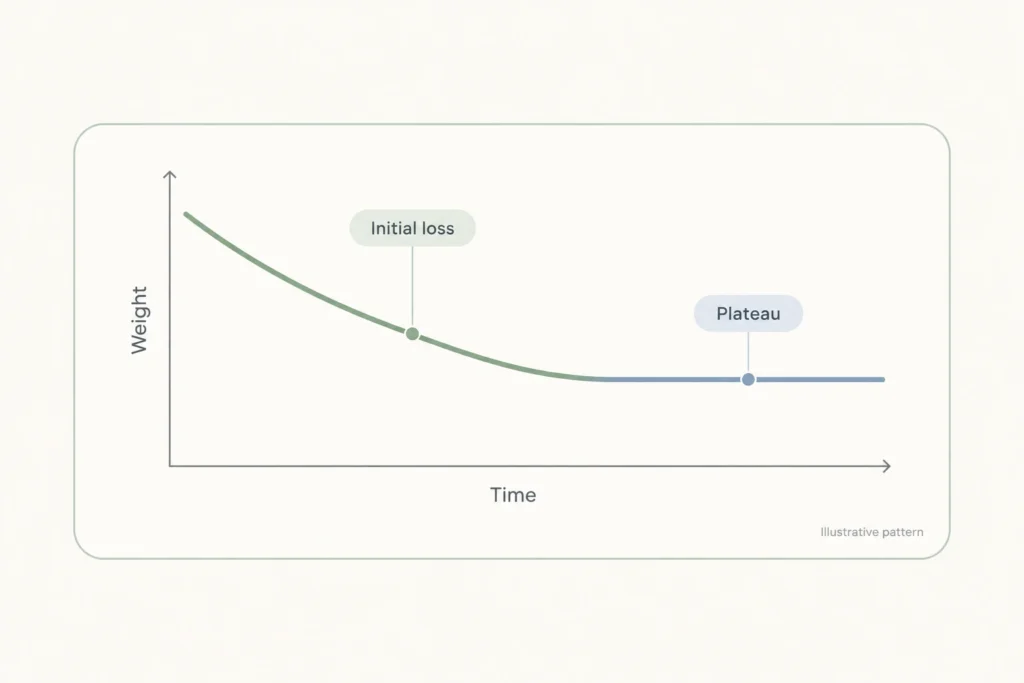
Supporting illustration for GLP-1 Plateau: Why Weight Loss Stalls and What to Do Next in a modern medical wellness setting

Frequently Asked Questions

A pause of two to four weeks with no change in weight is common and often resolves on its own once the body adjusts. A plateau lasting longer than six to eight weeks with no other explanation is worth reviewing with your prescriber.
No. It usually means your body’s energy needs have adjusted to your new weight, narrowing the deficit the medication and your habits were creating together. The medication is still active. The math around it has simply shifted.
Not automatically. A dose increase is one option, but it should follow a review of protein intake, strength training, and how long you’ve actually been at the current dose, since those factors often explain a plateau on their own.
No separate fee applies to a plateau review. It’s a standard part of ongoing supervision in a GLP-1 program at Body Works, a cash-pay clinic with payment plans and HSA and FSA eligibility.
Our Nolensville office at Burkitt Commons and our Franklin office on Murfreesboro Road both review stalled progress as part of routine GLP-1 follow-up visits, checking dose, technique, nutrition, and training together. Patients from Brentwood, Spring Hill, Cool Springs, and across Williamson County use whichever office is closer.

Medically reviewed by Dr. Donald Vollmer, MD
Managing Physician, Body Works TN

Browse Our Blog

See Body Works first in your Google results.

Add as a preferred source on Google