

Semaglutide in Nolensville, TN: Availability and How to Start
Searching for semaglutide in a town the size of Nolensville turns up a strange gap: national telehealth ads everywhere, but almost nothing about a real
If you are an active adult in your 40s or 50s, you have probably noticed that your ambition is still outrunning your body. The Saturday lifting session that used to cost you a day of soreness now lingers into the middle of the week. A tweaked shoulder that once healed in a long weekend hangs around for two months. This is exactly the gap that peptides for active adults are meant to address, and it is a real, measurable shift, not a motivation problem.
Peptides are short chains of amino acids that act as signaling molecules. Instead of supplying raw building blocks the way a protein shake does, they carry instructions: repair this tissue, release this hormone, calm this inflammation. As you age, your own production of several of these signals quietly drops off, which is part of why recovery slows. At Body Works, we look at peptide therapy as a way to restore that signaling under medical supervision, paired with honest expectations about what the science does and does not yet prove.
This guide walks through the peptides that runners, lifters, golfers, and weekend athletes ask about most, the difference between recovery support and the doping conversation, and why where you source these compounds matters more than almost anything else.
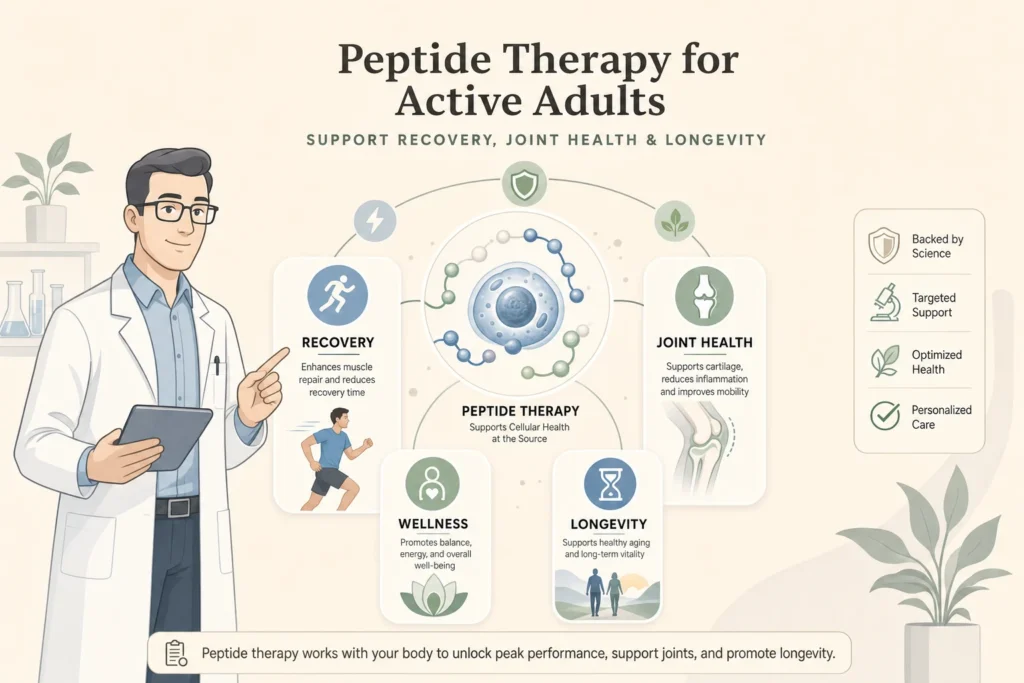
Peptides matter more after 40 because the body’s own signaling slows down right when the demands on it stay high. A peptide is a short chain of amino acids that binds to a specific receptor and triggers a natural pathway: tissue repair, growth hormone release, or metabolic regulation. Your body makes thousands of them. The catch is that several decline with age.
Growth hormone output is the clearest example. A 1997 review of growth hormone and the somatopause documented that growth hormone and IGF-1 levels fall in healthy older adults, contributing to less lean mass, more central fat, and slower recovery from injury. This age-related dip in signaling is why tissue that bounced back in your 20s now drags. Peptide therapy aims to nudge those depleted pathways back toward a more youthful baseline rather than overriding them with a synthetic hormone.
For active adults specifically, the appeal is targeted. Rather than treating a single symptom, the goal is to support the underlying repair and recovery machinery so that training, sleep, and joint health all improve together. That is the framing we use when patients ask where peptides fit into an already disciplined routine.
BPC-157 is the peptide active adults most often ask about for stubborn tendon, ligament, and soft-tissue complaints, and the preclinical signal is genuinely strong. BPC-157 is a synthesized fragment based on a protein found in gastric juice, and laboratory work points to tissue-protective and regenerative effects. A 2011 study in the Journal of Applied Physiology found that the peptide promoted tendon-cell outgrowth, improved cell survival under stress, and boosted tendon-cell migration, the cellular steps behind tendon repair.
Here is where honesty matters. Almost all of that evidence comes from animal and cell studies. A 2025 narrative review in Current Reviews in Musculoskeletal Medicine concluded that, despite strong preclinical results, only three small human pilot studies exist, and the authors recommend treating BPC-157 as investigational until well-designed clinical trials are done. That gap between mouse data and human trials is real, and any provider who glosses over it is not giving you the full picture.
What this means in practice: tendons and ligaments have notoriously poor blood supply, which is why they heal slowly, and the regenerative rationale for BPC-157 is biologically plausible. But plausible is not proven. We discuss BPC-157 as one option within a supervised plan, not a guaranteed fix, and we keep expectations grounded in what the trials show. You can read a deeper breakdown in our guide to BPC-157 and tissue repair.
Growth hormone peptides support recovery mainly by helping your body release its own growth hormone in natural pulses, much of which happens during deep sleep. Sermorelin, CJC-1295, and ipamorelin are growth hormone secretagogues: they prompt the pituitary to release growth hormone on its own schedule rather than flooding the system with synthetic hormone. A 2006 study in the Journal of Clinical Endocrinology and Metabolism showed that CJC-1295 produced sustained, dose-dependent increases in growth hormone and IGF-1 in healthy adults.
Ipamorelin is often paired with CJC-1295 because it is selective. The 1998 paper in the European Journal of Endocrinology that introduced ipamorelin found it triggers growth hormone release without the spikes in cortisol or appetite-driving hormones seen with older compounds. That selectivity is the reason it shows up in so many modern recovery protocols.
Sleep is the lever that ties this together. A 2000 study in JAMA tracked healthy men and found that deep slow-wave sleep dropped from roughly 19 percent of sleep in early adulthood to about 3 percent by midlife, and that decline ran in parallel with a major drop in growth hormone. Because growth hormone peptides work with your sleep architecture, better rest and better recovery tend to move together. We cover the mechanism more fully in our article on peptides and better sleep.
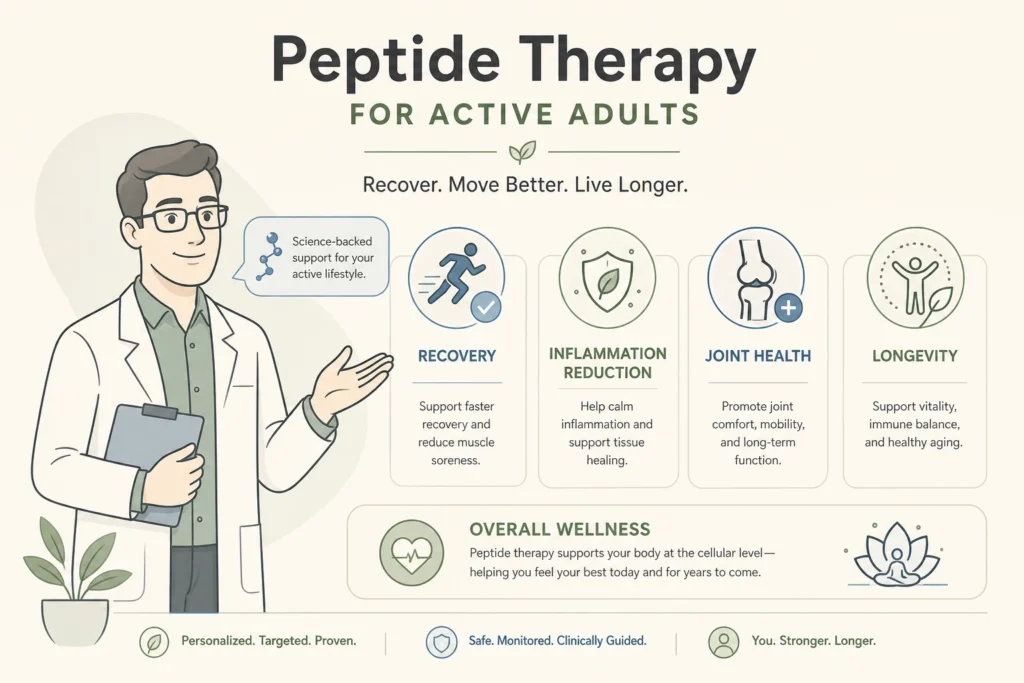
The recovery-focused peptides active adults ask about fall into two broad buckets: local tissue-repair signals and whole-body growth hormone signals. They are used for different problems, and the strength of the human evidence varies widely between them. The table below summarizes how they are typically discussed in a clinical setting, with the evidence caveats kept front and center.
| Peptide | Primary Role | Common Goal | Evidence Note |
|---|---|---|---|
| BPC-157 | Local tissue and soft-tissue support | Tendon, ligament, and joint recovery | Strong animal data; minimal human trials, investigational |
| CJC-1295 | Growth hormone secretagogue | Lean mass, recovery, deep sleep | Human pharmacology studied; long-term outcome data limited |
| Ipamorelin | Selective growth hormone secretagogue | Recovery without cortisol spikes | Selectivity established; often paired with CJC-1295 |
| Sermorelin | Growth hormone releasing hormone analog | Restoring natural GH pulses | Established GH-axis stimulation; individualized dosing |
No table replaces an evaluation. Which of these, if any, makes sense depends on your labs, your history, your training load, and your goals. That is the entire point of building a protocol with a clinician rather than ordering from the internet.
Physician supervision matters because the single biggest danger in the peptide world is not the peptides themselves; it is the unregulated supply chain. A large share of what is sold online is labeled “for research use only, not for human consumption,” which is a legal dodge that lets sellers skip the sterility, purity, and dosing standards that real medications require. These products can be contaminated, underdosed, or simply not what the label claims.
This is the dividing line between a wellness protocol and a gamble. The peptides used in a medical setting come from licensed compounding pharmacies that test for purity and sterility, and they are prescribed only after baseline lab work and a real conversation about your history. Supervision also means someone is watching for interactions, adjusting your dose, and tracking results over time instead of leaving you to guess.
There is one more reason supervision is not optional. Many of these compounds, including BPC-157 and the growth hormone secretagogues, sit on the World Anti-Doping Agency prohibited list. If you compete in a sanctioned sport, that matters enormously. For the broader population of active adults who simply want to recover and age well, the relevance is different, but it is a reminder that these are potent biological tools, not supplements.
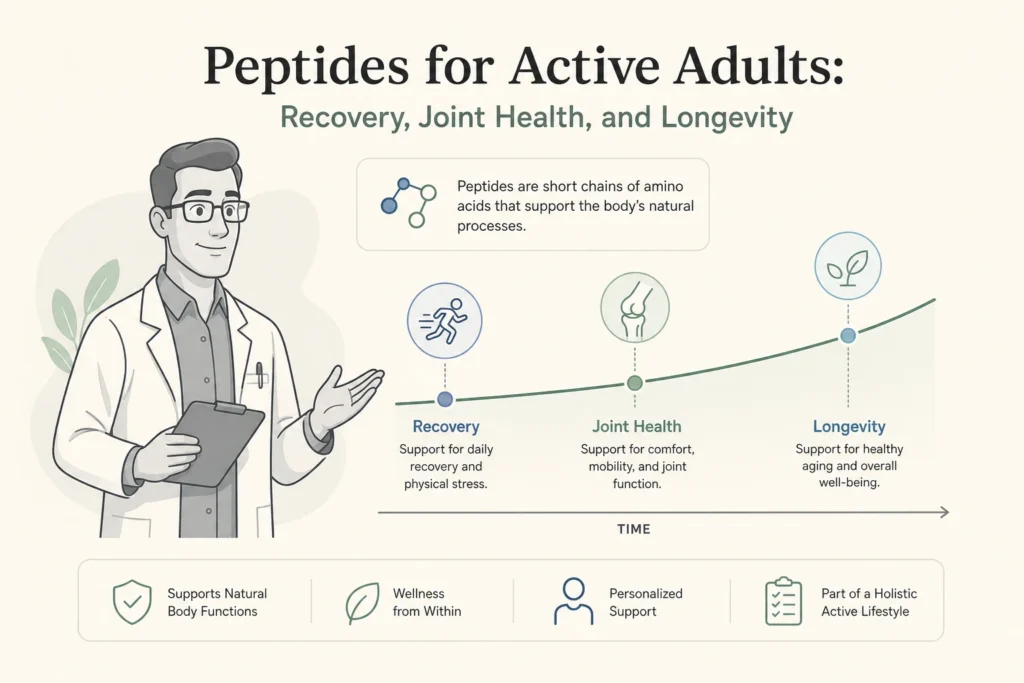
Peptide therapy works best as one part of a coordinated plan, not a standalone shortcut. At Body Works, our process starts with a conversation and baseline labs, because a protocol that ignores your hormones, your sleep, and your training load is a protocol built on guesswork. Whether you visit our Franklin, TN or Nolensville, TN office, the goal is the same: a supervised plan matched to your biology and your goals.
For many active adults, medically supervised peptide therapy pairs naturally with other tools. Hormone optimization through testosterone therapy for men often complements recovery goals, and our deeper look at testosterone explains why hormones and signaling peptides are best considered together. Targeted custom IV hydration can support the nutrient side of the equation. For the full picture, start with our complete guide to peptide therapy.
If nagging injuries keep sidelining you, or recovery just is not what it used to be, a supervised evaluation is the right next step. Our medical team serves active adults across Franklin and Nolensville, and we will walk you through what the evidence supports and what it does not. Schedule a Free Consultation to talk through your goals.
Medically reviewed by Dr. Donald Vollmer, MD
Managing Physician, Body Works TN
Searching for semaglutide in a town the size of Nolensville turns up a strange gap: national telehealth ads everywhere, but almost nothing about a real

If you have been researching semaglutide for weight loss, you have probably hit the same wall everyone else does: a telehealth app that ships a

The needle is the easy part. Most people who quit a GLP-1 medication early do not quit because of the injection itself, they quit because
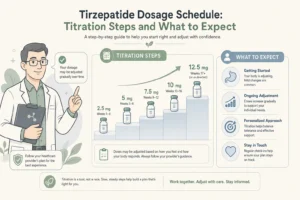
Patients starting tirzepatide often expect the first injection to feel like the start of real treatment. It isn’t. The 2.5 mg starting dose is a
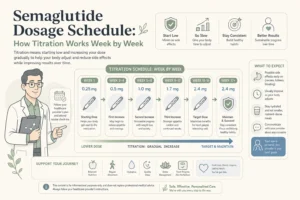
The dose on a semaglutide prescription rarely matches the dose a patient ends up taking, and that gap confuses people every week. Someone reads that
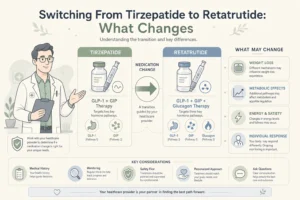
Switching from tirzepatide to retatrutide is a supervised medication change, not a milligram match. Retatrutide (GLP-3) adds the glucagon receptor and produced 24.2% weight loss
See Body Works first in your Google results.