

Semaglutide in Nolensville, TN: Availability and How to Start
Searching for semaglutide in a town the size of Nolensville turns up a strange gap: national telehealth ads everywhere, but almost nothing about a real
“Weeks to months.” That is the answer almost every peptide therapy provider hands a patient who asks how long it takes to feel something. It is technically correct, and completely useless. Anti-aging signals do not follow the same curve as recovery from a soft tissue injury. Sleep changes do not show up on the same schedule as body composition shifts. Different peptides, different goals, different timelines.
The honest peptide therapy results timeline depends on which peptide you are using and what specific outcome you are tracking. Some changes show up in the first two weeks. Some require the full cycle. Some only become obvious in retrospect when you stop. At Body Works in Franklin, TN and Nolensville, TN, we walk patients through realistic expectations by indication, not by vague hand-waving. Here is the breakdown by goal.
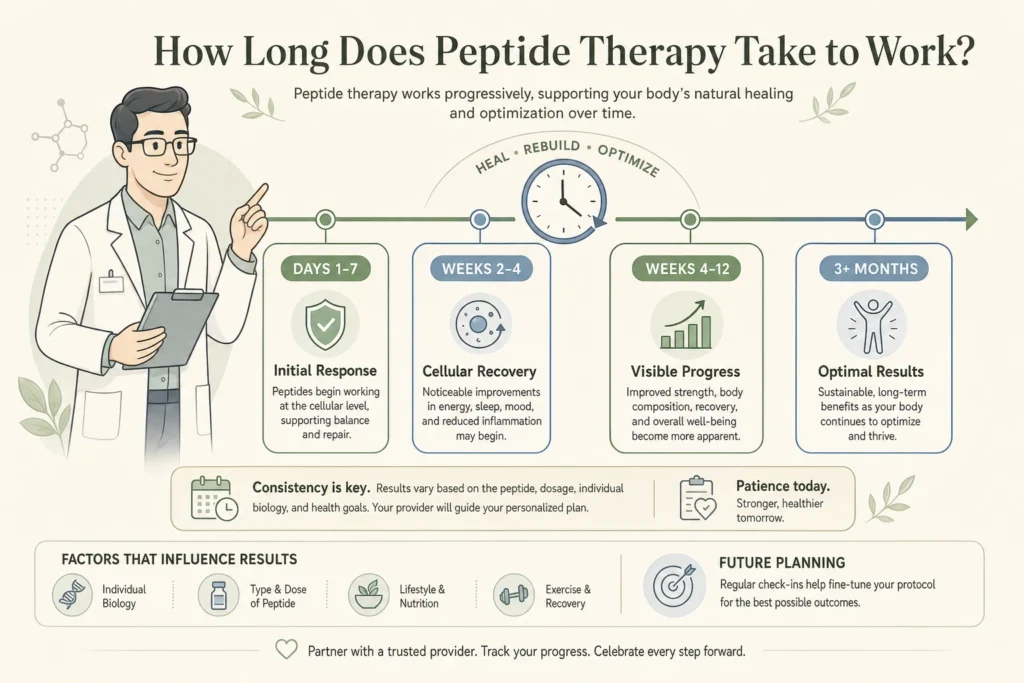
For most patients, the first measurable shift from a growth hormone releasing peptide stack lands in week 2 to week 4, usually in the form of sleep quality. The deeper structural changes, including body composition and recovery capacity, build over weeks 8 to 16. Tissue repair peptides like BPC-157 follow a faster curve at the injury site, with preclinical evidence of measurable changes within 10 to 14 days.
The reason for the spread is that peptides do not work like pain medication. They modulate signaling, and the downstream tissue and whole-body changes take time to express. A Teichman et al. study in the Journal of Clinical Endocrinology and Metabolism, 2006 showed that a single dose of CJC-1295 produced dose-dependent increases in growth hormone and 1.5 to 3 fold elevations in IGF-1 that lasted 9 to 11 days. The biochemical change is fast. The visible change takes the body weeks to translate into something you can see in the mirror or feel on a recovery day.
BPC-157 has the most concentrated timeline of any peptide currently in clinical use. Preclinical and limited human data suggest tendon, ligament, and gut tissue repair signals begin within the first 2 weeks of consistent dosing, with peak structural changes documented at the 3 to 4 week mark in animal models.
The mechanism is angiogenesis and growth factor upregulation, which the body uses to reorganize collagen and rebuild damaged tissue. A review by Seiwerth et al., Current Pharmaceutical Design, 2018, “BPC 157 and Standard Angiogenic Growth Factors” documents that BPC-157 was consistently effective across acute and chronic injury models for tendon, ligament, muscle, and bone healing, with the biggest effect window in the first 4 to 8 weeks after injury. Remodeling continues for 3 to 6 months regardless of intervention, but the peptide’s primary contribution is front-loaded. Patients with chronic injuries who have plateaued in physical therapy sometimes report the most dramatic subjective shift, often within the first cycle. The 2026 FDA regulatory status of BPC-157 is covered in our April 2026 peptide compounding update.
Sleep is usually the first signal patients notice on a growth hormone releasing peptide stack. The reason is biological: roughly 70 percent of daily growth hormone secretion in adult men occurs during sleep, with the largest pulse arriving within minutes of the first slow wave sleep episode. Peptides that potentiate that pulse make the sleep itself feel different.
Patients on a CJC-1295 and ipamorelin protocol commonly report deeper, less fragmented sleep within 2 to 4 weeks. The link between sleep onset and nocturnal growth hormone release was established decades ago by Born et al., Psychoneuroendocrinology, 1988, which demonstrated that sleep onset and slow wave sleep are tightly coupled to growth hormone secretion. Recovery from training sessions, joint stiffness on waking, and morning energy tend to shift in the same window. None of this requires a year of treatment to evaluate. If a patient hits week 6 on a properly dosed protocol with zero perceived sleep change, that is a clinical signal worth discussing, not a reason to wait and hope.
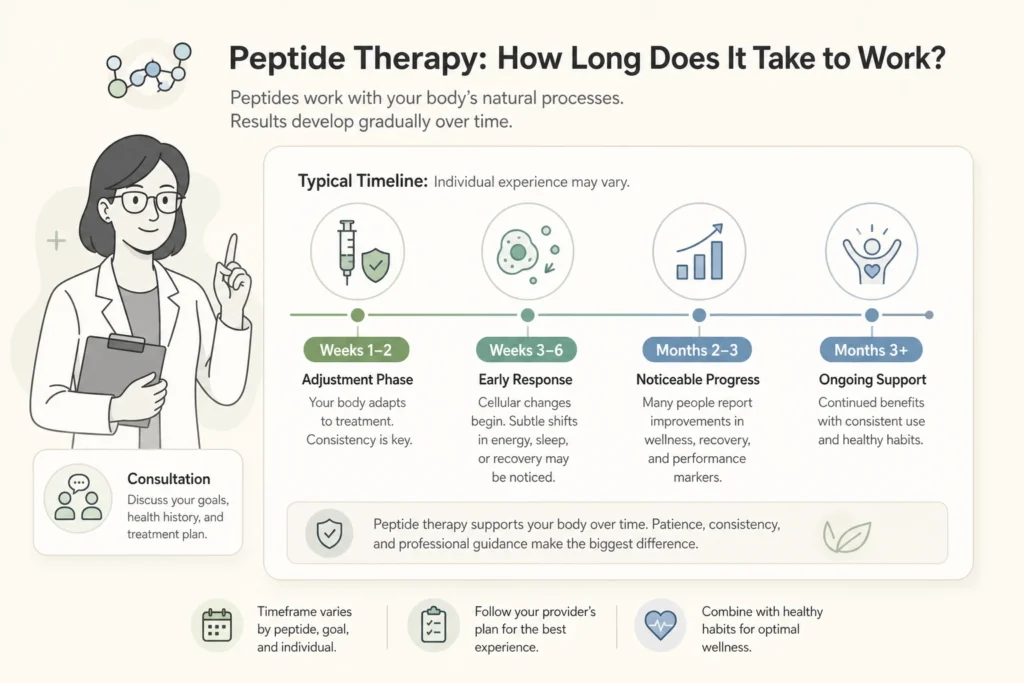
Body composition is the slowest peptide therapy outcome to measure, and the one patients most often misjudge. Visible changes in lean mass, abdominal adipose tissue, and skin tone generally require 8 to 16 weeks of consistent dosing combined with the strength training and nutrition habits that actually drive composition shifts.
The biological reason is that growth hormone releasing peptides nudge the IGF-1 axis, which in turn supports protein synthesis, lipolysis, and connective tissue turnover. Those processes operate on a tissue-remodeling timeline, not a drug-response timeline. The Molitch et al. Endocrine Society Clinical Practice Guideline, JCEM 2011 confirms that growth hormone therapy in documented adult deficiency produces measurable benefits in body composition, and in practice those shifts accrue over several months of consistent treatment rather than weeks. Patients who expect a 4 week visible transformation are setting themselves up to abandon a working protocol. Patients who commit to a full 12 to 16 week cycle, paired with resistance training and adequate protein, generally see what they came for. When fat loss is the goal, peptides usually run alongside a medical weight loss program, not on their own. For new patients, our guide on what to expect at your first peptide therapy appointment sets expectations from day one.
Anti-aging is the hardest timeline to give a clean number for, because the outcome is the absence of decline rather than a positive shift you can measure on a scale. Subjective markers like energy stability, skin elasticity, and exercise tolerance usually shift somewhere between week 6 and week 12. Objective markers like IGF-1 levels generally rise within 4 to 12 weeks of starting a sermorelin or CJC-1295 protocol.
An editorial by Walker, Clinical Interventions in Aging, 2006 framed sermorelin as a more physiologic alternative to direct growth hormone replacement for aging adults, because it stimulates the body’s own pulsatile growth hormone release rather than overriding it. That gradual, feedback-regulated mechanism is consistent with the slow-building effect we see clinically. Patients hunting for a dramatic week-2 transformation will be disappointed. Patients who treat anti-aging peptides as a 6 to 12 month commitment, with bloodwork checkpoints at weeks 6, 12, and 24, usually see the cumulative effect they were after. The pillar covers the full mechanism in our complete guide to peptide therapy, and our plain-English peptide primer is the simpler starting point for anyone newer to the category.
The same peptide protocol can produce very different timelines across two patients. Several variables drive that spread, and most of them are within the patient’s control.
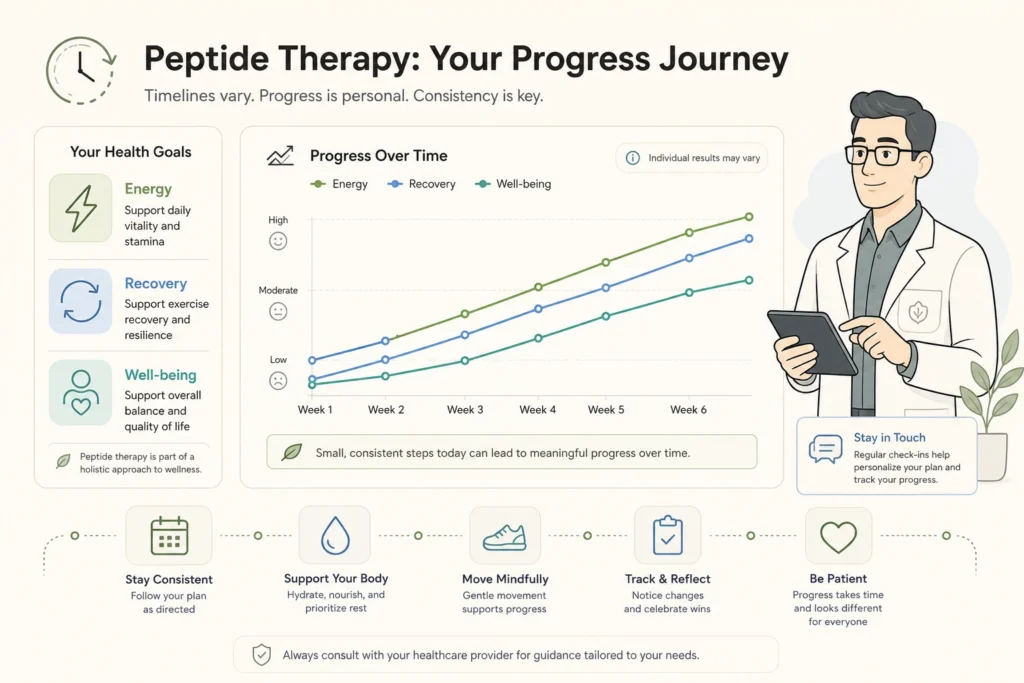
A well-run protocol is built around your stated goal and the bloodwork that drops on the front end. The standard cadence schedules a follow-up at week 6 to check subjective response and adjust dosing if indicated, and another at week 12 for IGF-1 and other relevant labs. That schedule matches the biological timelines documented in the literature, not a sales calendar.
If a patient is six weeks into a protocol and the expected signal is not showing up, the response is not “give it another two months and hope.” It is to look at sleep hygiene, training load, nutrition, injection consistency, and whether the dose itself needs revisiting. Physician-supervised peptide therapy at Body Works is built around that feedback loop.
If you are weighing peptide therapy and want to know what a realistic timeline looks like for your specific goal, the safest first step is a physician-led conversation. Schedule a Free Consultation at the Franklin or Nolensville location. Call the Franklin office at (615) 790-2548 or the Nolensville office at (615) 941-1000.
Peptide therapy is available at both the peptide therapy clinic in Franklin and in Nolensville.
Medically reviewed by Dr. Donald Vollmer, MD
Managing Physician, Body Works TN
Searching for semaglutide in a town the size of Nolensville turns up a strange gap: national telehealth ads everywhere, but almost nothing about a real

If you have been researching semaglutide for weight loss, you have probably hit the same wall everyone else does: a telehealth app that ships a

The needle is the easy part. Most people who quit a GLP-1 medication early do not quit because of the injection itself, they quit because
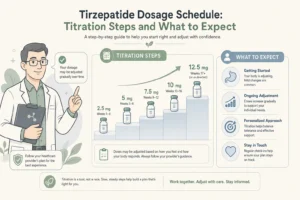
Patients starting tirzepatide often expect the first injection to feel like the start of real treatment. It isn’t. The 2.5 mg starting dose is a
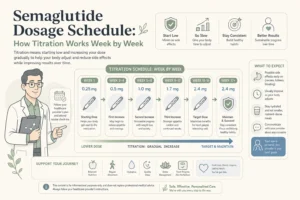
The dose on a semaglutide prescription rarely matches the dose a patient ends up taking, and that gap confuses people every week. Someone reads that
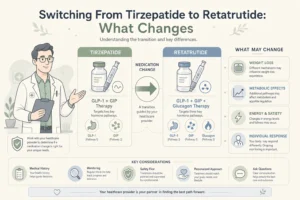
Switching from tirzepatide to retatrutide is a supervised medication change, not a milligram match. Retatrutide (GLP-3) adds the glucagon receptor and produced 24.2% weight loss
See Body Works first in your Google results.