

Semaglutide in Nolensville, TN: Availability and How to Start
Searching for semaglutide in a town the size of Nolensville turns up a strange gap: national telehealth ads everywhere, but almost nothing about a real
The dose on a semaglutide prescription rarely matches the dose a patient ends up taking, and that gap confuses people every week. Someone reads that the standard maintenance dose for chronic weight management is 2.4 mg, does the math on how fast they expect results, and then gets handed a pen loaded with roughly a tenth of that amount for the first injection.
Semaglutide starts at 0.25 mg once weekly and reaches the 2.4 mg maintenance dose over about sixteen weeks, climbing through four fixed steps roughly a month apart. The low starting dose isn’t a smaller version of treatment. It’s the same treatment on a schedule built to let the digestive system adjust before the medication does its full job. Body Works providers in Franklin, TN and Nolensville, TN set that schedule at the first visit and then move it around how each patient actually tolerates it, not a fixed calendar.
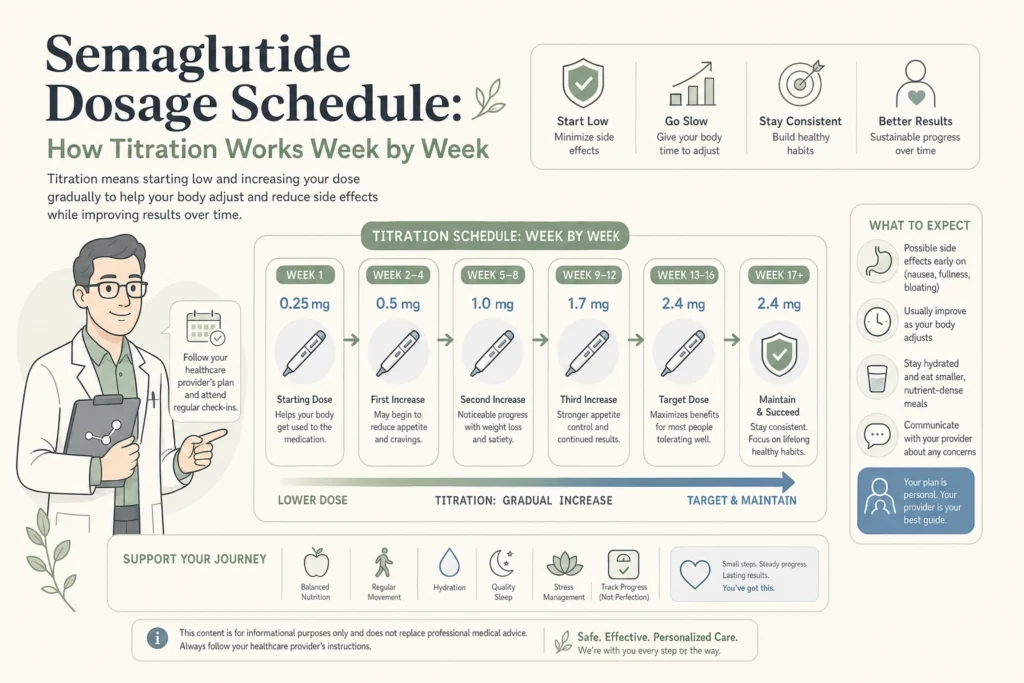
The FDA-approved label for semaglutide’s weight management indication lays out five dose levels, each held for four weeks before the next increase, unless a prescriber decides more time is needed. That structure is deliberate: the dose that treats obesity long-term is more than nine times the starting dose, and reaching it in one step would make the early gastrointestinal side effects far worse for most patients.
| Step | Weeks | Dose | Purpose |
|---|---|---|---|
| 1 | 1 to 4 | 0.25 mg weekly | Initiation, not intended for a weight-loss effect |
| 2 | 5 to 8 | 0.5 mg weekly | First increase |
| 3 | 9 to 12 | 1 mg weekly | Mid-range step |
| 4 | 13 to 16 | 1.7 mg weekly | Pre-maintenance step |
| 5 | 17 onward | 2.4 mg weekly | Standard maintenance dose |
These numbers come from the FDA-approved prescribing information for semaglutide. A prescriber sets and adjusts the actual schedule for each patient based on tolerability, response, and medical history, so the table describes the labeled default, not a guarantee of your own timeline.
Semaglutide’s most common side effects, nausea, constipation, and diarrhea, are dose related, so a slow climb spreads the adjustment period over months instead of concentrating it in the first week. In the STEP 1 trial published in the New England Journal of Medicine, participants who titrated on this same four-week schedule lost an average of 14.9% of body weight at 68 weeks with a discontinuation rate for gastrointestinal events under 5%.
The mechanism behind the side effects is the same mechanism behind the results: semaglutide slows stomach emptying and quiets appetite signals, and a body adjusting to that gradually tolerates it better than one hit with the full dose at once. Four weeks is roughly how long it takes the gut to adapt to a given dose level before the next step raises the bar again.

Staying at a dose for an extra four weeks, or longer, is following the label, not falling behind it. The prescribing information allows a prescriber to hold a patient at any step until side effects are manageable before increasing again, and there is no penalty for taking five or six months to reach maintenance instead of four.
This flexibility matters most in the first two dose levels, where most of the early nausea and appetite change happens. A patient who needs two months at 0.5 mg instead of one isn’t behind. They’re being titrated correctly for their body. What is and is not typical to feel at each step, and which symptoms warrant a same-day call instead of patience, is covered in our guide to GLP-1 side effects by week.

Both medications use a four-week step-up pattern, but tirzepatide’s ceiling is higher and its first month is a true lead-in dose rather than a therapeutic one. Semaglutide moves through five doses from 0.25 mg to 2.4 mg. The FDA-approved prescribing information for tirzepatide starts patients at a 2.5 mg dose not intended to produce weight loss on its own, then allows increases in 2.5 mg increments to a maximum of 15 mg, with each step spaced at least four weeks apart.
Neither schedule is faster in absolute terms since both give patients roughly four months to reach a standard maintenance dose, but tirzepatide’s dual GLP-1/GIP mechanism produced larger average weight loss at its top dose in trials, 22.5% of body weight at 72 weeks in the SURMOUNT-1 trial published in the New England Journal of Medicine, compared with semaglutide’s 14.9% at 68 weeks in STEP 1. That gap is why some patients who plateau on semaglutide’s maintenance dose ask about switching rather than simply waiting longer at 2.4 mg. The two drugs are titrated for the same underlying reason, tolerability, even though they are not interchangeable milligram for milligram, and the full step-by-step tirzepatide breakdown is in our tirzepatide dosage schedule guide. Both medications are available through semaglutide therapy and tirzepatide therapy at Body Works.
Most patients feel the strongest appetite and digestive effects in the first week after each dose increase, then notice them settle before the next step. According to the semaglutide injection instructions published by MedlinePlus, the medication should be injected on the same day each week in the upper arm, thigh, or stomach area, rotating the site with every dose to reduce irritation at any one spot.
Appetite reduction is usually the first thing patients notice, often within the first two weeks, well before the scale reflects much change. Weight loss then tends to accelerate as the dose climbs through the middle steps. For a realistic week-by-week and month-by-month picture of when results actually show up, see our semaglutide results timeline. Injection technique itself, including site rotation and what to do about a missed dose, is covered in how to inject semaglutide and tirzepatide.
Since 2022, Body Works providers in Franklin and Nolensville have built semaglutide titration schedules around the patient in front of them rather than a printed chart, adjusting pace when nausea runs longer than expected or holding a dose when lab work suggests waiting. That’s the part of the FDA label a chart can’t show: which of the five steps needs to move slower for a specific person, and how to tell the difference between an expected adjustment and a symptom that needs medical attention.
Once semaglutide reaches its maintenance dose, most patients stay there for the rest of active treatment, occasionally stepping back down if side effects reappear. Our guide to GLP-1 microdosing and maintenance covers what changes after titration ends.
Whether you are about to start semaglutide or you are partway through titration and want a second opinion on your pace, our physician-supervised teams in Franklin and Nolensville build the schedule around your labs, your history, and how your body is actually responding. Schedule a Free Consultation to get started.

Medically reviewed by Dr. Donald Vollmer, MD
Managing Physician, Body Works TN
Searching for semaglutide in a town the size of Nolensville turns up a strange gap: national telehealth ads everywhere, but almost nothing about a real

If you have been researching semaglutide for weight loss, you have probably hit the same wall everyone else does: a telehealth app that ships a

The needle is the easy part. Most people who quit a GLP-1 medication early do not quit because of the injection itself, they quit because

Patients starting tirzepatide often expect the first injection to feel like the start of real treatment. It isn’t. The 2.5 mg starting dose is a
Switching from tirzepatide to retatrutide is a supervised medication change, not a milligram match. Retatrutide (GLP-3) adds the glucagon receptor and produced 24.2% weight loss

You can lower your odds of the gaunt, sunken look people call Ozempic face. Here is how pacing, protein, muscle, and skin care protect your
See Body Works first in your Google results.