
Testosterone Replacement Therapy in Franklin and Nolensville: What Physician-Supervised Treatment Looks Like

Testosterone Replacement Therapy in Franklin and Nolensville: What Physician-Supervised Treatment Looks Like

October 14, 2026

A lot of what passes for testosterone replacement therapy in Franklin, TN and nationwide in 2026 is a questionnaire, a card swipe, and a prescription mailed to your door, no exam, no repeat labs, no provider who’s actually looked at your bloodwork twice. That model exists because it’s fast and it’s cheap to run. It also means nobody’s watching your hematocrit, nobody’s asking whether your symptoms actually match a hormonal cause, and nobody’s adjusting your dose based on how you’re actually responding.

Physician-supervised TRT looks different, and slower, on purpose. At Body Works, treatment for men in Franklin, TN and Nolensville, TN starts with a real diagnostic workup and stays supervised through every dose adjustment after that. Here’s what that process actually looks like, start to finish.

Illustration of Testosterone Replacement Therapy in Franklin and Nolensville: What Physician-Supervised Treatment Looks Like in a modern medical wellness setting

What Happens at the First TRT Consultation?

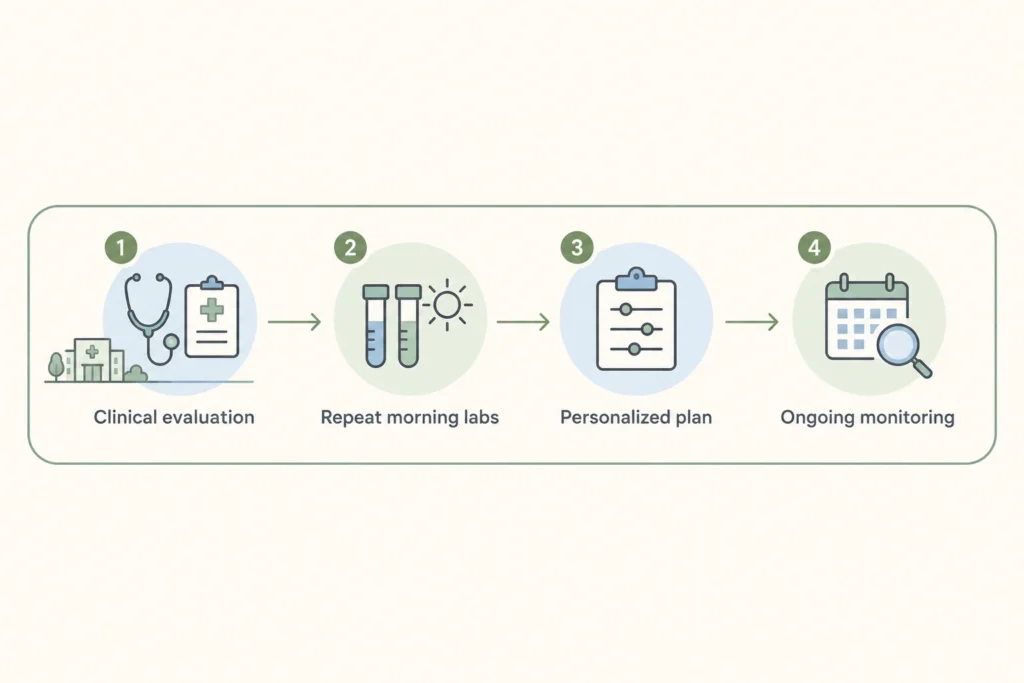
The first visit is a conversation before it’s a blood draw. A provider reviews your symptoms against the pattern clinicians actually screen for, since fatigue, low libido, and mood changes overlap with a dozen other conditions and testosterone testing without a symptom match rarely changes anything useful. The low testosterone symptoms checklist covers the specific pattern that pattern-matches to a hormonal cause versus a lifestyle one.

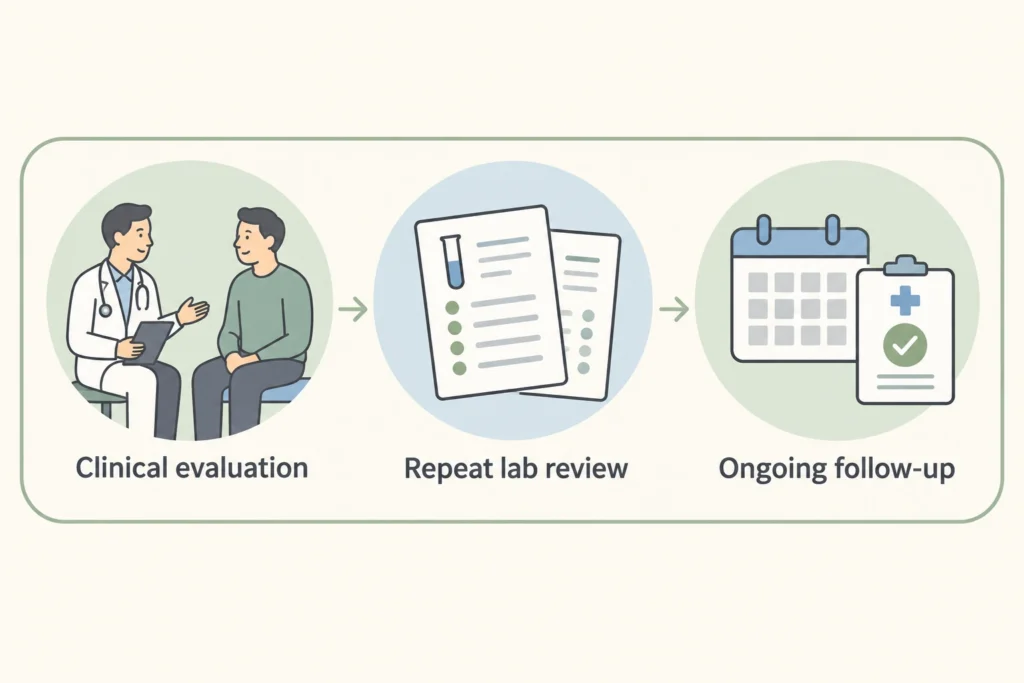
If your symptoms and history support testing, labs come next, timed correctly. The Endocrine Society’s clinical practice guideline on testosterone therapy calls for a fasting morning draw, confirmed by a second separate measurement, before any diagnosis is made. That two-draw standard is the default at Body Works, not an upsell; a single afternoon test is exactly the kind of shortcut that produces a wrong answer in either direction.

How Is a TRT Diagnosis Actually Confirmed?

Diagnosis requires both a confirmed low testosterone level and a symptom pattern that matches it, not one or the other. Testosterone levels by age covers why a single “normal” lab result doesn’t always settle the question, particularly for men whose number sits near a lab’s cutoff or whose free testosterone tells a different story than their total testosterone.

Depending on what the labs show, the diagnosis also determines the treatment options on the table. Men with a healthy testicular signal but low pituitary drive sometimes have a genuine alternative to direct testosterone replacement. Enclomiphene vs. TRT walks through that decision for men where fertility is part of the conversation.

What Does a TRT Protocol Include?

Once a diagnosis is confirmed and treatment is the right call, the protocol covers medication, dose, delivery method, and a monitoring schedule built in from day one, not added later if something goes wrong. The Mayo Clinic’s overview of testosterone therapy notes that delivery options include injections, gels, and pellets, each with different dosing rhythms and different tradeoffs a provider should walk through based on your lifestyle and lab response, not a one-size default.

Baseline hematocrit and estradiol are drawn before the first dose, with a recheck built into the calendar at three to six months and annually after that. TRT side effects and how they’re managed covers exactly what that monitoring catches and what happens if a number runs outside the expected range.
Supporting illustration for Testosterone Replacement Therapy in Franklin and Nolensville: What Physician-Supervised Treatment Looks Like in a modern medical wellness setting

What Should I Expect in the First Few Months?

Results don’t arrive on day one. Most men notice little change in the first two weeks, a real lift in mood, libido, and energy by four to eight weeks, and measurable changes in strength and body composition around the three-month mark, once levels have stabilized and tissue has had time to respond. The full TRT results timeline breaks down what changes at each checkpoint so you know what’s expected and what’s worth flagging to your provider.

Recent regulatory changes are also worth knowing before you start. Testosterone products carried a boxed cardiovascular warning for years; the FDA removed that warning in February 2025 based on large-scale trial data showing no increase in major cardiac events, while adding a new blood pressure warning across the product class. A physician-supervised protocol accounts for both the updated safety picture and the individual monitoring that still matters.

Why Physician Supervision Matters for TRT

A prescription is not the hard part of testosterone therapy. Getting the diagnosis right, catching a hematocrit or estradiol trend before it becomes a problem, and adjusting a protocol based on how an individual man actually responds, that’s the part a ten-minute online intake form cannot do. The Cleveland Clinic’s overview of testosterone replacement therapy describes ongoing lab monitoring and dose adjustment as a routine, expected part of treatment, which only works if a provider is actually reviewing results and adjusting course rather than auto-refilling the same dose indefinitely.

This is also where a diagnostic threshold question matters. Specialty guidelines don’t fully agree on where the biochemical cutoff for low testosterone sits; the American Association of Clinical Endocrinologists’ guideline on hypogonadism in adult men has historically used a different threshold than some other specialty frameworks, which means the same lab number can read differently depending on which guideline a provider follows. Working with a provider who treats the lab value and the symptom pattern together, rather than a number in isolation, is what keeps a diagnosis from becoming a guess.

None of this requires a man to become an expert in endocrinology before his first visit. It’s the reason physician supervision exists in the first place: someone trained to weigh these frameworks against your specific labs and symptoms, rather than applying a single fixed cutoff to every man who walks in the door.

Supporting illustration for Testosterone Replacement Therapy in Franklin and Nolensville: What Physician-Supervised Treatment Looks Like in a modern medical wellness setting

Testosterone Replacement Therapy in Franklin, TN

Body Works’ Franklin location, at 1113 Murfreesboro Rd Suite 307, Franklin, TN 37064, offers the same physician-supervised process described above: symptom review, confirmed diagnostic labs, a tailored protocol, and ongoing monitoring. Learn more about TRT at the Franklin location or call (615) 790-2548 to ask questions before booking.

TRT in Nolensville, TN

Body Works’ Nolensville location, at 210 Burkitt Commons Ave, Nolensville, TN 37135, runs the identical diagnostic and monitoring process for men closer to that side of Williamson County. Learn more about TRT at the Nolensville location or call (615) 941-1000 with questions ahead of your visit.
Supporting illustration for Testosterone Replacement Therapy in Franklin and Nolensville: What Physician-Supervised Treatment Looks Like in a modern medical wellness setting

What to Bring to Your First Visit

Bring any recent lab results, even if they’re from an urgent care visit or a previous provider, along with a specific list of symptoms and how long each has been present. If you’re weighing TRT against a fertility-preserving alternative, come with that priority named upfront, since it changes which labs get ordered on day one rather than after a diagnosis is already set. A current medication list and a rough timeline of when symptoms started are also worth having ready; both shape how a provider reads your first set of labs.

If you’ve already had testosterone checked elsewhere and were told your number was “normal,” bring that result anyway rather than assuming it settles the question. A single number without a repeat draw, without a free testosterone check, and without a symptom conversation attached to it is often an incomplete answer rather than a final one.

Men working with Body Works’ hormone therapy program in Franklin and Nolensville get the same physician-supervised standard regardless of which location is more convenient: confirmed labs before treatment, a real monitoring schedule after it, and a provider who reviews results rather than auto-renewing a prescription.

Schedule a Free Consultation at either location to start with a real conversation, not a questionnaire.

Frequently Asked Questions

No referral is required. A consultation and, if appropriate, diagnostic labs are the starting point for any man considering testosterone therapy.
Confirming a diagnosis typically takes two visits, since guidelines call for a second, separate morning lab draw before treatment starts. This protects against basing treatment on a single unreliable result.
Yes. Both locations offer the same physician-supervised diagnostic and treatment process, so the choice between them typically comes down to which is more convenient for you.
TRT replaces testosterone directly, while enclomiphene stimulates your body to produce more of its own. Which one fits depends on the type of hypogonadism you have and whether preserving fertility is a priority; the full comparison covers both options in detail.
Cost depends on the labs ordered, the protocol chosen, and ongoing monitoring. Body Works is a cash-pay practice, and a free consultation is the fastest way to get exact pricing for your specific situation before anything is prescribed.
The Franklin office is at 1113 Murfreesboro Rd Suite 307, Franklin, TN 37064, reachable at (615) 790-2548. The Nolensville office is at 210 Burkitt Commons Ave, Nolensville, TN 37135, reachable at (615) 941-1000.

Medically reviewed by Dr. Donald Vollmer, MD
Managing Physician, Body Works TN

Browse Our Blog

GLP-1 Side Effects by Week: What Is Normal, What Passes, What to Report

GLP-1 Side Effects by Week: What Is Normal, What Passes, What to Report

October 12, 2026

A symptom that is completely normal in week two can be a reason to call your prescriber in week fourteen. Nausea right after a dose increase is expected. The same nausea, unchanged, six weeks after your last increase is not, and treating every GLP-1 side effect as equally routine is how patients miss the ones that actually need attention.

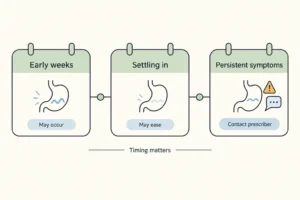
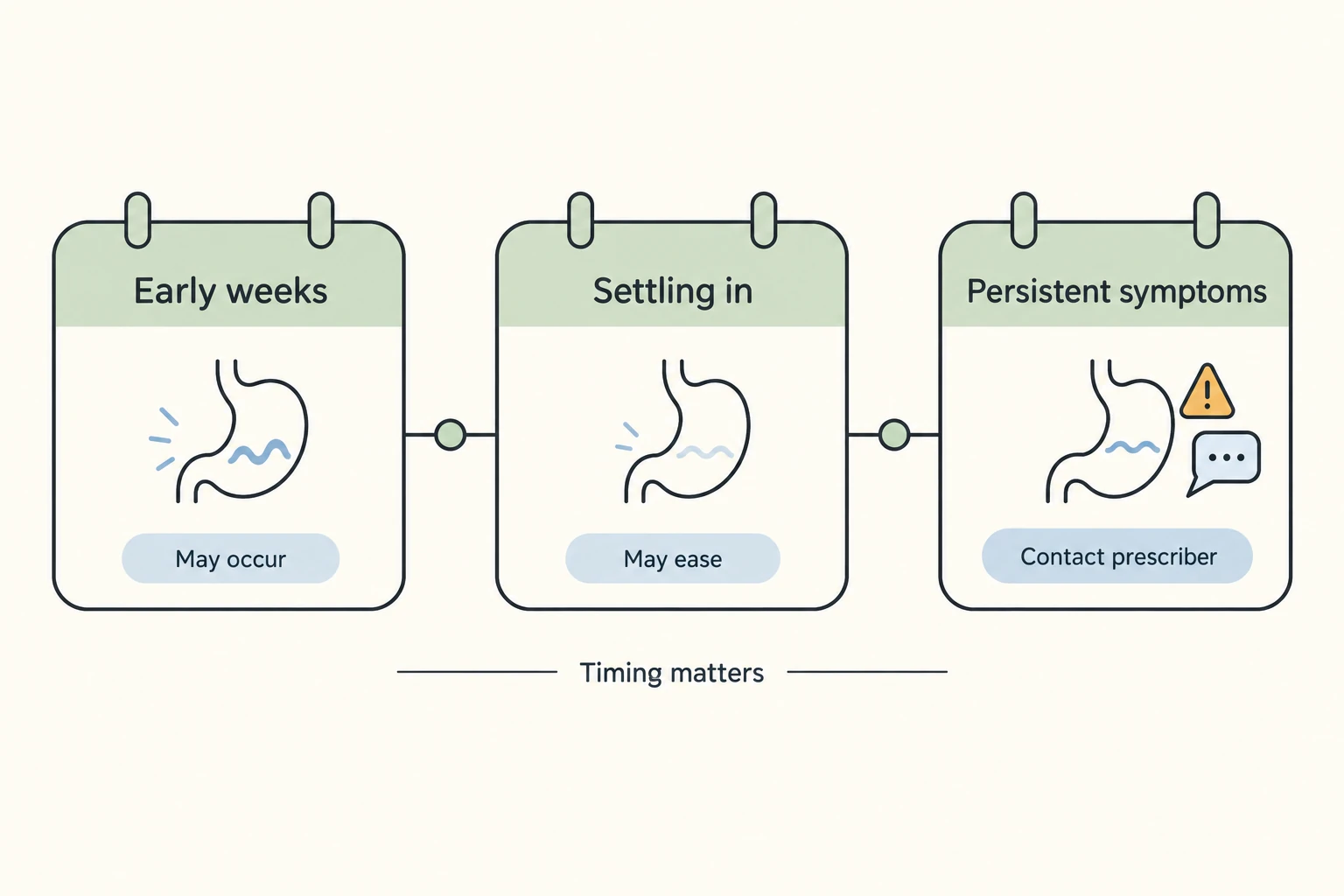
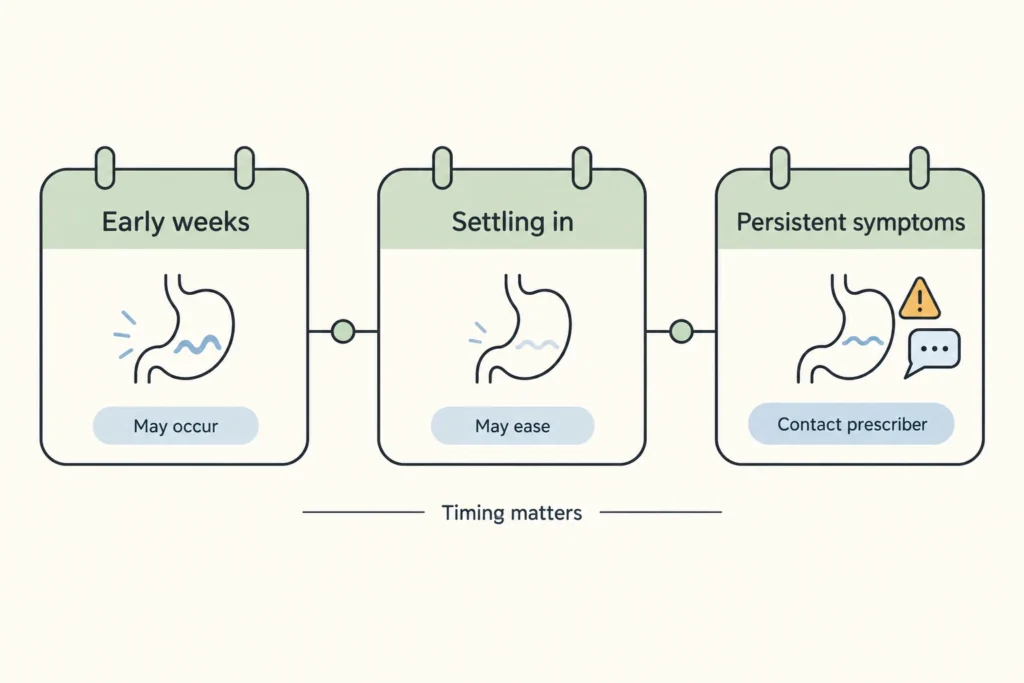
GLP-1 side effects follow the dose, not the calendar: they cluster in the days after each increase, fade before the next one, and mean something different depending on where you are in titration. Semaglutide, tirzepatide, and retatrutide all share this pattern even though their exact rates differ. Body Works physicians in Franklin, TN and Nolensville, TN use that pattern, not just the symptom itself, to tell routine from concerning.

Illustration of GLP-1 Side Effects by Week: What Is Normal, What Passes, What to Report in a modern medical wellness setting

What Is Normal in the First Four Weeks?

Mild nausea, reduced appetite, and occasional loose stool are the most common early effects, and they usually show up within the first few days of the starting dose. The FDA-approved semaglutide label reports nausea in 44% of patients during the trial period, most heavily concentrated in the early weeks, against 16% on placebo.

These effects exist because the medication is intentionally slowing digestion and quieting appetite signals, the mechanism doing exactly what it’s supposed to do. Most patients notice symptoms easing within a week of a dose increase, well before the next one arrives a month later. Full details on what to expect at this stage, and how the schedule is built to minimize it, are in our semaglutide dosage schedule guide.

What Changes During Weeks 5 Through 16?

Each dose increase brings a brief return of symptoms, usually milder than the first time, followed by another period of adjustment. Constipation tends to become more prominent in this window as appetite and food volume drop further, appearing in 24% of semaglutide patients per the FDA label, and in 11% to 17% of tirzepatide patients depending on dose according to its own FDA-approved prescribing information.

This is also when patients most often ask whether something is wrong because a side effect they’d stopped noticing came back. A returning symptom right after a scheduled dose increase is expected and typically settles within a week or two. The same symptom appearing with no dose change behind it is the pattern that deserves a closer look, covered in the red-flag section below.

Do Semaglutide Side Effects Differ From Tirzepatide's?

Yes, modestly. Semaglutide side effects run somewhat higher for nausea, 44% versus 25% to 29% for tirzepatide depending on dose, while tirzepatide’s dual GLP-1/GIP mechanism produces a comparable or lower gastrointestinal burden at equivalent points in titration. In the STEP 1 trial published in the New England Journal of Medicine, gastrointestinal events were the most common reason for discontinuation, at under 5% of participants. The SURMOUNT-1 trial reported a similarly low discontinuation rate for tirzepatide.

Neither medication’s side-effect profile predicts how well it will work for a given patient. Some people tolerate semaglutide with almost no symptoms and struggle more with tirzepatide, and the reverse happens just as often. Our tirzepatide dosage schedule guide covers what to expect at each of its six possible dose steps.

Supporting illustration for GLP-1 Side Effects by Week: What Is Normal, What Passes, What to Report in a modern medical wellness setting

What About Retatrutide Side Effects?

Retatrutide’s side-effect pattern looks similar to the other two but is documented in trial data only, since it does not yet have an FDA label. In its phase 2 trial published in the New England Journal of Medicine, gastrointestinal events were the most common adverse effect and were clearly dose related, with a lower starting dose reducing their frequency, the same titration logic that governs semaglutide and tirzepatide.

Because retatrutide is a triple agonist acting on GLP-1, GIP, and glucagon receptors, sometimes nicknamed “GLP-3,” its side-effect profile is being watched closely as more patients start it. The pattern so far tracks the same week-by-week logic as the other two medications rather than introducing anything new.

Supporting illustration for GLP-1 Side Effects by Week: What Is Normal, What Passes, What to Report in a modern medical wellness setting

Do Side Effects Change Once You Reach a Maintenance Dose?

Yes, for most patients they drop off sharply once titration ends. The bulk of GLP-1 side effects cluster around the weeks immediately following an increase, so once you stop climbing and settle into a maintenance dose, the body has no new adjustment to make and most gastrointestinal symptoms fade to occasional rather than routine.

What tends to persist longer term is less about the medication’s direct action and more about lifestyle habits that interact with it. Alcohol is a common one patients ask about after they’ve been stable for a few months, since drinking on an empty, slower-emptying stomach can intensify nausea or lower blood sugar in ways that feel different from before starting treatment. Our guide to alcohol and GLP-1 medications covers what actually changes and how to handle it.

Supporting illustration for GLP-1 Side Effects by Week: What Is Normal, What Passes, What to Report in a modern medical wellness setting

What Symptoms Mean You Should Call Your Provider the Same Day?

Severe or persistent abdominal pain, an inability to keep fluids down for more than a day, yellowing of the skin or eyes, or a rapid heartbeat with dizziness are not routine GLP-1 side effects at any week of treatment, whether you are in your first month or your twelfth. Both FDA labels carry warnings for acute pancreatitis and gallbladder disease, and the tirzepatide label separately warns that acute kidney injury has occurred, most often in patients already vomiting or having diarrhea and unable to stay hydrated.

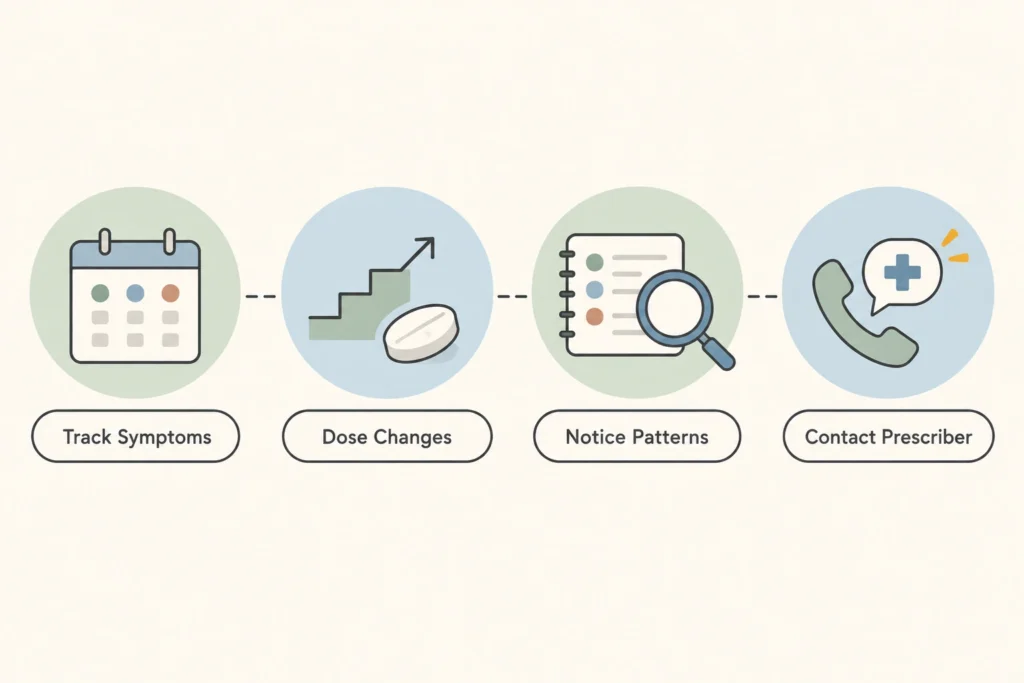
These symptoms warrant a same-day call regardless of how far along you are in titration or how mild your previous side effects have been. A dose increase does not raise the risk of these specific complications in a way that makes them more “expected” later in treatment, and waiting to see if they pass on their own is the wrong instinct for this particular list of symptoms, even for a patient who has otherwise tolerated the medication well for months. If nausea specifically is what’s driving concern, our guide to GLP-1 nausea and stomach side effects covers the full timeline, and constipation is addressed in our fiber and protein guide. Hair thinning, a later and less discussed effect, is covered separately in GLP-1 hair loss.

The most useful question our clinical team asks a patient reporting a symptom isn’t just what it is, it’s when it started relative to the last dose change and whether anything else changed around the same time, like travel, a new medication, or a skipped meal. That single detail usually separates an expected adjustment from something that needs a closer look, and it’s why Body Works reviews titration timing at every follow-up rather than treating each visit as a blank slate.

If a symptom doesn’t fit the expected pattern, or you’re not sure whether what you’re feeling is routine, our physician-supervised teams in Franklin and Nolensville can help you sort it out quickly. Schedule a Free Consultation to get started.

Frequently Asked Questions

Most early side effects ease within a week of starting or increasing a dose, then largely settle until the next scheduled increase. Symptoms that persist unchanged for more than two weeks without a recent dose change are worth discussing with your prescriber.
Trial data suggests the opposite trend for nausea, with tirzepatide running somewhat lower than semaglutide at comparable points in titration, though individual response varies. Neither medication is uniformly easier to tolerate for every patient.
A normal side effect tracks with a recent dose increase and improves within one to two weeks. A red flag, severe abdominal pain, inability to keep fluids down, or yellowing skin or eyes, shows up regardless of timing and needs same-day medical attention rather than a wait-and-see approach.
No. Side-effect monitoring and adjustment are part of a supervised GLP-1 program at Body Works, a cash-pay clinic with payment plans and HSA and FSA eligibility. A free consultation covers program pricing alongside a personalized plan.
Our Franklin office on Murfreesboro Road and our Nolensville office at Burkitt Commons both manage semaglutide, tirzepatide, and retatrutide patients under physician supervision, including side-effect triage by phone between visits. Patients from Brentwood, Spring Hill, Cool Springs, and across Williamson County use whichever office is closer.

Medically reviewed by Dr. Donald Vollmer, MD
Managing Physician, Body Works TN

Browse Our Blog

Ipamorelin vs Sermorelin vs Tesamorelin: Which Growth Hormone Peptide Fits Your Goal

Ipamorelin vs Sermorelin vs Tesamorelin: Which Growth Hormone Peptide Fits Your Goal

October 6, 2026

All three of these show up in the same conversation, usually because someone read that they all “boost growth hormone” and assumed that made them interchangeable. They are not. Ipamorelin, sermorelin, and tesamorelin raise growth hormone through three different mechanisms, and the one worth choosing depends entirely on what problem you are trying to solve.

Sermorelin is a growth hormone-releasing hormone analog that stimulates the pituitary’s natural, pulsatile release pattern and has the longest clinical track record of the three. Ipamorelin is a selective ghrelin receptor agonist that triggers growth hormone release without raising cortisol or other hormones, making it the gentlest option on paper. Tesamorelin is a stabilized, more potent GHRH analog with the strongest clinical trial evidence, concentrated specifically in visceral fat reduction. None of the three is simply a stronger or weaker version of the others; they are built differently, on purpose.

Body Works offers physician-supervised protocols for all three at its Nolensville, TN and Franklin, TN offices. Here is what separates them and how a provider matches one to your goal.

Illustration of Ipamorelin vs Sermorelin vs Tesamorelin: Which Growth Hormone Peptide Fits Your Goal in a modern medical wellness setting

What Do Ipamorelin, Sermorelin, and Tesamorelin Have in Common?

All three increase growth hormone output from the pituitary gland, and all three are given as subcutaneous injections rather than pills, because growth hormone-axis peptides do not survive oral digestion intact. Beyond that, the similarities mostly end. Each targets a different receptor system, has a different depth of clinical trial evidence behind it, and is reasonably matched to a different goal, general wellness and sleep quality, a more selective and minimal-side-effect release pattern, or measurable visceral fat reduction.

How Does Sermorelin Work?

Sermorelin is a synthetic 29-amino-acid fragment of growth hormone-releasing hormone that retains the full biological activity of the much larger natural hormone. It binds the GHRH receptor on pituitary cells and stimulates the gland’s own pulsatile release pattern, rather than flooding the body with growth hormone directly, which is part of why it is considered a more physiologic approach than direct growth hormone injections. A published clinical review of sermorelin’s use in diagnosing and treating growth hormone deficiency documented its efficacy and safety profile across a substantial clinical trial history, the deepest evidence base of the three peptides discussed here, even though its original approved use was for growth hormone deficiency rather than general wellness.

How Does Ipamorelin Work, and How Is It Different From Sermorelin?

Ipamorelin works through an entirely different receptor: it is a selective agonist of the ghrelin receptor, which also drives growth hormone release, but through a separate signaling pathway than GHRH does. The original research describing ipamorelin found that it stimulated growth hormone release without meaningfully increasing cortisol, prolactin, or other pituitary hormones, even at doses far above what was needed for its growth hormone effect. That selectivity is the entire reason ipamorelin has the reputation it does: older ghrelin-receptor peptides in the same family raised cortisol and prolactin alongside growth hormone, and ipamorelin was specifically developed to avoid that.

A broader review of growth hormone secretagogues in the management of body composition in hypogonadal men noted that adverse effects with ipamorelin were rare and comparable to sermorelin’s safety record, which is a meaningful finding since it means the selectivity does not come at the cost of a worse safety record.

Supporting illustration for Ipamorelin vs Sermorelin vs Tesamorelin: Which Growth Hormone Peptide Fits Your Goal in a modern medical wellness setting

How Does Tesamorelin Work, and Why Is It Studied for Visceral Fat?

Tesamorelin is a stabilized synthetic GHRH analog, more potent and longer-acting than sermorelin, that binds the same GHRH receptor but produces a stronger and more sustained growth hormone response. It has the most rigorous clinical trial record of the three, built around a specific outcome: visceral fat reduction. A post hoc analysis of a phase 3 placebo-controlled trial found that tesamorelin produced a measurable and consistent reduction in visceral adipose tissue across the study population, and a more recent analysis in patients on modern antiretroviral regimens confirmed tesamorelin maintained both efficacy and a favorable safety profile in that population. The trial evidence behind tesamorelin is specifically about visceral fat, the metabolically active fat around internal organs, not general body composition or growth hormone deficiency the way sermorelin’s evidence is.

FactorSermorelinIpamorelinTesamorelin
Receptor targetGHRH receptorGhrelin receptorGHRH receptor
Best-matched goalGeneral wellness, sleep, natural GH rhythmMinimal side-effect selective GH releaseVisceral fat reduction
PotencyModerateModerateHigher, longer-acting
Effect on other hormonesMinimal at typical useMinimal; does not raise cortisol or prolactinMinimal at typical use
Depth of clinical trial evidenceExtensive, decades of useModerate, strong mechanism dataMost rigorous, phase 3 trial data

Can Ipamorelin, Sermorelin, or Tesamorelin Be Combined?

Ipamorelin is frequently paired with CJC-1295, a longer-acting GHRH analog, rather than with sermorelin or tesamorelin, since combining two peptides that hit the same receptor rarely adds meaningful benefit over using the stronger one alone. The detailed comparison of sermorelin against the CJC-1295 and ipamorelin combination covers that specific pairing decision in more depth than fits here. Tesamorelin, because its evidence is built around a specific outcome, visceral fat, is more commonly used on its own for that goal rather than added into a combination protocol. A provider reviewing your goals and bloodwork is the right way to decide whether a combination makes sense for you, rather than assuming more peptides automatically means a better result.

Supporting illustration for Ipamorelin vs Sermorelin vs Tesamorelin: Which Growth Hormone Peptide Fits Your Goal in a modern medical wellness setting

Which One Should You Choose?

Start with the goal, not the peptide. If general wellness, sleep quality, and a natural growth hormone rhythm are the priority, sermorelin’s long track record makes it the reasonable starting point. If minimizing any effect on cortisol or prolactin matters most, ipamorelin’s selectivity is the differentiator. If the specific concern is visceral fat, the fat that sits around organs and is linked to metabolic risk, tesamorelin has the strongest clinical trial evidence behind that particular outcome. A physician reviewing bloodwork, goals, and health history is the appropriate way to make this decision, not a forum thread comparing anecdotal results.

Supporting illustration for Ipamorelin vs Sermorelin vs Tesamorelin: Which Growth Hormone Peptide Fits Your Goal in a modern medical wellness setting

Growth Hormone Peptides in Nolensville, TN

The question the Nolensville team hears most often is not “which peptide is strongest,” it is “which one actually matches what I’m dealing with.” A patient asking about sleep and general energy gets steered toward a different conversation than one whose bloodwork shows high visceral fat markers, and that goal-first approach is why the team asks about labs and history before naming a peptide at all. Sorting the goal from the peptide first is what keeps the recommendation from defaulting to whichever option is most talked about online that month.

If you want a physician to review your goals and match them to sermorelin, ipamorelin, or tesamorelin, rather than guessing based on what sounds most popular, the Nolensville and Franklin teams can help. Schedule a Free Consultation to get started, or read more about tesamorelin’s specific evidence for visceral fat.

Frequently Asked Questions

Neither is universally better; they work through different receptors and suit different goals. Ipamorelin’s advantage is selectivity, minimal effect on other pituitary hormones, while sermorelin has the longer clinical track record. The right choice depends on what you are trying to achieve.
Cost varies by which peptide, or combination, your provider recommends and the length of the protocol. Body Works does not publish fixed pricing online because every plan is individualized; your consultation includes a specific cost breakdown along with information on payment plans.
Tesamorelin does raise growth hormone and IGF-1 levels generally, since it works through the same GHRH receptor as sermorelin, but its clinical trial evidence specifically documents visceral fat reduction as the primary measured outcome. Broader body composition or wellness effects have less dedicated trial data behind them.
Sermorelin and CJC-1295, both GHRH analogs, are less commonly paired with each other, but ipamorelin is frequently combined with CJC-1295 rather than sermorelin specifically, since the two GHRH analogs largely overlap in mechanism. A provider can explain which combination, if any, fits your specific goal.
Body Works offers physician-supervised sermorelin, ipamorelin, and tesamorelin protocols at its Nolensville and Franklin, TN offices. A consultation includes bloodwork review so the recommendation is based on your goals and health history, not a generic default.
All three have published safety data showing a generally favorable profile when used under physician supervision with appropriate monitoring, though tesamorelin has the most extensive long-term trial data of the three. Ongoing bloodwork is the standard way a provider tracks safety over time.

Medically reviewed by Dr. Donald Vollmer, MD
Managing Physician, Body Works TN

Browse Our Blog

GLP-1 Nausea and Stomach Issues: What Actually Helps

GLP-1 Nausea and Stomach Issues: What Actually Helps

October 2, 2026

The first injection goes fine. The second one too. Then somewhere around the first dose increase, breakfast stops sounding like a good idea and you start wondering whether this is what the next year looks like. In the FDA label for semaglutide, 44% of patients reported nausea. The label does not say when it stops.

GLP-1 nausea is common and, for most people, temporary. It clusters around dose increases and fades as the body adjusts, usually within a few weeks of each step. It happens because these medications slow how fast your stomach empties and change the signals that tell your brain you’re full. Those are the same actions that produce the weight loss, but nausea itself is not proof the medication is working. The dose schedule and what you eat change how it goes, and a short list of symptoms means you call your provider the same day.

Body Works manages semaglutide and tirzepatide patients under physician supervision in Franklin, TN and Nolensville, TN. What follows is the side-effect conversation that belongs before the first injection.

Illustration of GLP-1 Nausea and Stomach Issues: What Actually Helps in a modern medical wellness setting

Why Do GLP-1 Medications Cause Nausea and Stomach Issues?

Because they slow the movement of food out of your stomach and act on the appetite centers in your brain at the same time. Food sits longer and fullness arrives sooner, so a normal meal can feel like too much. The result is the cluster most patients recognize: nausea, a heavy feeling after small meals, burping, reflux, and in some people vomiting or diarrhea.

The numbers are not small. In the FDA prescribing information for semaglutide, nausea was reported by 44% of patients versus 16% on placebo, vomiting by 24% versus 6%, and burping by 7% versus under 1%. Tirzepatide runs lower on nausea at every dose on its label: the FDA label for tirzepatide reports nausea in 25% to 29% of patients across the 5 mg, 10 mg, and 15 mg doses, against 8% on placebo.

GLP-1 nausea is a predictable effect of two things the medication is designed to do, slowing stomach emptying and increasing fullness signals, which is why it sits at the top of both FDA labels’ adverse-reaction tables. The realistic goal is to keep it mild and short.

How Long Does GLP-1 Nausea Last?

For most patients, days to a few weeks after each dose increase, and then it settles. In the SURMOUNT-1 trial of tirzepatide in the New England Journal of Medicine, gastrointestinal events were the most common side effects, mostly mild to moderate, and occurred primarily during the dose escalation period. The same pattern holds for semaglutide.

The clearest picture comes from a pooled analysis of the STEP 1 to 3 trials published in Diabetes, Obesity and Metabolism, covering 2,117 patients on semaglutide 2.4 mg. It found that 99.5% of gastrointestinal events were non-serious, 98.1% were mild to moderate, and they occurred most often during or shortly after dose escalation. Only 4.3% of patients permanently stopped the medication because of stomach symptoms. Put the other way, fewer than 5 in 100 stopped for that reason.

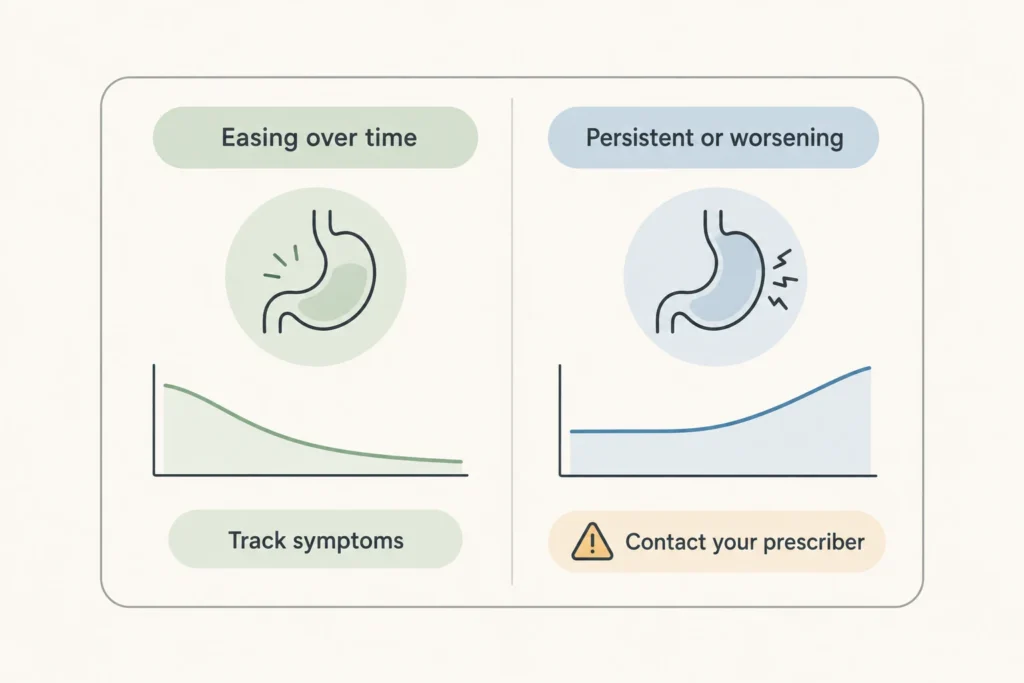
The calendar matters. Nausea that flares in the week after a dose step and eases by the next injection is the expected course. Nausea that persists at a stable dose for several weeks, or worsens, is the signal to slow down or hold the dose.

Nausea Is Not a Sign the Medication Is Working

A common belief is that feeling sick means the dose is “doing something,” and that people who feel fine must be losing less. The evidence says otherwise. In the same pooled STEP analysis, patients who never had a gastrointestinal side effect lost between 9.6% and 17.1% of their body weight, about the same as the 11.4% to 17.7% lost by patients who did. A formal mediation analysis concluded that gastrointestinal side effects contributed little to the weight loss semaglutide produced.

That finding changes the decision you make on a bad week. If nausea drops away at week six and the scale keeps moving, nothing is wrong. If you feel sick and are tempted to push through because you believe it’s the price of results, you’re paying for something that isn’t buying you anything. The weight loss comes from appetite and fullness signaling over months, not from feeling ill. A dose that keeps you comfortable and consistent beats a dose that makes you skip injections.

For the same reason, a lower maintenance dose is a legitimate end point for some patients. The approach to microdosing and maintenance on GLP-1 medications covers how that decision gets made once the initial weight comes off.

Supporting illustration for GLP-1 Nausea and Stomach Issues: What Actually Helps in a modern medical wellness setting

What Can You Do About GLP-1 Nausea Today?

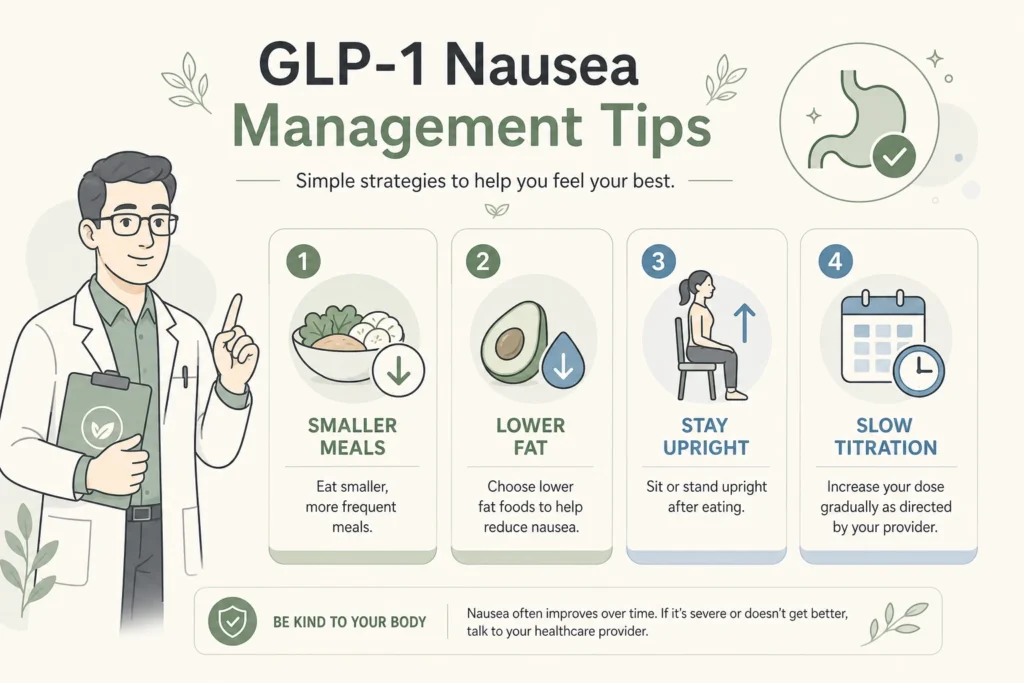
Eat smaller amounts more often and keep drinking. For the first few days after a dose change, keep fat low. A 2025 joint nutrition advisory from four medical societies published in Obesity notes that nausea often occurs in the morning or after long stretches without eating, that skipping meals because of nausea makes it worse, and that vomiting is more likely after large meals. Its advice is a small breakfast followed by small meals every three to four hours, with adequate fluids. Fatty and high-fiber foods are the ones to avoid during the first few days of treatment. Ginger or peppermint tea and acupressure bands are listed as options that can help.

A multidisciplinary expert consensus in the Journal of Clinical Medicine adds the clinical side: how to reach the maintenance dose, what to do when stomach symptoms appear during escalation, and how to minimize nausea, vomiting, diarrhea, and constipation, steps the authors say may keep patients from withdrawing from treatment.

In practice that looks like bland, lower-fat foods on injection day and the day after (toast, rice, eggs, yogurt, lean protein, broth-based soups), with fluids sipped through the day instead of large volumes with meals. Stay upright after eating, since lying down on a full, slow-emptying stomach is the fastest way to turn nausea into reflux. If the first day after each dose is your worst, ask your prescriber about injection timing.

If constipation is the symptom instead, it needs its own plan built around fiber, protein, and fluid. The guide to managing GLP-1 constipation with fiber and protein targets covers that, and the companion article on what to eat on GLP-1 medications covers the food list.

How Does Dose Titration Reduce Stomach Side Effects?

By giving your digestive system weeks to adapt to each level of the medication before the next increase. Semaglutide starts at 0.25 mg weekly for four weeks and steps up through 0.5 mg, 1 mg, and 1.7 mg before reaching the 2.4 mg maintenance dose at week 17, a schedule the label states exists to minimize gastrointestinal adverse reactions. Tirzepatide begins at 2.5 mg and increases in 2.5 mg steps no faster than every four weeks. The tirzepatide label notes that most nausea, vomiting, and diarrhea occurred during dose escalation and decreased over time.

The schedule on the label is a ceiling on speed, not a requirement to climb. A patient who is still queasy at 0.5 mg in week eight does better holding there for another four weeks, the delay the semaglutide label itself suggests, than stepping up on time. The 2025 nutrition advisory notes that trial participants were allowed to stay at a dose for up to eight weeks to let stomach symptoms settle. After a gap, the semaglutide label directs that if more than two consecutive doses are missed, restarting at a lower dose and re-escalating may reduce the stomach symptoms that come with reinitiation.

Titration is the most useful nausea tool the label gives you, and it only works when someone is watching the dose, the symptom, and the calendar together. The tirzepatide dosing guide and the medical weight loss program treat the escalation schedule as a starting point that gets adjusted to the patient.

Side effect (FDA label, versus placebo)Semaglutide 2.4 mgTirzepatide 5 mg to 15 mg
Nausea44% vs 16%25% to 29% vs 8%
Diarrhea30% vs 16%19% to 23% vs 8%
Vomiting24% vs 6%8% to 13% vs 2%
Constipation24% vs 11%11% to 17% vs 5%
Stopped treatment for stomach symptoms4.3% vs 0.7%4.3% at 15 mg vs 0.5%
Supporting illustration for GLP-1 Nausea and Stomach Issues: What Actually Helps in a modern medical wellness setting

Which Stomach Symptoms Mean You Should Call Your Provider?

Ordinary nausea can wait for your next check-in. Pain, dehydration, and vomiting that won’t stop cannot. The MedlinePlus drug guide for semaglutide injection, revised in May 2026, lists nausea, vomiting, diarrhea, stomach pain, constipation, heartburn, and burping as expected side effects to report if they are severe or do not go away. It separates out a shorter list that calls for immediate medical attention:

  • Ongoing pain that begins in the upper left or middle of the stomach and may spread to the back, with or without vomiting, which can signal pancreatitis.
  • Pain in the upper stomach with yellowing of the skin or eyes, fever, or clay-colored stools, which can signal a gallbladder problem.
  • Decreased urination, or swelling of the legs, ankles, or feet.
  • Severe stomach or intestinal problems.

Dehydration is the one that catches people. Both FDA labels warn that acute kidney injury has occurred in patients whose nausea, vomiting, or diarrhea left them dehydrated. If you can’t keep fluids down, or you’re dizzy when you stand, that’s a same-day call, not a wait-and-see. The tirzepatide label also carries postmarketing reports of ileus, a bowel that has stopped moving, so severe abdominal pain with bloating and no bowel movement belongs on the urgent list as well.

Supporting illustration for GLP-1 Nausea and Stomach Issues: What Actually Helps in a modern medical wellness setting

What Side-Effect Support Looks Like in Franklin and Nolensville

In 2025, Body Works guided more than 130 patients through its medical weight loss program at the Nolensville office alone, and the side-effect conversation is built into the first visit. Patients starting semaglutide or tirzepatide leave with written nutrition and symptom guidance. When a patient reports a digestive side effect, the team reviews what they have been eating and drinking and when the symptom began relative to the last dose increase, because those two facts usually point to the fix: a food change, a fluid change, or a slower climb.

If you are considering a GLP-1 medication and want the side effects handled properly, or you’re already on one and feeling worse than you think you should, the Franklin and Nolensville teams can build the plan around you. Schedule a Free Consultation to get started.

Frequently Asked Questions

Usually days to a few weeks after each dose increase, easing before the next step. In the pooled STEP trials, 98% of stomach side effects were mild to moderate and most occurred during or just after escalation. Nausea that persists for weeks at a stable dose is the signal to talk to your prescriber about holding or lowering the dose.
Don’t stop or skip doses on your own. Call your prescriber instead, because holding at the current dose or stepping down is usually the better move and keeps you on schedule. The semaglutide label notes that missing more than two consecutive doses may mean restarting at a lower dose to avoid a return of stomach symptoms.
The FDA labels suggest so: nausea in 25% to 29% of tirzepatide patients versus 44% of semaglutide patients, with vomiting also lower. Those figures come from separate trials with no head-to-head comparison, so treat the gap as a tendency, and remember that both medications are titrated slowly for the same reason.
Side-effect management is included in the program, and pricing depends on the medication and plan you choose. Body Works is a cash-pay clinic with payment plans and HSA and FSA eligibility, and the free consultation is where you get the exact figure along with your titration plan.
The Franklin office on Murfreesboro Road and the Nolensville office at Burkitt Commons both manage semaglutide and tirzepatide patients under physician supervision, including dose adjustments and nutrition support. Patients from Brentwood, Spring Hill, Cool Springs, and across Williamson County use whichever location is closer.

Medically reviewed by Dr. Donald Vollmer, MD
Managing Physician, Body Works TN

Browse Our Blog

See Body Works first in your Google results.

Add as a preferred source on Google