Switching From Tirzepatide to Retatrutide: What Changes

Switching From Tirzepatide to Retatrutide: What Changes

September 13, 2026

You reached 15 mg. The scale that dropped two pounds a week for eight months has been flat since spring, and the weekly shot now feels like maintenance you did not sign up for. Then a friend mentions the “GLP-3,” and the question writes itself: is switching from tirzepatide to retatrutide the next step, or a mistake you pay for in nausea?

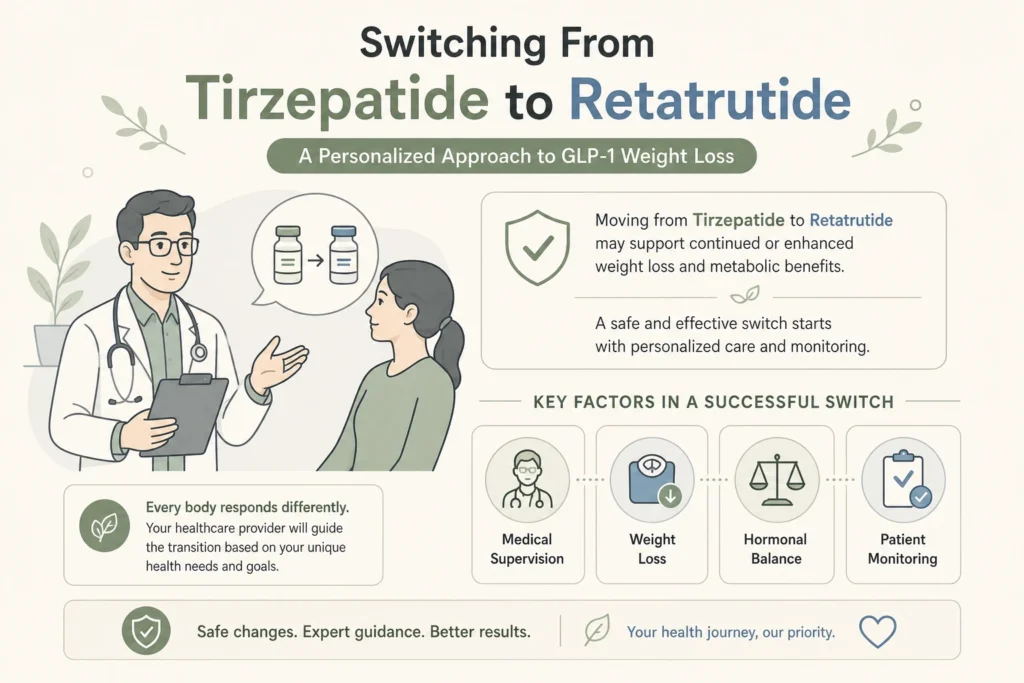
Switching from tirzepatide to retatrutide is a supervised change in medication, not an upgrade you can dose your way into. Retatrutide, the medication people call a GLP-3, adds a third receptor that tirzepatide does not touch, and in its 48-week phase 2 trial the top dose produced 24.2% average weight loss, ahead of the 20.9% tirzepatide reached in its own 72-week trial. The switch works best for people who have stalled at a stable tirzepatide dose, and it is timed to the weekly schedule you already keep, with retatrutide started low and raised on its own ladder rather than matched milligram for milligram.

Body Works manages semaglutide, tirzepatide, and retatrutide (GLP-3) patients under physician supervision in Franklin, TN and Nolensville, TN. Here is what the switch involves and how the first eight weeks tend to go.
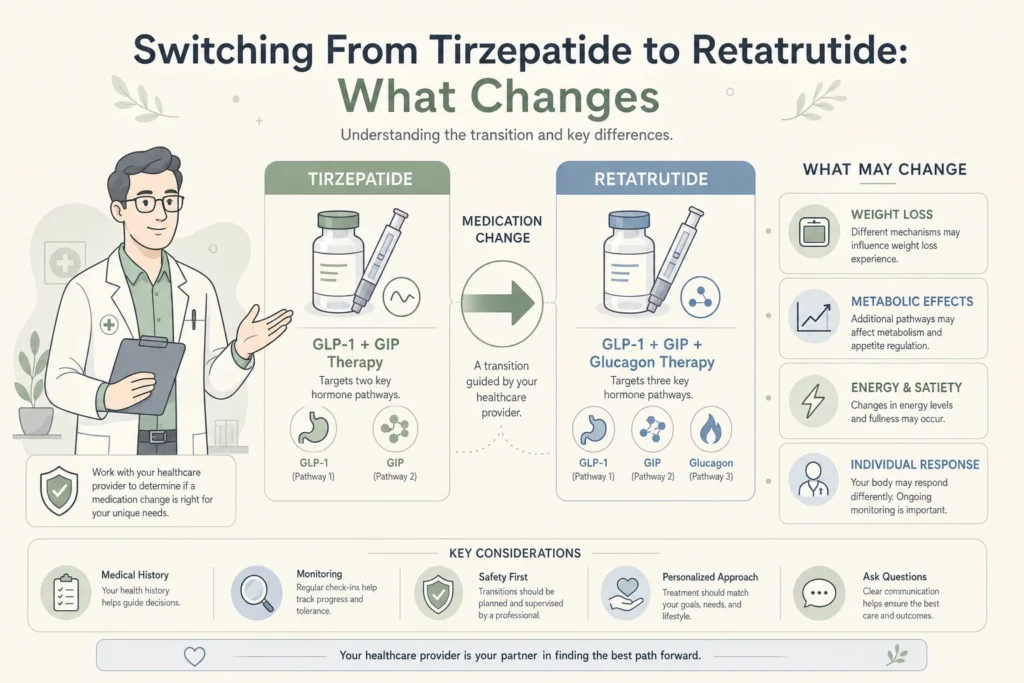
Illustration of Switching From Tirzepatide to Retatrutide: What Changes in a modern medical wellness setting

Why Do People Switch From Tirzepatide to Retatrutide?

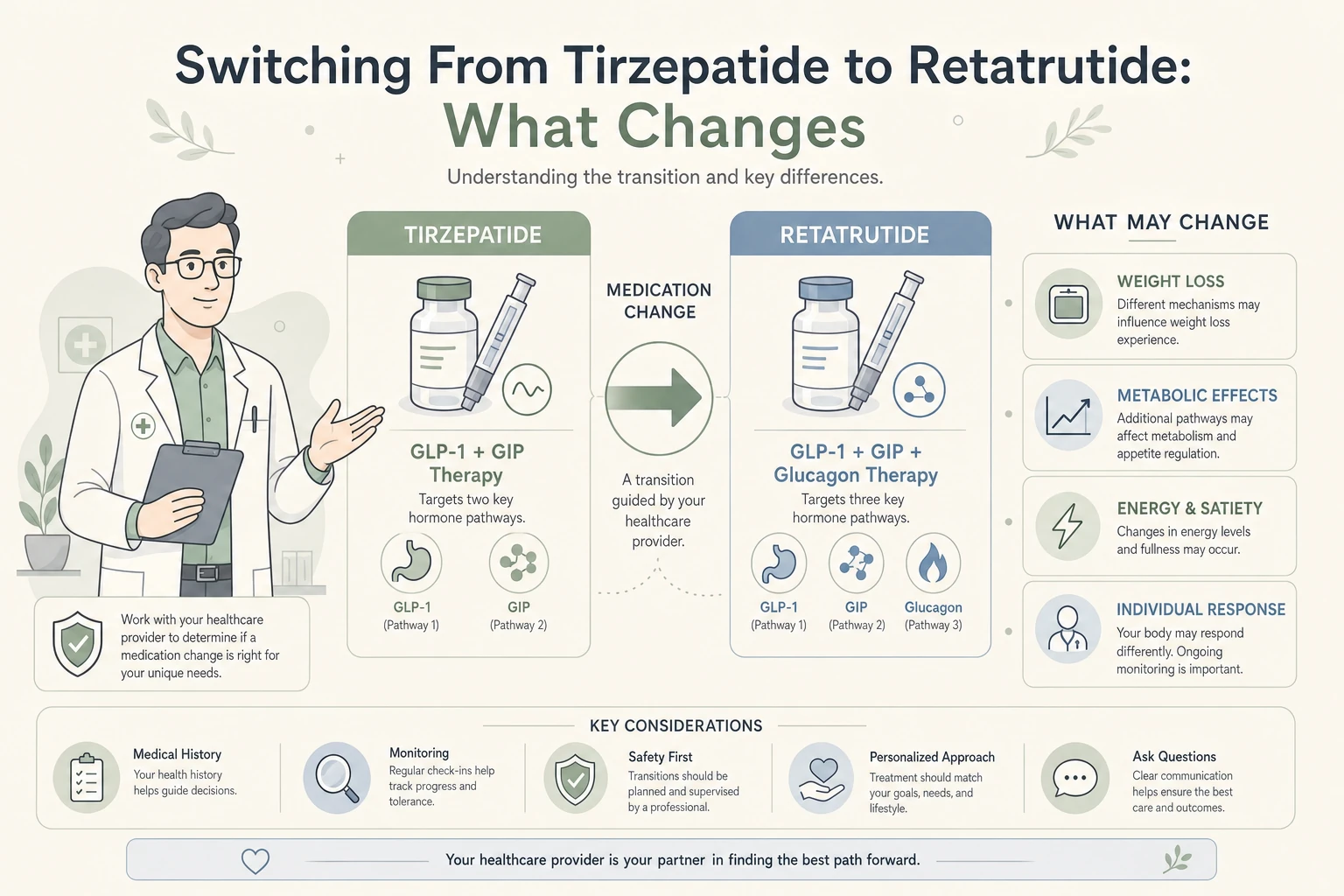
Because they have stopped losing weight on tirzepatide, or because they want the extra mechanism retatrutide adds. Tirzepatide acts on two receptors, GIP and GLP-1, which together reduce appetite and slow stomach emptying. Retatrutide acts on those two plus the glucagon receptor, and glucagon activity is associated with higher energy expenditure. Tirzepatide mostly changes how much you eat, and retatrutide is designed to change both how much you eat and how much you burn.

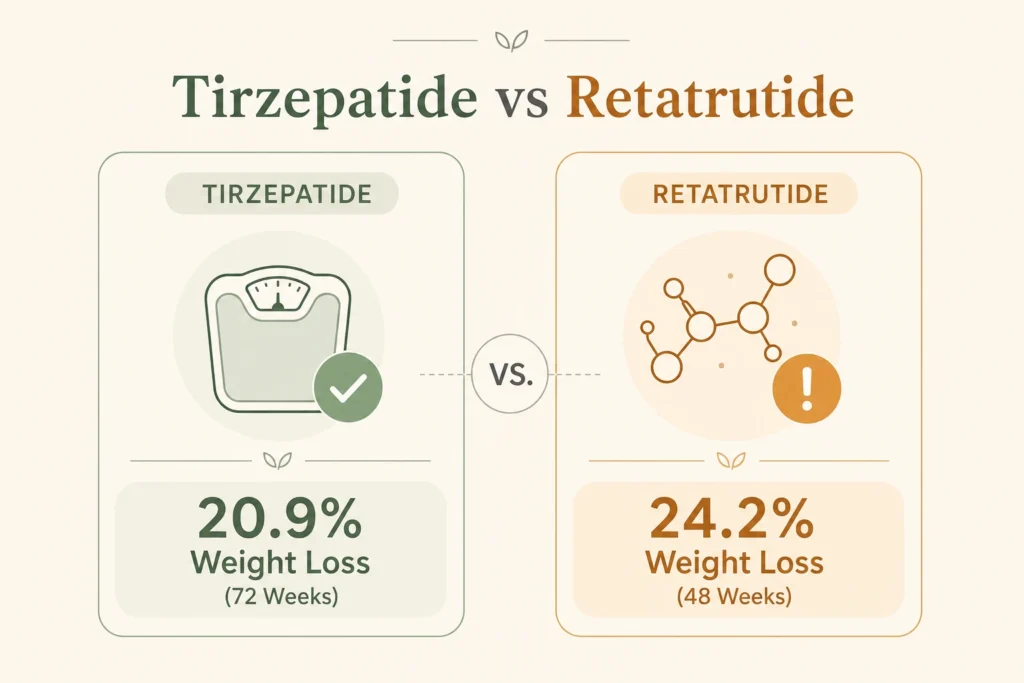
The trial numbers are the reason the question keeps coming up. In the SURMOUNT-1 trial of tirzepatide in the New England Journal of Medicine, participants on 15 mg lost 20.9% of their body weight over 72 weeks. In the phase 2 retatrutide trial in the same journal, participants on 12 mg lost 24.2% in 48 weeks, and every participant at 8 mg or 12 mg lost at least 5%. Those are separate trials with different lengths and populations, so the gap is a tendency, not a measured head-to-head result. The direct comparison, a phase 3 study of retatrutide against tirzepatide in adults with obesity, is registered on ClinicalTrials.gov as NCT06662383 and is active but not yet reporting.

A plateau is the most common trigger in practice. Weight loss on any GLP-1 medication slows as the body settles at a new set point, and a stable weight for three months at the highest dose you tolerate is a reasonable point to ask about the next option.

How Does Retatrutide Differ From Tirzepatide?

Three receptors instead of two, a different dose ladder, and a weight-loss ceiling that appears to sit higher. Both are once-weekly injections. Both are titrated slowly because gastrointestinal side effects cluster around dose increases. The practical differences are in the table.

FactorTirzepatideRetatrutide (GLP-3)
ReceptorsGIP and GLP-1GIP, GLP-1, and glucagon
Trial doses5, 10, and 15 mg weeklyPhase 2: 1, 4, 8, and 12 mg weekly. Phase 3 (type 2 diabetes): 4, 9, and 12 mg
Starting dose in trials2.5 mg, raised by 2.5 mg no faster than every 4 weeks2 mg or 4 mg, raised toward the target dose
Weight loss at top dose20.9% at 72 weeks (SURMOUNT-1)24.2% at 48 weeks (phase 2)
Main side effectsNausea, diarrhea, constipation, mostly during escalationSame pattern, dose-related, reduced by a 2 mg start
Regulatory statusFDA approved for chronic weight managementPhase 3 under way. First results published 2026

The phase 3 program has started to report. The TRANSCEND-T2D-1 trial published in The Lancet in June 2026 gave retatrutide 4 mg, 9 mg, or 12 mg to 537 adults with type 2 diabetes for 40 weeks. Body weight fell 11.5%, 13.9%, and 15.3% respectively against 2.6% on placebo, and the gastrointestinal side effects were mostly mild to moderate and subsided over time. Only 2% to 5% of participants stopped because of side effects.

The three-way comparison with semaglutide and the explainer on why retatrutide is nicknamed GLP-3 go deeper.

When Is the Right Time to Switch?

After you have reached a stable tirzepatide dose and held it long enough to know what it does for you. Switching in the middle of the tirzepatide ladder gives up information: you do not yet know whether 12.5 mg or 15 mg would have restarted the loss. Three signals make the switch worth discussing.

  • A true plateau. Weight has been flat for roughly three months at the highest tirzepatide dose you can tolerate, with your eating and activity unchanged.
  • A goal tirzepatide is unlikely to reach. In SURMOUNT-1, 57% of participants on 15 mg lost 20% or more of their body weight at 72 weeks, which means 43% did not. If you have lost 15% and your provider agrees another 10% is realistic and medically appropriate, the higher ceiling in the retatrutide data becomes the deciding factor.
  • Side effects you cannot get past. Some patients cannot climb the tirzepatide ladder without persistent nausea. Retatrutide is not automatically gentler, but its trials showed that starting at 2 mg rather than 4 mg partially mitigated stomach side effects, which gives a supervised switch a slower on-ramp to try.

If tirzepatide is still working, the honest advice is to stay on it. And if the plateau traces to something fixable, such as protein intake that has drifted below target or a dose that was never fully raised, that gets addressed first. The tirzepatide dosing and results guide walks through what the full ladder should have delivered before a plateau is called.
Supporting illustration for Switching From Tirzepatide to Retatrutide: What Changes in a modern medical wellness setting

How Is the Switch Timed, and Do You Need a Washout?

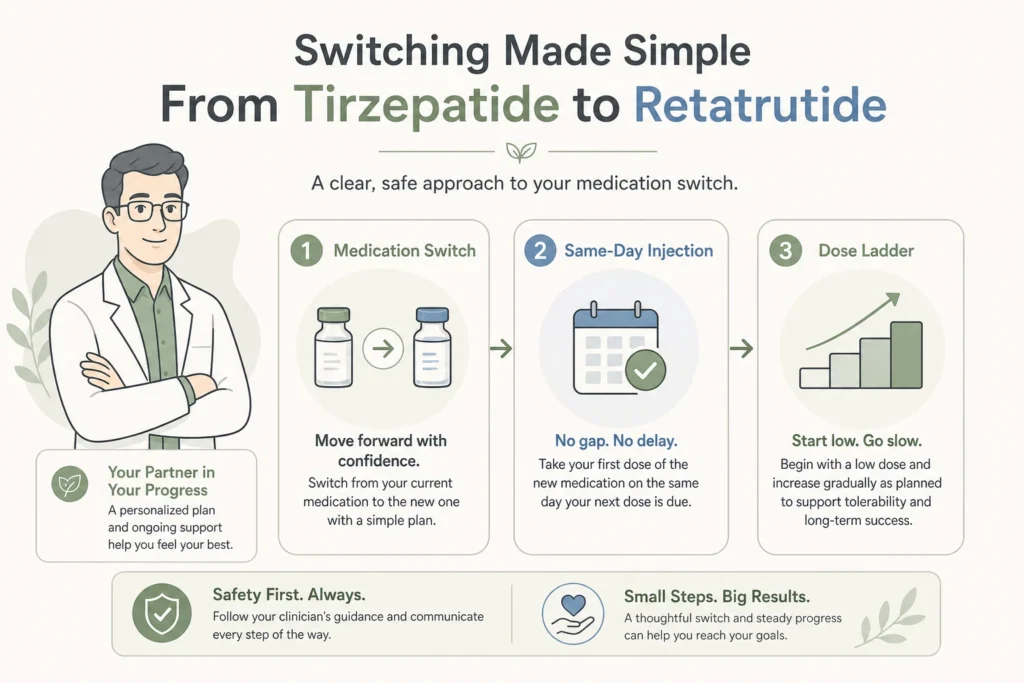
No washout period is built into the switch. Retatrutide replaces tirzepatide on the next scheduled injection day. Tirzepatide has a half-life of approximately 5 days according to its FDA prescribing information, which is why it is dosed weekly and why the label allows a missed dose to be taken within 4 days. By the time your next weekly injection comes due, the previous tirzepatide dose is already declining. Taking the first retatrutide dose on that same day keeps the weekly rhythm and avoids a gap in appetite control.

The dose starts over rather than converting. There is no published table that maps 15 mg of tirzepatide onto a retatrutide dose, and the two molecules are not interchangeable at the receptor level. Retatrutide begins at the low end of its own ladder regardless of how high your tirzepatide dose was, because the glucagon activity is new to your body, and the phase 2 investigators reported that a 2 mg start, compared with 4 mg, partially mitigated the stomach side effects. Anyone who tells you to “match the milligrams” is guessing.

Two things carry over unchanged from your tirzepatide plan. Protein stays at target, because a 2025 joint nutrition advisory from four medical societies recommends 1.2 to 1.6 grams per kilogram per day during medication-driven weight loss to protect lean mass, and a second round of rapid loss raises the stakes. And resistance training continues, for the same reason. The guide to preventing muscle loss on GLP-1 medications covers the plan.

What Should You Expect in the First Eight Weeks?

A return of the early-titration feeling, then a new drop in weight. The first weeks on retatrutide look like the first weeks on tirzepatide did: appetite falls further, meals get smaller, and stomach symptoms show up around each dose increase and fade before the next. In the 48-week phase 2 trial the side effects were dose-related, mostly mild to moderate, and the 2 mg starting dose eased them. One effect is specific to retatrutide: a dose-dependent increase in resting heart rate that peaked at 24 weeks and declined afterward. Your provider will track it.

The weight response arrives in stages. Across the phase 2 dose groups, participants had lost 7.2% to 17.5% by week 24 and 8.7% to 24.2% by week 48, with the higher doses pulling away over time. The first month tells you little, because the curve is still steep at week 24. Constipation is worth planning for from the first injection, because slower stomach emptying plus smaller meals is the setup for it, and the fiber, protein, and fluid plan for GLP-1 constipation applies to retatrutide without changes.

Call your provider the same day for persistent vomiting, dehydration, severe upper abdominal pain, or a racing heart at rest. Those symptoms change the plan.
Supporting illustration for Switching From Tirzepatide to Retatrutide: What Changes in a modern medical wellness setting

Who Should Not Switch to Retatrutide?

Anyone for whom tirzepatide is still doing its job, anyone who is pregnant or planning pregnancy, and anyone with the conditions that already ruled out tirzepatide. The tirzepatide label carries a boxed warning for people with a personal or family history of medullary thyroid carcinoma or Multiple Endocrine Neoplasia syndrome type 2, and a history of pancreatitis calls for caution. Retatrutide shares the GLP-1 pathway and the same precautions apply until its own label says otherwise.

The phase 3 trials excluded certain groups, and a supervised clinic follows the same logic: the switch is for adults who have finished a proper tirzepatide course with current bloodwork and a reason that holds up in a consultation. A patient who wants retatrutide because it is newer, with weight still coming off on tirzepatide, does not need it yet.
Supporting illustration for Switching From Tirzepatide to Retatrutide: What Changes in a modern medical wellness setting

Switching From Tirzepatide to Retatrutide in Franklin and Nolensville

In 2025, Body Works guided more than 130 patients through its medical weight loss program at the Nolensville office alone. Every patient starting a GLP-1 medication there leaves the first visit with written nutrition and symptom guidance, and when a patient reports a problem the team looks at two things first: what they have been eating and drinking, and when the change began relative to the last dose increase. Bring the same two facts to a plateau conversation, your dose history and a week of meals, because they sort the plateaus that need a medication change from the ones that need a protein correction or a final dose step. That sorting happens before any retatrutide is discussed.

If you have stalled on tirzepatide and want to know whether retatrutide (GLP-3) is the right next step, the Franklin and Nolensville teams can review your history and build the plan. Schedule a Free Consultation to get started, or read about the retatrutide program at Body Works and the broader medical weight loss program.

Frequently Asked Questions

Yes, under physician supervision. Retatrutide replaces tirzepatide on the next scheduled weekly injection day, and it starts at the low end of its own dose ladder rather than at a dose matched to your tirzepatide dose. No washout period is required because tirzepatide’s 5-day half-life means the prior dose is already declining by the next injection day.
The trial data point that way. Retatrutide’s top phase 2 dose produced 24.2% weight loss at 48 weeks, versus 20.9% for tirzepatide’s top dose at 72 weeks in SURMOUNT-1. Those are separate trials, and the head-to-head phase 3 study registered as NCT06662383 has not reported yet, so the difference is a tendency until it does.
On the next scheduled injection day, about seven days after your last tirzepatide dose. There is no benefit to a longer gap, and a gap of several weeks brings appetite back before the new medication takes over. The switch keeps the weekly rhythm you already have.
Pricing depends on the medication, the dose, and the plan you choose, and the free consultation is where you get the exact figure along with your titration schedule. Body Works is a cash-pay clinic with payment plans and HSA and FSA eligibility, and the review of whether a switch is warranted is part of the visit.
The Franklin office on Murfreesboro Road and the Nolensville office at Burkitt Commons both manage retatrutide (GLP-3) and tirzepatide patients under physician supervision, including the timing of a switch and the new dose ladder. Patients from Brentwood, Spring Hill, Cool Springs, and across Williamson County use whichever location is closer.

Medically reviewed by Dr. Donald Vollmer, MD
Managing Physician, Body Works TN

Browse Our Blog
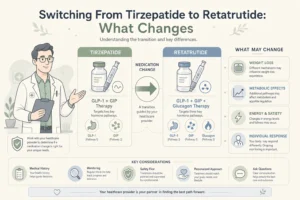
Illustration of The Real Dangers of Buying Peptides Online in a modern medical wellness setting

The Real Dangers of Buying Peptides Online

When Tennessee investigators tested counterfeit weight loss vials seized in Medina, one was mostly water. That was the good outcome. The dangers of buying peptides
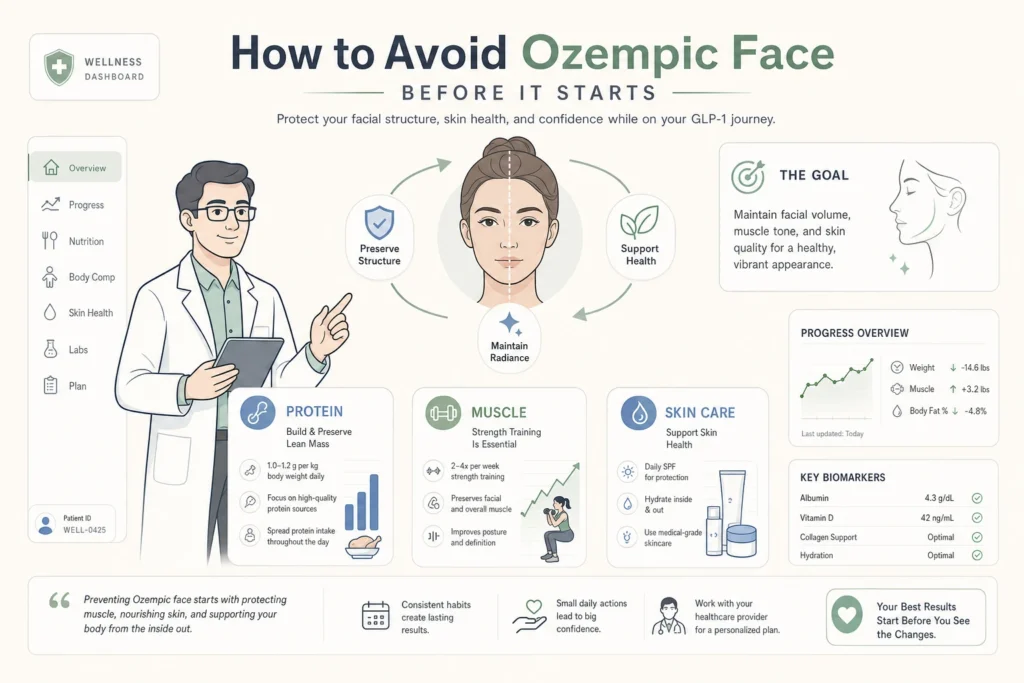
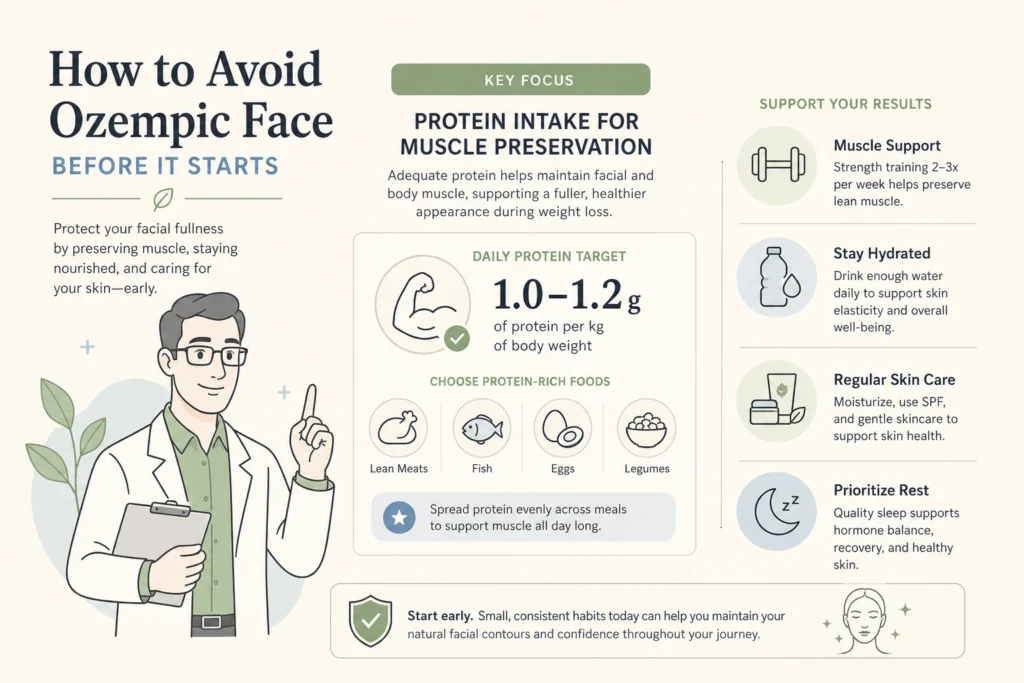
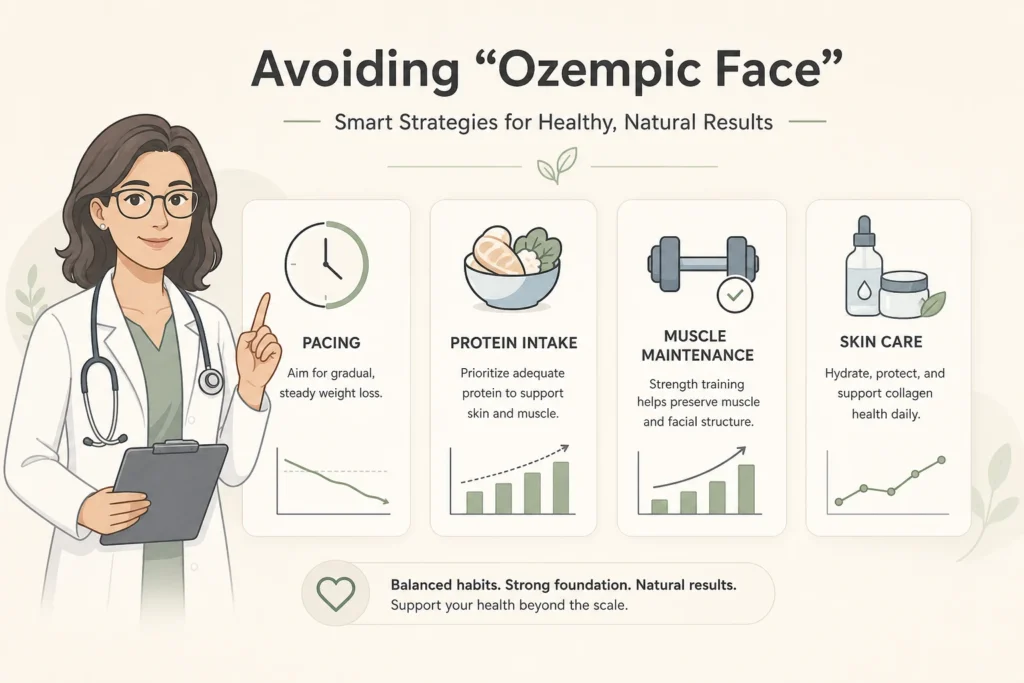
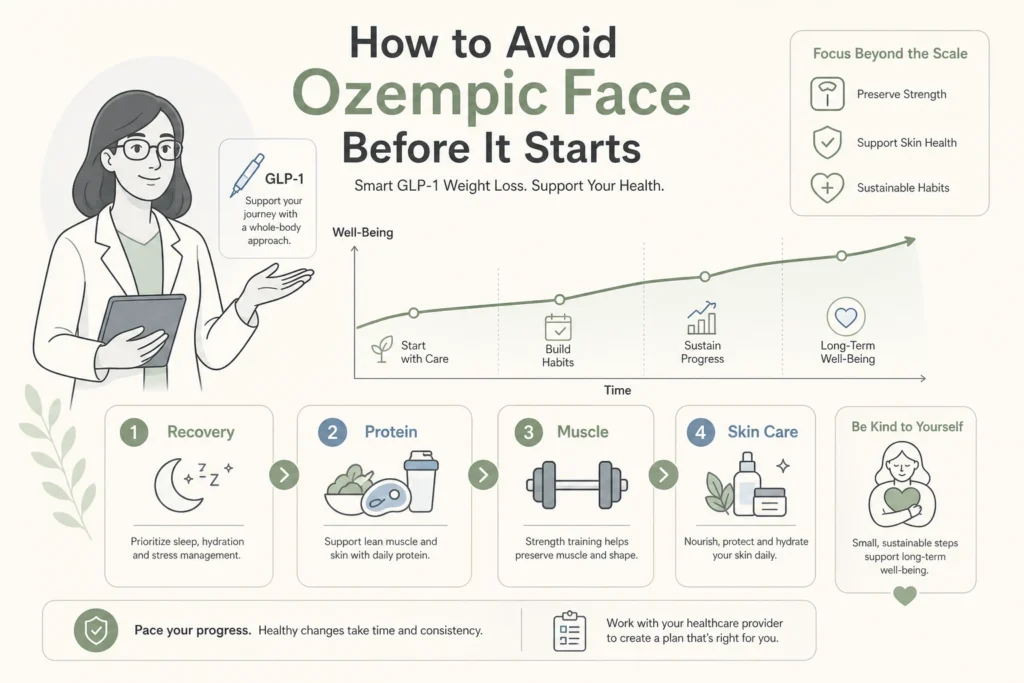
How to Avoid Ozempic Face Before It Starts

How to Avoid Ozempic Face Before It Starts

September 11, 2026

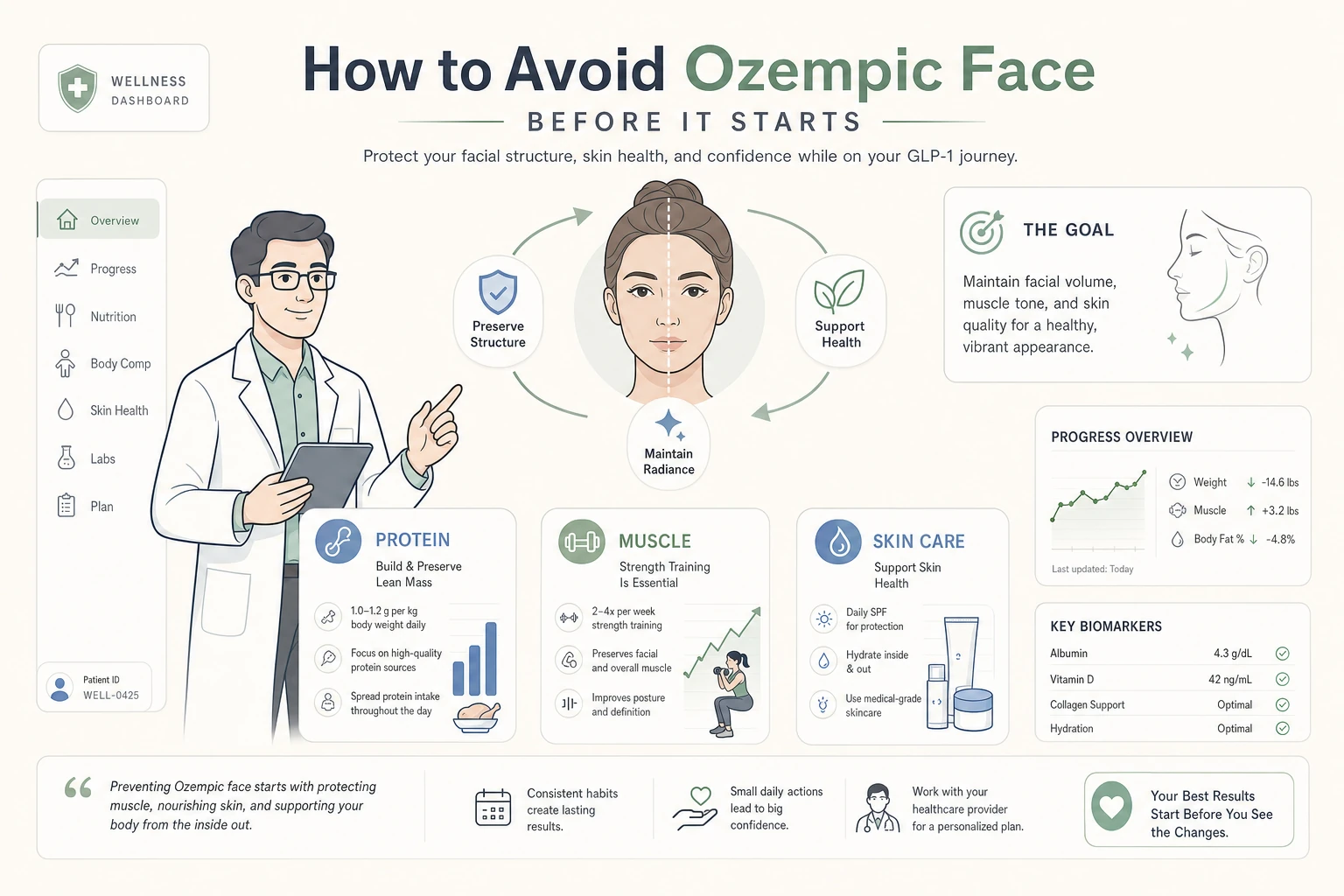
Yes, you can lower your odds of the drawn, hollow look people call “Ozempic face,” and the best time to start is before it shows up. That nickname points to the facial volume loss some people notice during fast weight loss on semaglutide or tirzepatide. It is not caused by the medication itself. It comes from losing fat and, sometimes, muscle faster than your skin and face can adjust. The habits that protect your face are the same ones that make weight loss healthier, so prevention costs you nothing extra.

This guide stays in the prevention lane. If you want the full background on why faces change, read our companion piece on why Ozempic face happens and what you can do, or step back for the bigger picture in our guide to how weight loss changes your face, skin, and muscle. Here, the focus is the levers you can pull now.

Illustration of How to Avoid Ozempic Face Before It Starts in a modern medical wellness setting

Can You Actually Prevent "Ozempic Face"?

You cannot guarantee a face that never changes, but you can meaningfully reduce the risk. Facial volume loss during weight loss is largely about how much fat you lose, how fast you lose it, and how much muscle you keep. All three are partly in your control. The face holds distinct fat pads that give cheeks their fullness, and rapid loss can deflate them before skin has time to retract.

According to Cleveland Clinic guidance on facial changes during weight loss, the sunken look tied to GLP-1 medications reflects the loss of facial fat that comes with any significant, rapid weight reduction, not a unique drug side effect. That distinction matters, because it means the same prevention levers that apply to any fast weight loss apply here: slow the pace, feed your muscles, and support your skin.

What Are the Early Signs of Ozempic Face?

The first signs of “Ozempic face” are subtle, and catching them early gives you time to adjust before they deepen. Most people notice flatter cheeks first, then more shadow under the eyes and along the jaw. Skin can start to look a little loose around the lower face, and fine lines may show up more because there is less volume underneath to smooth them.

Common early signals include cheeks that look deflated in photos, temples that appear slightly hollow, and a jawline that reads softer or more crepey than before. None of these mean something is wrong. They are cues to check your pace of loss and your protein, not reasons to panic. If you spot them, treat them as an early prompt to talk with your provider about adjusting your plan.

How Does Your Pace of Weight Loss Affect Your Face?

The speed of your weight loss is the single biggest lever for protecting your face. When you lose weight gradually, your skin has more time to shrink along with you, and you are more likely to lose fat while keeping muscle. When you drop weight very fast, fat leaves the face quickly and skin can lag behind, which is what creates that deflated look.

This is one reason steady, provider-guided loss beats crash results. A slower climb in your dose and a moderate rate of loss give the face and skin a fairer chance to keep up. It also protects the muscle and bone that support facial structure. If your loss feels alarmingly fast, that is worth flagging, because pace is something your provider can adjust with you.

Supporting illustration for How to Avoid Ozempic Face Before It Starts in a modern medical wellness setting

Why Does Protein Protect Your Face?

Protein protects your face by helping you hold onto muscle and lean tissue while you lose fat. During any calorie deficit, some of the weight you lose can come from muscle unless you actively defend it, and muscle loss in the face and neck contributes to that hollow, aged look. Eating enough protein is the most reliable way to shift more of your loss toward fat.

A review of protein and body weight published in the American Journal of Clinical Nutrition, 2015 found that higher protein intake during weight loss helps preserve lean body mass and supports appetite control at the same time. Practically, that means building each meal around a protein source, spreading protein across the day rather than saving it for dinner, and not letting GLP-1 appetite suppression push your intake too low. Muscle you keep is structure your face keeps.

How Does Strength Training Preserve Facial Fullness?

Strength training preserves facial fullness indirectly, by signaling your body to hold onto muscle everywhere while you lose fat. You cannot target the muscles of your face with exercise, but total-body muscle preservation is what keeps your body composition and structure intact during weight loss. When you protect lean mass, more of the weight you lose is fat, and the supporting tissue under your skin stays fuller.

Research summarized by the National Institute of Diabetes and Digestive and Kidney Diseases points to combining resistance activity with adequate protein to protect muscle during weight management. You do not need a complicated program. Two or three sessions a week that work the major muscle groups, paired with enough protein, cover the essentials. This pairs closely with protecting your skin, which we cover in our guide to tightening skin after weight loss naturally.

Supporting illustration for How to Avoid Ozempic Face Before It Starts in a modern medical wellness setting

Does Hydration and Skin Care Help Prevent Ozempic Face?

Hydration and basic skin care will not stop fat loss, but they help your skin look and behave its best while your face changes. Well-hydrated skin appears plumper and more resilient, and dehydration can make hollow areas look more pronounced. GLP-1 medications can reduce your thirst and appetite, so many people quietly drink less without noticing.

Keep water intake steady across the day, and support your skin barrier with simple habits: a gentle moisturizer, daily sunscreen to limit collagen breakdown from sun exposure, and consistency over expensive products. These steps support skin elasticity, which is the skin’s ability to snap back as your face reshapes. For a deeper look at what actually helps skin bounce back, our review of collagen and supplements for skin during weight loss separates the useful from the overhyped.

How Does Provider Monitoring Prevent Ozempic Face?

Working with a provider who monitors your progress is one of the most underrated ways to avoid “Ozempic face.” Regular check-ins let someone catch a too-fast rate of loss, thinning muscle, or dropping protein intake before those show up in your face. A provider can slow your dose escalation, adjust your target rate, or add support when the numbers call for it.

This is where the medically supervised approach at Body Works earns its keep. The team that manages your medical weight loss program is watching the same trends that drive facial change, so the plan can flex as you go. In our patients, the people who avoid the gaunt look are almost always the ones who lose steadily and keep their protein and strength work consistent, not the ones chasing the fastest possible number on the scale.

Supporting illustration for How to Avoid Ozempic Face Before It Starts in a modern medical wellness setting

Frequently Asked Questions

Protecting Your Results at Body Works

Often, yes, at least in part. Once your weight stabilizes, skin has time to retract and your face usually settles into its new shape over several months. Some volume loss can persist, especially with older skin or very rapid loss, but the drawn look tends to soften once you stop losing weight quickly. Keeping up protein and strength work during that stabilizing period gives your face its best chance to fill back out naturally.
You support skin tightening by protecting muscle and skin elasticity as you lose weight and after you stabilize. Steady loss, adequate protein, resistance training, good hydration, and daily sunscreen all help skin retract more effectively. Mild to moderate looseness often improves on its own over six to twelve months. If it does not, a provider can walk you through in-office options during a consultation. Our guide on natural skin tightening covers the at-home side in detail.
To a degree, yes. Because “Ozempic face” is mostly volume and elasticity change rather than damage, much of it can improve once your weight holds steady and you support your muscle and skin. How fully it reverses depends on your age, how fast you lost weight, and your skin quality. Prevention gives you the best odds, which is why pacing and protein matter from day one.
Water alone will not prevent it, but staying hydrated helps. Well-hydrated skin looks fuller and more elastic, and GLP-1 medications can blunt your thirst enough that you drink less without realizing it. Think of hydration as one supporting habit alongside the bigger levers: your pace of loss, your protein intake, and your muscle.
The smartest way to avoid “Ozempic face” is to build prevention into your weight loss plan from the start, and that is easier with a team watching your pace, your protein, and your progress. At Body Works, care for patients across Franklin and Nolensville pairs steady, supervised weight loss with the coaching that keeps your face and skin looking their best along the way. Schedule a Free Consultation to talk through a plan that protects your appearance while you reach your goals.

Medically reviewed by Dr. Donald Vollmer, MD
Managing Physician, Body Works TN

Browse Our Blog

Illustration of The Real Dangers of Buying Peptides Online in a modern medical wellness setting

The Real Dangers of Buying Peptides Online

When Tennessee investigators tested counterfeit weight loss vials seized in Medina, one was mostly water. That was the good outcome. The dangers of buying peptides

GLP-1 Constipation, Fiber and Protein: What Nobody Tells You

GLP-1 Constipation, Fiber and Protein: What Nobody Tells You

September 10, 2026

Nobody warns you about the third week. The nausea from the first injections has settled, the scale has started to move, and then your digestion simply stops. On semaglutide, one in four patients in the FDA label reports constipation. On tirzepatide it is as many as one in six. Most of them never hear a plan for it until they are already uncomfortable.

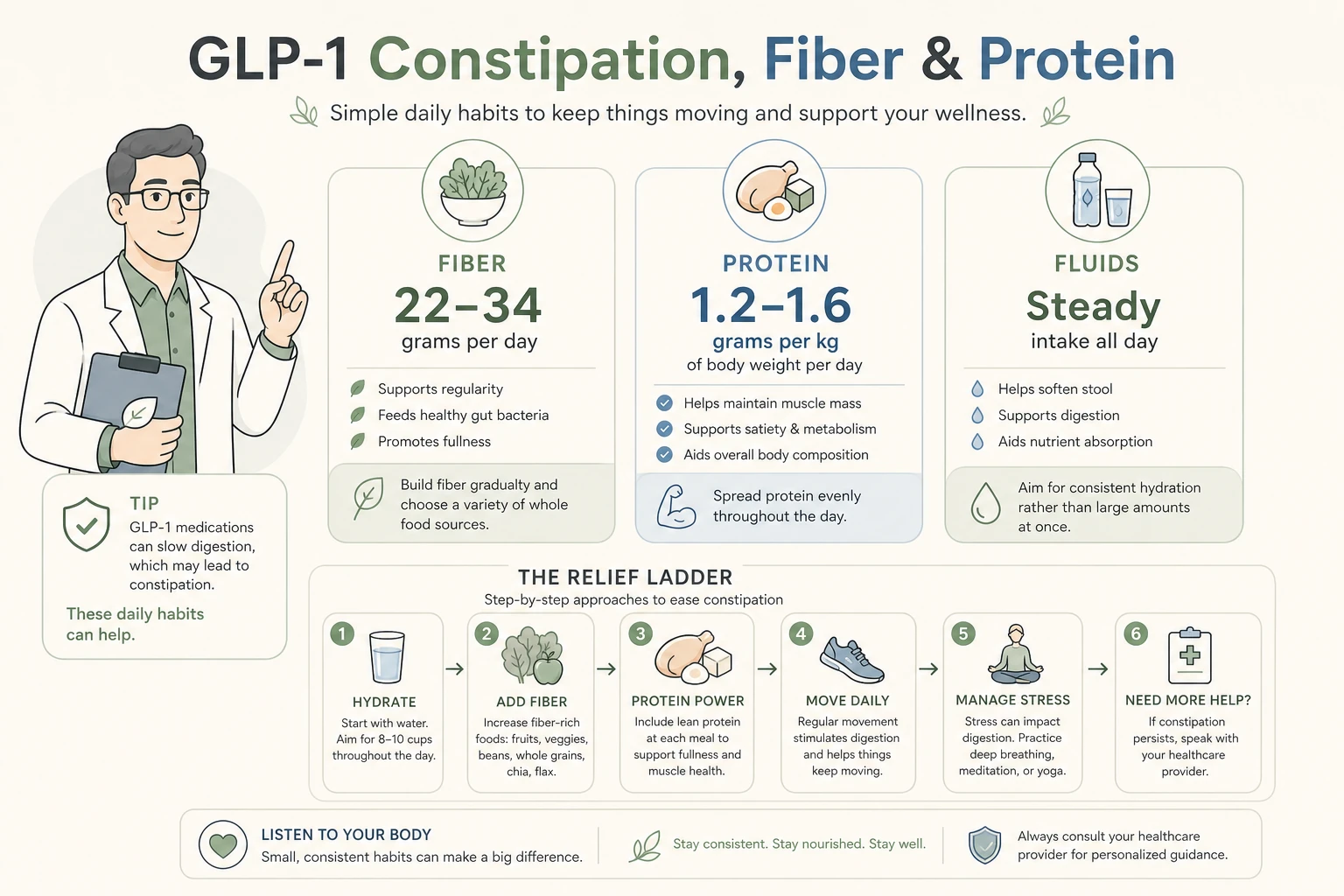
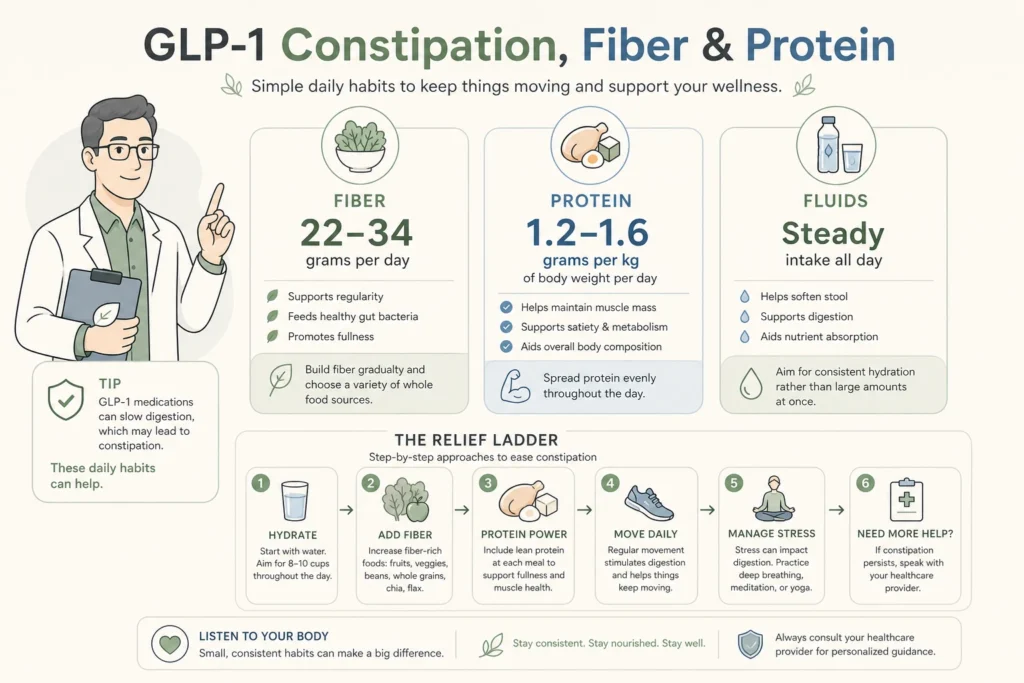
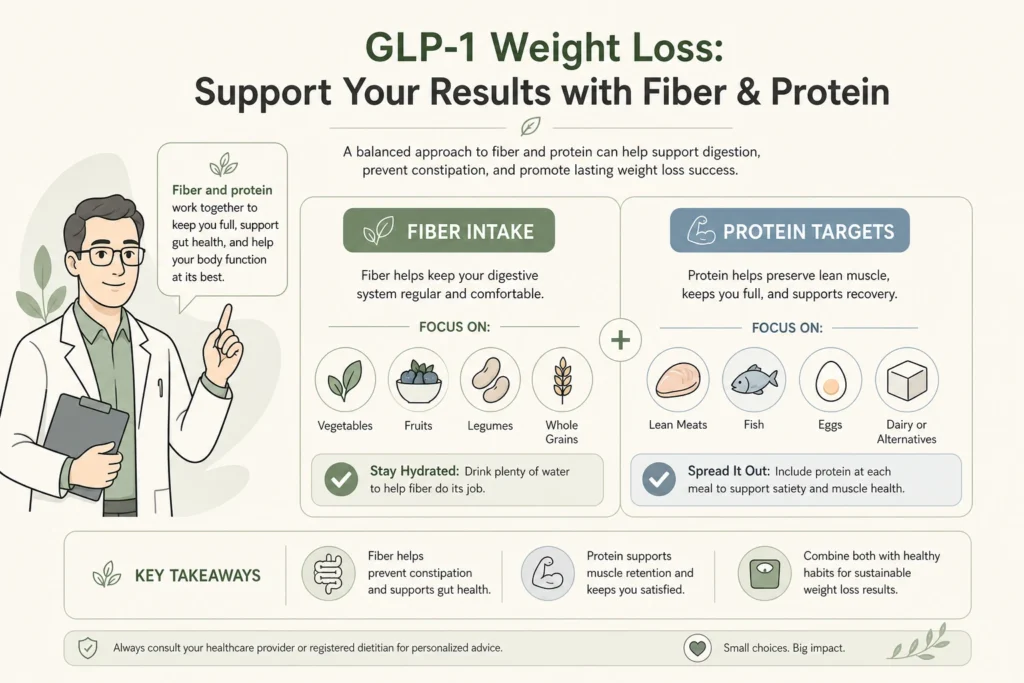
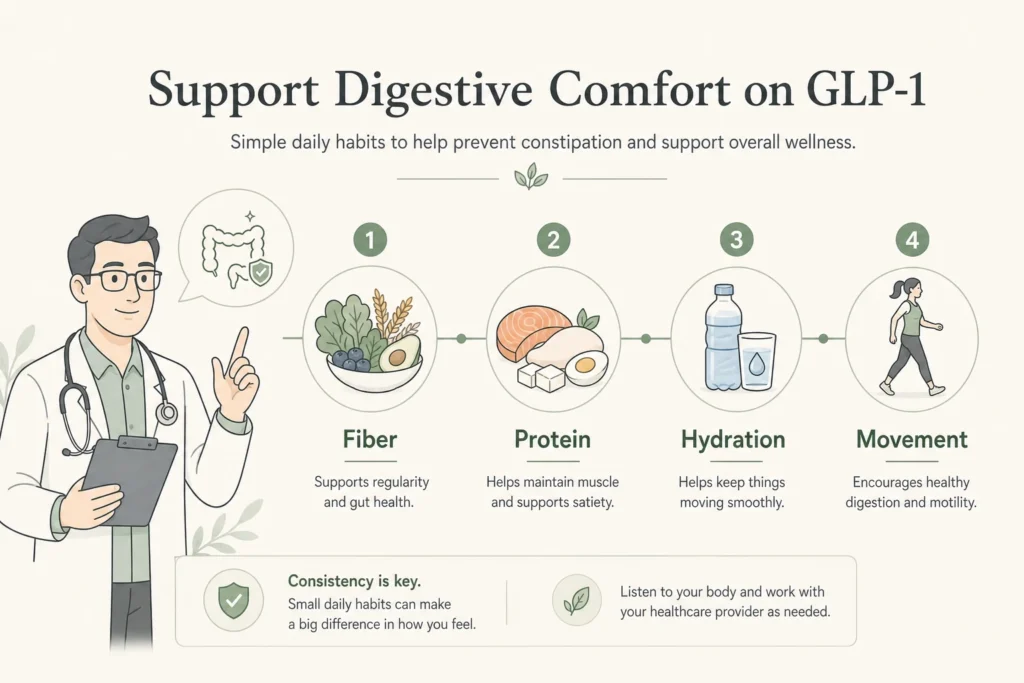
GLP-1 constipation is predictable, and it is manageable with three numbers: 22 to 34 grams of fiber a day, 1.2 to 1.6 grams of protein per kilogram of body weight, and enough fluid to make both of them work. All three medications slow the movement of food through your gut and cut how much you eat, so there is less bulk and less water, and transit slows. The fix is a schedule set before the problem starts, with a defined escalation order if it shows up anyway.

Body Works offers physician-supervised GLP-1 programs in Franklin, TN and Nolensville, TN, and the guidance below is the part of that program that rarely makes it into the prescribing conversation.

Illustration of GLP-1 Constipation, Fiber and Protein: What Nobody Tells You in a modern medical wellness setting

Why Does GLP-1 Constipation Happen on Semaglutide, Tirzepatide, and Retatrutide?

Because these medications slow stomach emptying and shrink your food intake at the same time, and both changes remove what a normal bowel movement is made of. In the FDA prescribing information for semaglutide, constipation was reported by 24% of patients compared with 11% on placebo, tied with vomiting and behind only nausea and diarrhea. The FDA label for tirzepatide lists constipation in 17% of patients at 5 mg, 14% at 10 mg, and 11% at 15 mg, against 5% on placebo. Retatrutide has no label yet. In its phase 2 trial published in the New England Journal of Medicine, gastrointestinal events were the most common side effect and were dose related, and a lower starting dose reduced them.

Slower transit gives the colon more time to pull water out of stool, so it hardens. A smaller appetite means less fiber and less volume to push. Nausea makes people drink less. Constipation on GLP-1 medications is the combined result of slower gut movement, a smaller volume of food and fiber, and lower fluid intake, which is why both labels list it among the most common adverse reactions rather than a rare one.

How Much Fiber Do You Need on a GLP-1, and How Do You Add It?

Adults need 22 to 34 grams of fiber a day depending on age and sex, and that target does not drop just because your appetite did. The National Institute of Diabetes and Digestive and Kidney Diseases guidance on eating for constipation points to whole grains, legumes, fruit with the skin on, vegetables, and nuts, while limiting low-fiber processed foods such as chips and fast food. Soluble fiber from oats and beans holds water and softens stool. Insoluble fiber from whole grains and vegetable skins adds the bulk that moves it.

Timing matters more on these medications than for most people. The 2025 joint nutrition advisory from the Obesity Medicine Association, The Obesity Society, and two partner societies recommends avoiding fatty and high-fiber foods during the first few days of treatment while nausea is at its worst, then increasing fiber gradually, with prunes and other dried fruit named as useful. The NIDDK’s own advice is to add fiber a little at a time, which in practice means a couple of weeks, not a weekend. When food alone cannot close the gap, a psyllium husk supplement (the fiber in products such as Metamucil) is the usual bridge.

How Much Protein Should You Eat on Semaglutide or Tirzepatide?

During GLP-1 weight loss, 1.2 to 1.6 grams of protein per kilogram of body weight per day, combined with strength training three times a week, is the evidence-based floor for protecting lean mass: in the STEP 1 semaglutide trial, 38% of the weight lost was lean body mass. Those figures come from the same joint nutrition advisory, which also offers an absolute target of 80 to 120 grams a day. For a 180-pound adult that is roughly 100 to 130 grams.

Protein is the first thing that disappears from a shrinking appetite, because a chicken breast is harder to want than crackers. Put it first on the plate at every meal and split it across the day rather than saving it for dinner. Pair every protein serving with a fiber source and a glass of water, because protein eaten without fiber and fluid makes constipation worse. The longer case for lean mass is in our guide to preventing muscle loss on GLP-1 medications, and the food-by-food breakdown is in what to eat on GLP-1 medications.
Supporting illustration for GLP-1 Constipation, Fiber and Protein: What Nobody Tells You in a modern medical wellness setting

What Actually Relieves Constipation on a GLP-1?

For GLP-1 constipation, the evidence-based order is fluids, then gradual fiber, then daily movement and timed bathroom habits, then psyllium, then an osmotic agent or magnesium, with stimulant laxatives reserved for severe cases under medical direction. A fixed ladder, climbed in order, resolves most cases without a prescription, and the NIDDK constipation treatment guidance lays out the sequence:

  1. Fluids first. Drink water and other liquids through the day so the fiber has something to absorb.
  2. Fiber to target, gradually. Work up to 22 to 34 grams a little at a time.
  3. Move daily. Regular physical activity relieves symptoms, and a short walk after meals counts.
  4. Train the clock. Try for a bowel movement at the same time each day, ideally 15 to 45 minutes after breakfast, and go as soon as you feel the urge.
  5. Add psyllium. With at least 8 ounces of liquid, one to three times daily, and check with your prescriber before using it for more than a week, as the MedlinePlus psyllium entry advises.
  6. Osmotic agent or magnesium. Polyethylene glycol 3350, or the daily magnesium the joint advisory suggests considering, draws water into the stool. Docusate is the stool softener option.
  7. Stimulant laxatives last. The NIDDK reserves stimulants for severe constipation or cases where nothing else has worked.

Two signals mean you stop climbing and call your prescriber the same day. The first is severe or persistent abdominal pain, because both FDA labels carry warnings for acute pancreatitis and acute gallbladder disease. The second is being unable to keep fluids down, because the tirzepatide label ties acute kidney injury to dehydration from gastrointestinal side effects.

What Else Should You Do on a GLP-1 Besides Fiber and Protein?

Steady fluids and small meals matter, and so does not rushing the dose. Dehydration is the most under-discussed risk on these medications. Both FDA labels warn that acute kidney injury has occurred, most often in patients who were already vomiting or having diarrhea, and the joint advisory names preventing it as a treatment priority. Sip fluids across the whole day rather than a large volume at once, and ask your prescriber about electrolytes if vomiting or diarrhea persists. Patients who cannot keep fluids down at all are who custom IV hydration exists for, as a bridge rather than a substitute for adjusting the dose.

The advisory’s meal instruction is a small breakfast followed by small meals every three to four hours, with fatty foods avoided during dose escalation. Stop eating at the first signal of fullness, because the medication has moved that signal earlier. The semaglutide label escalates from 0.25 mg to 2.4 mg over 16 weeks in four-week steps specifically to minimize gastrointestinal reactions, and tirzepatide moves from 2.5 mg to 5 mg after four weeks, then in 2.5 mg steps at least four weeks apart. A prescriber who holds you at a dose for an extra month is following the label, not stalling your progress.

Supporting illustration for GLP-1 Constipation, Fiber and Protein: What Nobody Tells You in a modern medical wellness setting

Semaglutide vs Tirzepatide vs Retatrutide: Side-Effect Snapshot

FactorSemaglutideTirzepatideRetatrutide
Constipation (label or trial)24% vs 11% placebo11% to 17% vs 5% placeboNot yet labeled, gastrointestinal events dose related in phase 2
Nausea44% vs 16% placebo25% to 29% vs 8% placeboMost common side effect class, mostly mild to moderate
Escalation schedule0.25 mg to 2.4 mg over 16 weeks, four-week steps2.5 mg start, 5 mg at week 5, then 2.5 mg steps at least four weeks apartLower starting dose (2 mg vs 4 mg) reduced side effects in phase 2
Weight change in the pivotal study14.9% at 68 weeks20.9% at 72 weeks (15 mg)24.2% at 48 weeks (12 mg, phase 2)
What helps mostThe same ladder for all three: fluids, gradual fiber, protein at 1.2 to 1.6 g/kg, daily movement, psyllium, then osmotic agents under medical direction

These percentages come from the FDA labels for semaglutide and tirzepatide and the retatrutide phase 2 trial linked above, and they describe each medication against its own placebo group, not against each other. The prevention plan is identical no matter which of the three you are prescribed. For a fuller comparison, see retatrutide vs tirzepatide vs semaglutide.

Supporting illustration for GLP-1 Constipation, Fiber and Protein: What Nobody Tells You in a modern medical wellness setting

How Body Works Pairs the Prescription With a Plan

In 2025, our Nolensville office alone saw more than 130 patients through its medical weight loss program. The point of this guide is to have those targets in place before the first dose rather than after the first bad week. Patients in the physician-supervised weight loss program start on the labeled titration under a licensed clinician and stay supported for the whole course, which is where these numbers get adjusted to your weight, your labs, and your first four weeks. At the start of therapy, our staff walk through nutrition and symptom guidance and send you home with written guides. When a patient reports constipation, the team reviews food and fluid intake and when the symptom began relative to the last dose increase.

Whether you are considering one of these medications or you are on one now and want the side effects handled properly, our teams in Franklin and Nolensville can build the plan around you. Schedule a Free Consultation to get started.

Frequently Asked Questions

Normal frequency varies widely from person to person, and the NIDDK defines constipation as fewer than three bowel movements a week. Act on a change from your own pattern that lasts several days despite the ladder above, and call your prescriber the same day if it comes with severe abdominal pain, repeated vomiting, or blood in the stool.
For most people, yes, and it’s the standard first supplement for GLP-1 constipation. Take it with at least 8 ounces of liquid, one to three times a day, keep it three hours away from the medications MedlinePlus lists, and check with your prescriber before using it for more than a week.
The labels suggest a lower rate, 11% to 17% for tirzepatide versus 24% for semaglutide, and its nausea rate is lower as well. Those figures come from separate trials rather than a head-to-head comparison, so the difference is a tendency, not a guarantee.
Program pricing depends on the medication and the plan you choose. Body Works is a cash-pay clinic with payment plans and HSA and FSA eligibility, and the free consultation is where you get the exact figure along with the nutrition and titration plan.
Our Franklin office on Murfreesboro Road and our Nolensville office at Burkitt Commons both manage semaglutide, tirzepatide, and retatrutide patients under physician supervision, including dose adjustments and nutrition support. Patients from Brentwood, Spring Hill, Cool Springs, and across Williamson County use whichever location is closer.

Medically reviewed by Dr. Donald Vollmer, MD
Managing Physician, Body Works TN

Browse Our Blog

Illustration of The Real Dangers of Buying Peptides Online in a modern medical wellness setting

The Real Dangers of Buying Peptides Online

When Tennessee investigators tested counterfeit weight loss vials seized in Medina, one was mostly water. That was the good outcome. The dangers of buying peptides

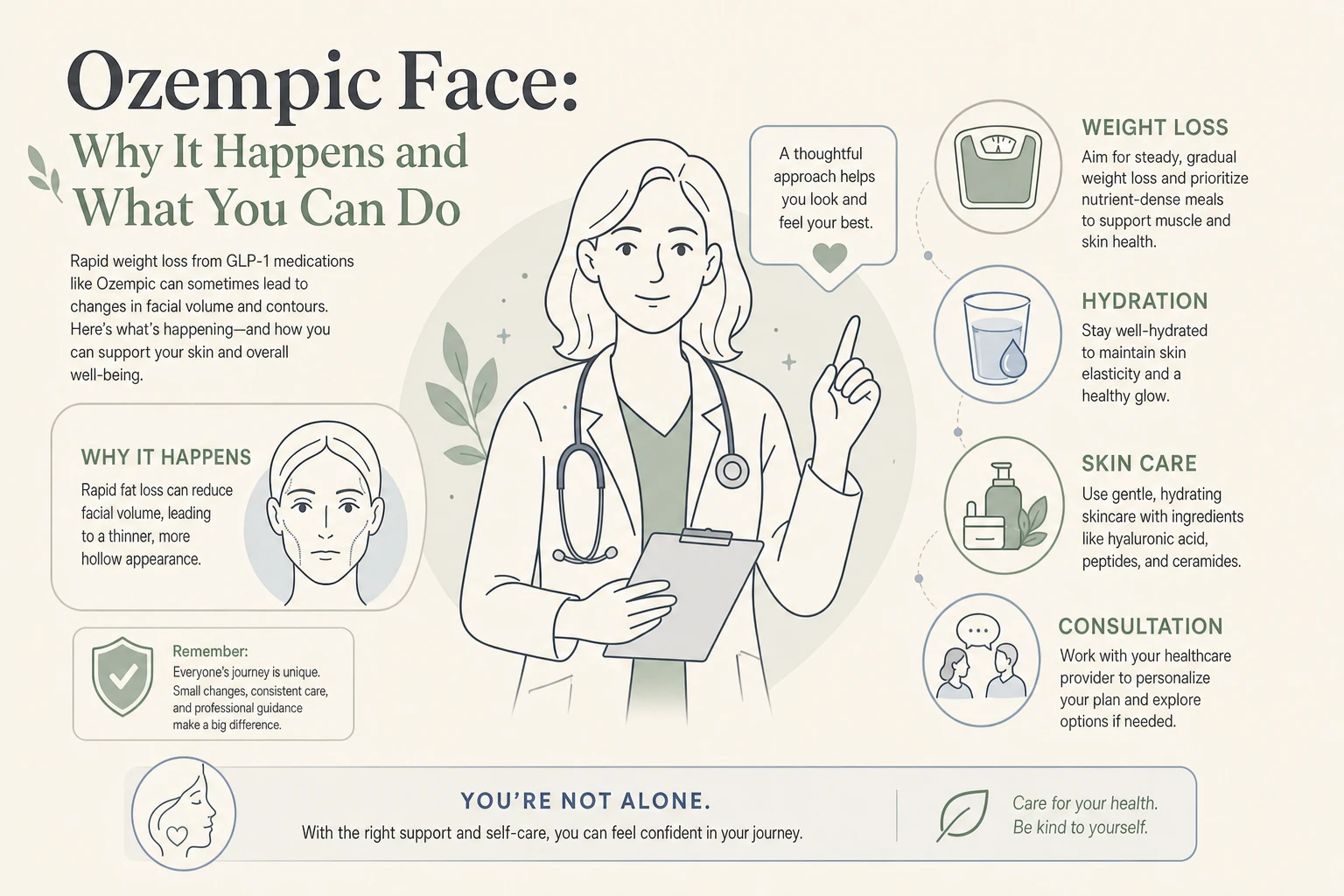
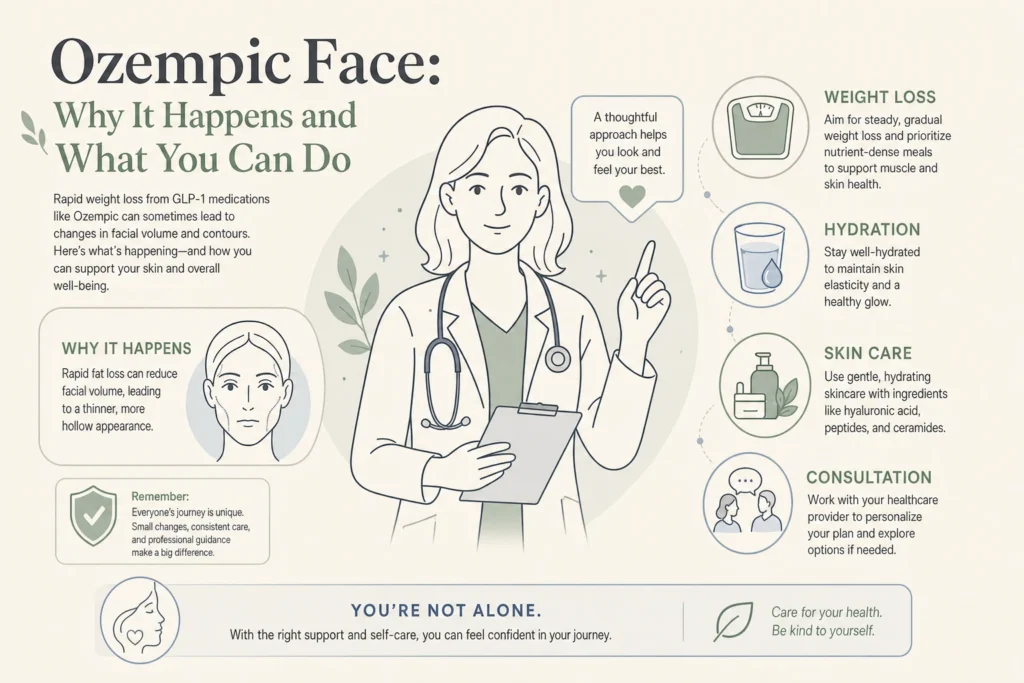
Ozempic Face: Why It Happens and What You Can Do

Ozempic Face: Why It Happens and What You Can Do

September 7, 2026

If you have started losing weight on a GLP-1 medication and your face suddenly looks thinner, more hollow, or older than you expect, you are seeing what people call “Ozempic face.” It is the popular nickname for the gaunt, deflated look that can show up in the cheeks, temples, and under the eyes after fast weight loss. The nickname points at one brand, but the change has nothing to do with any single drug. It comes from losing fat quickly, and it can follow semaglutide, tirzepatide, bariatric surgery, or a crash diet just the same.

The reassuring part is that this is a known, expected change, not a sign that something has gone wrong. Understanding why it happens and what shapes it puts you back in control. At Body Works in Franklin, TN and Nolensville, TN, facial changes are one of the most common concerns weight loss patients raise, and they are usually manageable once you know what you are dealing with. This guide is the anchor for our full picture of body changes after GLP-1 weight loss.

Quick answer: Ozempic face is the hollow, gaunt look that can appear in the cheeks, temples, and under the eyes after rapid weight loss on a GLP-1 medication. It comes from losing facial fat quickly, not from the drug itself, and it is common, expected, and usually manageable.

Illustration of Ozempic Face: Why It Happens and What You Can Do in a modern medical wellness setting

What Is Ozempic Face?

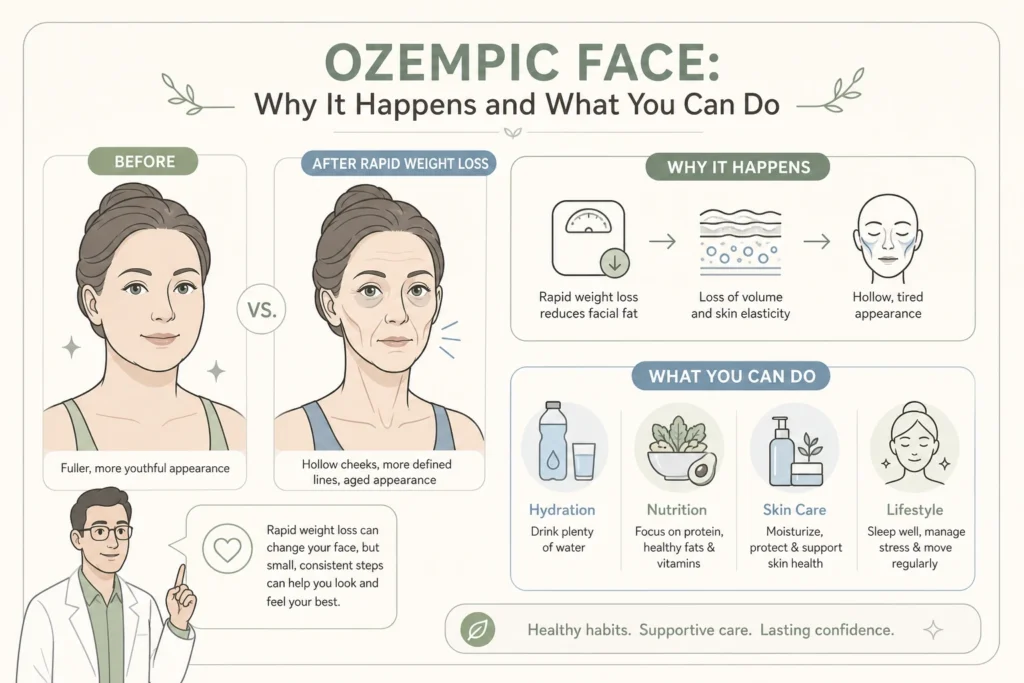
Ozempic face is facial hollowing and mild sagging that appears after rapid weight loss, most visibly in the cheeks, temples, and the areas around the eyes. Your face is padded by small fat compartments that sit under the skin and keep it looking full and smooth. When you lose weight quickly, those pads shrink along with the rest of your body fat, and the skin over them no longer has as much volume to drape across. The result can be a flatter, more drawn look that reads as older, even when the weight loss itself is healthy.

According to the Cleveland Clinic, rapid weight loss removes subcutaneous fat from the face and neck, which causes facial hollowing and sagging skin, and it can make natural aging appear to happen faster (Cleveland Clinic explainer on Ozempic face). That capsule matters because it names the real cause: the fat loss under the skin, not the medication itself.

Why Does Ozempic Face Happen?

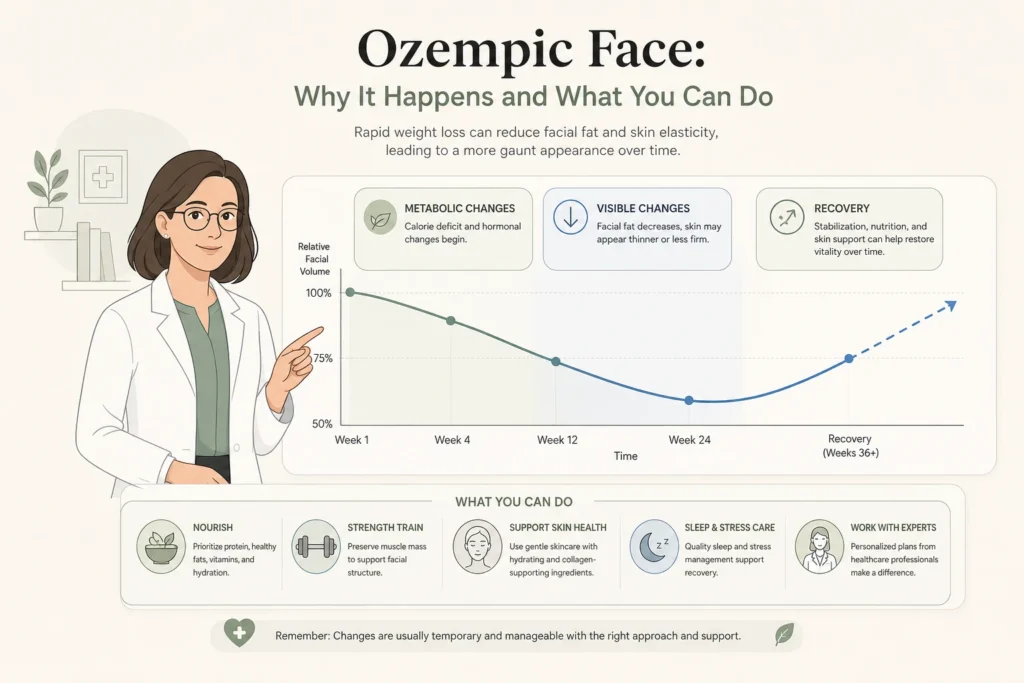
Ozempic face happens because facial fat, skin elasticity, and the pace of weight loss all move at different speeds. Fat leaves the face along with fat everywhere else, but the skin and the collagen beneath it cannot shrink to match nearly as fast. When the padding disappears in weeks or months instead of years, the skin is left with more surface area than the structure underneath can fill, so it looks loose and hollow.

Three forces drive this. First is fat pad loss: the small superficial fat compartments in the mid-cheek and temples deflate, and the temples in particular tend to lose a large share of their volume. Second is skin elasticity, which depends on collagen and elastin. Rapid weight loss lowers both proteins, so the skin springs back less. Third is pace. A systematic review of soft tissue facial changes after major weight loss found consistent, patterned volume loss across the face, with the superficial fat compartments deflating first (2024 systematic review in PMC). The faster the loss, the less time skin has to adapt.

Is Ozempic Face Real, or Just Hype?

Ozempic face is a real, documented change, not a social media exaggeration. The nickname is new and a little unfair to one brand, but the underlying event is well established in the medical literature on weight loss and facial aging. Clinicians have described volume loss in the face after major weight change for decades, long before GLP-1 medications were common. What is new is how many people are losing significant weight quickly, which has made the facial version of this change far more visible.

It helps to separate the phenomenon from the fear. Ozempic face is not a disease, a drug side effect in the traditional sense, or a sign that the medication is harming you. It is the predictable cosmetic result of subcutaneous fat leaving the face. Framing it that way keeps it in proportion: it is common, it is understood, and it responds to a mix of prevention and treatment rather than being something you simply have to accept.

Supporting illustration for Ozempic Face: Why It Happens and What You Can Do in a modern medical wellness setting

Who Is Most Likely to Get Ozempic Face?

The people most likely to notice Ozempic face are those over 40, those losing a large share of their body weight, and those who start with leaner faces. Age is the strongest factor. Collagen and elastin production fall with each decade, so older skin has less ability to contract and adapt when the volume beneath it drops (2018 review on skin aging in PMC). Someone in their 50s losing 40 pounds will usually see more facial change than someone in their 20s losing the same amount.

The amount and speed of loss matter next. Losing 15 percent or more of your body weight, especially over just a few months, gives skin little time to keep up. Genetics and starting anatomy play a role too. People with naturally slim faces have less fat to spare before hollowing shows, and women often notice the change sooner because female facial fat sits more heavily in the mid-face. None of these traits guarantee Ozempic face, but stacked together they raise the odds.

What Are the Signs of Ozempic Face?

The signs of Ozempic face are subtle at first and tend to appear in a recognizable pattern. The earliest change is usually flatter cheeks, where the rounded fullness that catches light begins to sink. From there, many people notice hollowing at the temples, a slight shadowing or bagginess under the eyes, and cheekbones or a jawline that look more prominent because there is less padding covering them.

As loss continues, some people see mild sagging along the lower face and jawline, sometimes described as early jowls, along with finer lines that were not obvious when the skin sat over more volume. These changes often show up between losing 10 and 15 percent of your starting weight, which for many falls a few months into treatment. Seeing them side by side is why “Ozempic face before and after” photos are searched so often: the contrast is what makes the shift feel sudden, even though it built gradually. Noticing the signs early is useful, because the earliest window is when prevention has the most room to work.

Supporting illustration for Ozempic Face: Why It Happens and What You Can Do in a modern medical wellness setting

Can You Prevent Ozempic Face?

You can lower your risk of Ozempic face, though you cannot always erase it, and prevention starts the day you begin losing weight rather than after the hollowing shows. The core levers are the pace of your weight loss, your protein intake, hydration, and protecting the collagen your skin already has. A steadier rate of loss gives facial skin more time to contract with the shrinking volume beneath it, which is one reason a provider may favor a gradual dosing plan over the fastest possible drop.

Nutrition supports the same goal. Eating enough protein helps preserve the muscle and structural tissue that keep your face and body from looking depleted, and steady hydration keeps skin more supple. There is real depth to each of these habits, and dosing pace in particular is a clinical decision. We cover the full playbook in our guide on how to avoid Ozempic face before it starts, so this section stays at the overview level on purpose.

Can Ozempic Face Be Reversed?

Ozempic face can often be improved or reversed, and how far you can go depends on how much of the change is lost volume versus loose skin. When the main issue is deflated fat pads, restoring volume tends to bring back a fuller, more rested look. When skin laxity is the bigger driver, the conversation shifts toward tightening the skin itself, which is a different set of options. Most people have some mix of both, so the right plan is rarely one single thing.

Nutrition and skin-supporting habits set the foundation, and some people ask whether supplements help. The honest answer is that the evidence is modest, which we walk through in our review of collagen and supplements for skin during weight loss. For the in-office side, including what volume restoration realistically can and cannot fix, our detailed guide on whether Ozempic face is reversible with fillers and collagen covers the options, timing, and limits. The key point here is that reversal is usually possible to a meaningful degree, and it is a decision to make with a provider who understands both your weight loss and your face.

Supporting illustration for Ozempic Face: Why It Happens and What You Can Do in a modern medical wellness setting

How Body Works Approaches Face Changes During Weight Loss

At Body Works, facial changes are part of the weight loss conversation from the start, not an afterthought once the hollowing appears. What we see in patients is that the people who fare best are the ones who plan for their face while they plan their weight loss, because pace, nutrition, and timing all overlap. The clinic that adjusts your medication is also the right place to talk about what the weight loss is doing to your skin, since both are being managed by the same team looking at the same goals.

That coordination is the whole idea behind our medical weight loss program: steady, supervised progress that protects how you look as much as what the scale says. If you are starting a GLP-1 medication, or you are already partway through and noticing changes in the mirror, the best next step is a conversation. Schedule a Free Consultation at our Franklin or Nolensville offices, and we will talk through your weight loss and your face together. You can also call the Franklin office at (615) 790-2548 or the Nolensville office at (615) 941-1000.

Frequently Asked Questions

Yes. Ozempic face is a real and well documented change, even though the nickname is recent. It describes facial hollowing and mild sagging that follow rapid weight loss, as the small fat pads under the skin of the cheeks, temples, and eye area shrink faster than the skin can adapt. Clinicians have recognized facial volume loss after major weight change for many years. What is new is the number of people losing weight quickly on GLP-1 medications, which has made this familiar change far more common and visible.
Your face often improves once your weight stabilizes, but it may not return exactly to how it looked before. When weight loss slows and holds steady, skin has more time to adjust to the reduced volume, and some early hollowing softens on its own. How much bounces back depends on your age, how much weight you lost, and your skin’s elasticity. Younger skin with good elasticity recovers more. If the change stays noticeable after your weight settles, volume restoration and skin-focused options can address what remains, which is worth discussing with a provider.
Fixing Ozempic face usually combines steady habits with in-office treatment, matched to whether your main issue is lost volume or loose skin. On the habit side, keeping your weight loss at a controlled pace, eating enough protein, and staying hydrated all help your skin adapt and protect the structure under it. When hollowing remains after your weight stabilizes, volume restoration is the most direct way to bring back fullness, while skin laxity may call for tightening approaches instead. The right mix is individual, so the most useful step is a consultation where a provider can look at your face and your weight loss plan together.
Most people who develop Ozempic face begin to notice it after losing roughly 10 to 15 percent of their starting body weight, which for many falls a few months into treatment. It rarely appears overnight. The first hints are usually flatter cheeks or slight temple hollowing, and the changes build gradually as weight loss continues. People over 40 and those losing weight quickly tend to see it sooner. Because the earliest window is when prevention works best, it is worth paying attention to your face early rather than waiting for the change to feel dramatic.
No. Ozempic face does not happen to everyone, and plenty of people lose significant weight without major facial change. The risk rises with older age, faster weight loss, a larger total amount lost, and a naturally lean face, since those factors leave skin less padding and less time to adapt. Younger people with elastic skin who lose weight gradually often see little difference. Because so much of the risk comes down to pace and how your skin responds, working with a provider who can steer the speed of your weight loss gives you real influence over the outcome.

Medically reviewed by Dr. Donald Vollmer, MD
Managing Physician, Body Works TN

Browse Our Blog

Illustration of The Real Dangers of Buying Peptides Online in a modern medical wellness setting

The Real Dangers of Buying Peptides Online

When Tennessee investigators tested counterfeit weight loss vials seized in Medina, one was mostly water. That was the good outcome. The dangers of buying peptides

The Real Dangers of Buying Peptides Online

The Real Dangers of Buying Peptides Online

September 1, 2026

When Tennessee investigators tested the counterfeit weight loss vials they seized from a house in Medina, one of them turned out to be mostly water. That was the good outcome.

The bad outcome is playing out in Melbourne, where doctors have now hospitalized seven patients with acute liver damage after they injected a weight loss peptide bought outside the medical system. One of them, a 32 year old woman profiled by ABC News Australia, took two injections four days apart. She was in acute liver failure within a week and six months later was still on steroids and still unable to work.

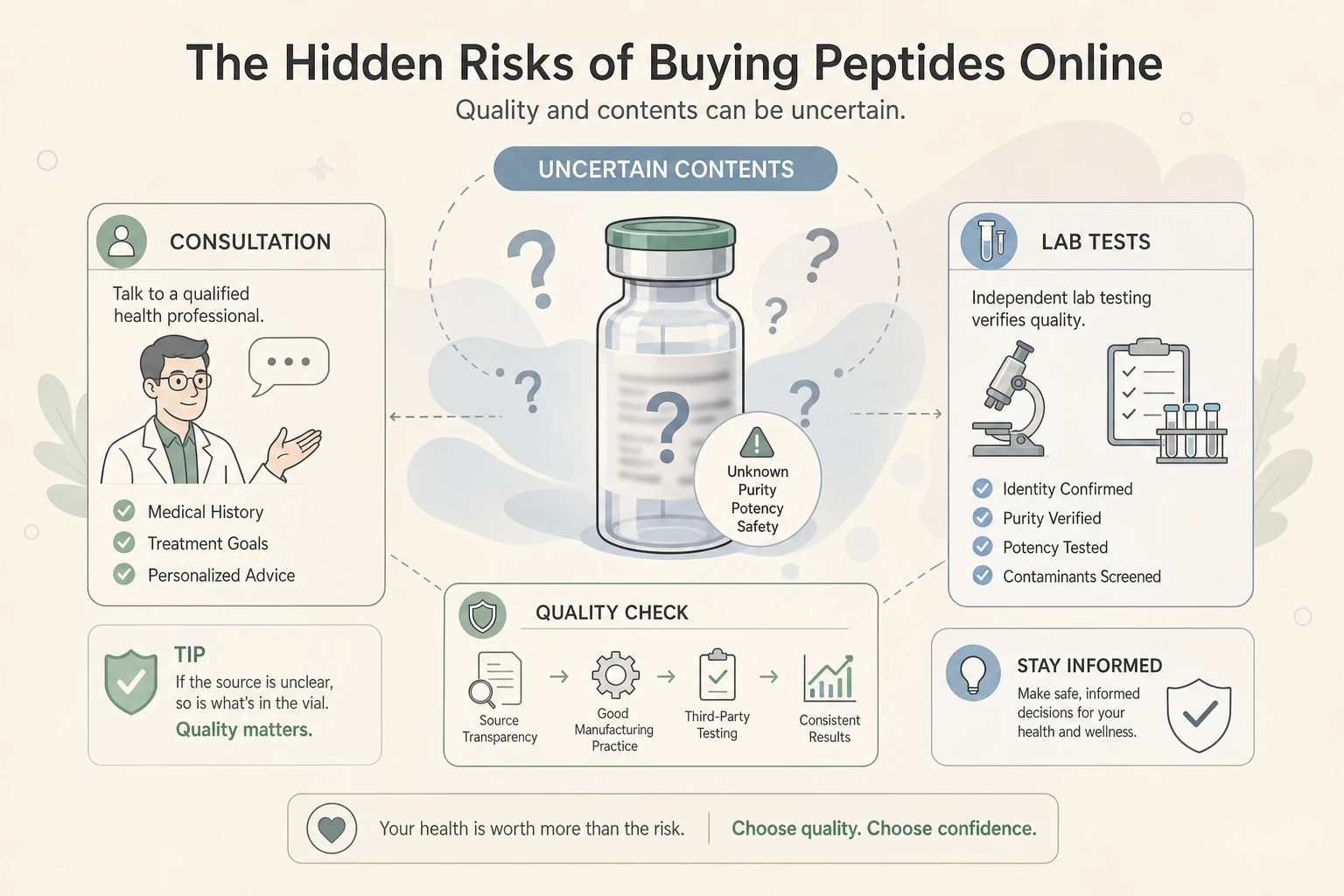
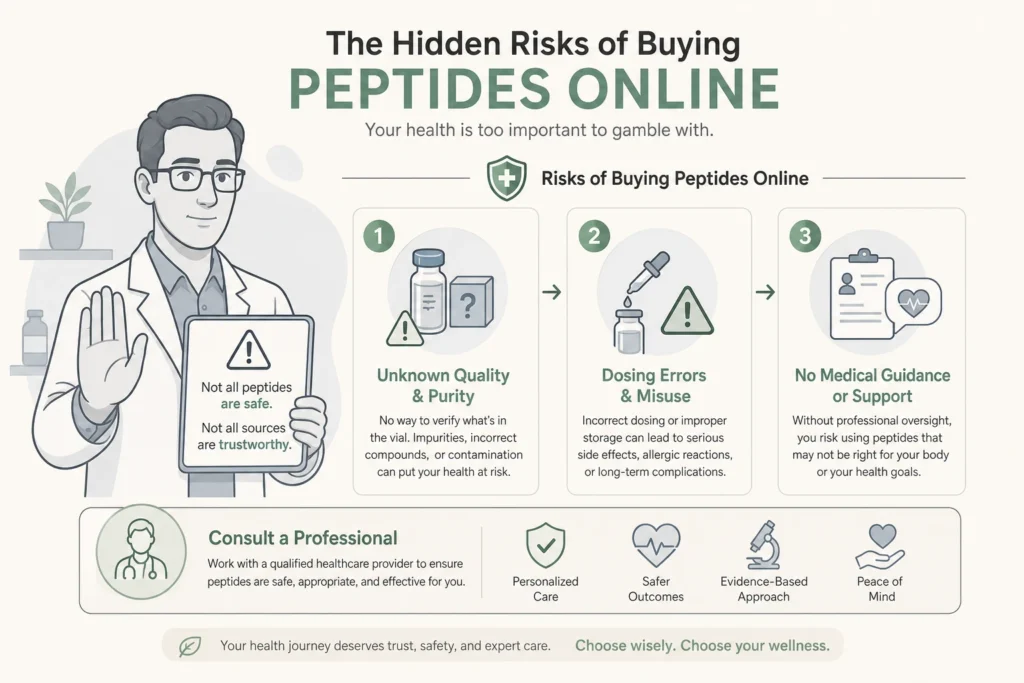
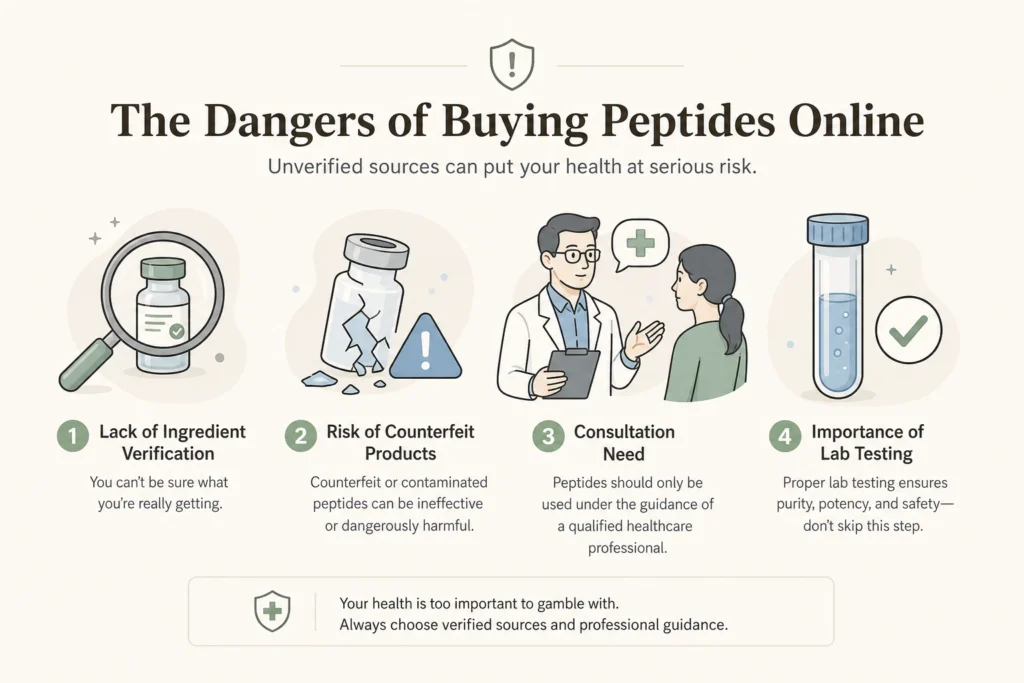
The dangers of buying peptides online come down to one problem that no amount of research on your part can solve: you cannot verify what is in the vial. Not the molecule, not the dose, not the sterility. Everything else people argue about, whether a given peptide works, what the studies show, which protocol is best, sits downstream of that single unanswerable question. This is what patients at Franklin, TN and Nolensville, TN ask about most often once they start looking at online sellers, and it deserves a direct answer.

Illustration of The Real Dangers of Buying Peptides Online in a modern medical wellness setting

What Is Actually in a Peptide Vial Bought Online?

Frequently, not what the label claims. The chief medical advisor of Australia’s Therapeutic Goods Administration called black market retatrutide a counterfeit product and said there were no good batches, and the liver transplant specialist treating the Melbourne patients put it more plainly: the retatrutide being sold is not the retatrutide in clinical trials.

The December 2024 seizure in Medina is the closest documented example. Investigators took more than 300 vials of counterfeit weight loss injectables out of a single home, one sample tested as mostly water, and the accused seller had allegedly been supplying two med spas in this state. Buyers reported rashes and injection site pain.

The FDA’s own position, stated in its statement on unapproved GLP-1 drugs used for weight loss, is that counterfeit drugs “claim to be authentic, but could contain the wrong ingredients, contain too little, too much or no active ingredient at all or other harmful ingredients, and are illegal.” That is not a theoretical risk profile. It is a description of what has repeatedly been found inside vials people already injected.

Does a "Research Use Only" Label Make It Legal or Safe?

No. It is a liability shield for the seller, and the FDA has said so directly, twice, to two different companies within ten weeks.

In a March 2026 warning letter to a peptide seller marketing retatrutide and tirzepatide, the agency wrote that despite labeling the products “Research Use Only,” evidence from the company’s own website established they were intended as drugs for human use. The same letter noted that injectable products “bypass some of the body’s key defenses against toxins and microorganisms that can lead to serious and life-threatening conditions.” A June 2026 warning letter to a different company selling gonadorelin used nearly identical reasoning.

Two enforcement letters, ten weeks apart, written by different reviewers about different compounds, applying the same legal theory. That is a standing FDA position on the category, not an isolated finding. The phrase on the bottle changes the seller’s exposure. It changes nothing about what happens inside your body.

Why Do Dosing Errors Send People to the Hospital?

Because a multi dose vial and a syringe ask an untrained person to do unit conversion correctly, every time, alone. The markings blur between units, milligrams, and milliliters, and the consequences of a decimal error are immediate.

The FDA has documented dosing errors with compounded semaglutide in multiple dose vials in which patients administered five to 20 times the intended dose. Some sought medical attention, some required hospitalization, and reported adverse events included acute pancreatitis and gallstones. The agency noted that most reports involved patients who were unfamiliar with how to measure the intended dose using a syringe.

This risk is entirely separate from whether the product is authentic. A perfectly legitimate molecule, measured wrong at a kitchen counter, produces a hospital visit. It is the single most preventable harm in this category, and supervision is what prevents it. If you are currently measuring your own doses out of a vial you bought online, that is the one thing worth changing this week, and a free consultation is enough to start.

Supporting illustration for The Real Dangers of Buying Peptides Online in a modern medical wellness setting

What Does the Medical Literature Show About Peptides Bought Online?

The published case reports are worth reading before ordering anything. Melanotan II, a tanning peptide widely sold online, has generated a documented trail of serious harm in the medical literature.

One patient injected six times the suggested starting dose and was admitted to intensive care, with muscle breakdown driving his CPK to 17,773 IU/L. In another case, a 45 year old man developed a renal infarction affecting roughly half of one kidney after six months of self injection with product obtained illegally online, and still had reduced kidney function and high blood pressure at follow up. A third report describes melanoma diagnosed in a 20 year old woman three months after a short course of self injections.

Note what these cases share. None is a story about a compound failing to work as designed. They are stories about unsupervised people injecting unverified product at self chosen doses, which is the mechanism of injury across this entire category.

Do Certificates of Analysis From an Online Peptide Seller Mean Anything?

Not unless you can trace it, and usually you cannot. A certificate of analysis means something when it names a licensed laboratory, ties to a specific lot, and was obtained by someone other than the seller who profits from the result. An image file on a product page satisfies none of those conditions.

Purity is also only one variable. Sterility, endotoxin load, and storage history appear on no certificate, and those are the failures that put someone in an emergency department rather than simply wasting their money.

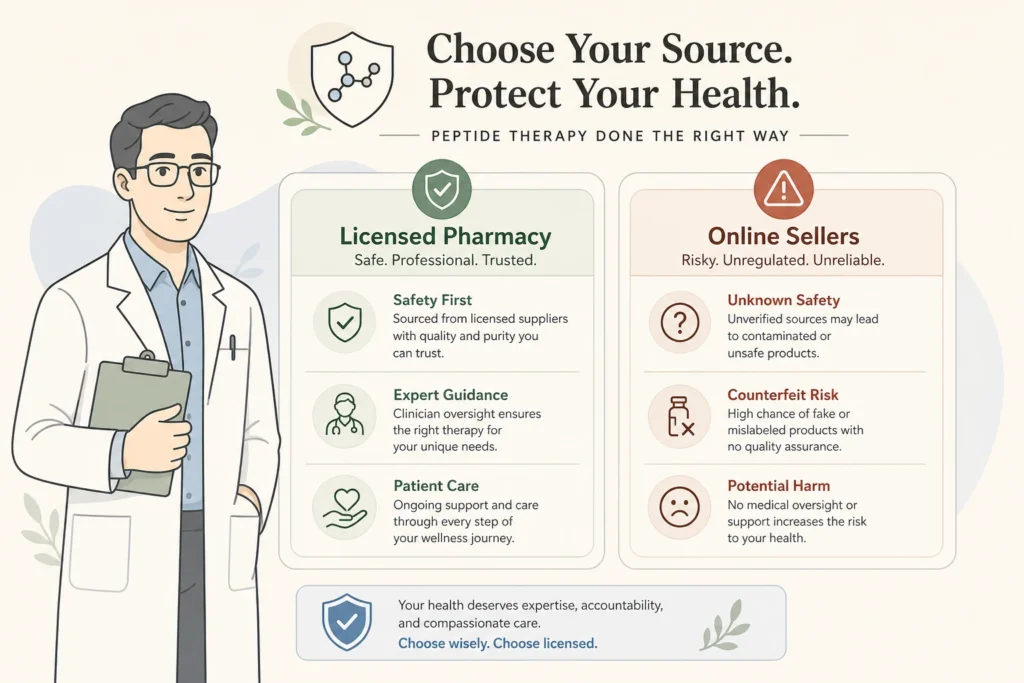
The verification that actually protects you is structural, not documentary. It is a licensed pharmacy accountable to a state board, dispensing against a prescription written for you, with a lot number that traces back through a regulated chain.

Supporting illustration for The Real Dangers of Buying Peptides Online in a modern medical wellness setting

What Does Legitimate Peptide Sourcing Look Like?

It has four requirements, and each one exists because its absence has hurt someone.

  • A licensed prescriber evaluates you first. History, exam, and lab work before anything is prescribed, so the decision accounts for your kidneys, liver, and medication list.
  • The prescription is patient specific. A 503A compounding pharmacy compounds against a valid prescriber order written for one named patient, not a bulk product sold to whoever adds it to a cart.
  • The pharmacy holds a verifiable state license. You should be able to look it up, and any clinic should be willing to name its pharmacy and its license number when you ask. That is the test.
  • The product is traceable. A lot number, an expiration date, and a pharmacy that answers the phone when something goes wrong.

Ask any clinic to walk you through those four points. A practice that cannot name its pharmacy or explain its testing is asking for the same blind trust an anonymous website asks for, just with better furniture. If you want the longer version of that evaluation, we wrote a separate guide on how to vet a peptide therapy provider.

How Does Supervised Care Compare to Ordering Online?

FactorOrdered from an online sellerPrescribed and pharmacy dispensed
Identity of the moleculeUnverifiable. Tested batches have contained no active drug.Compounded by a licensed pharmacy against a specific order
Dose accuracyYou calculate and measure it yourselfPrescribed dose, with instruction and follow up
Screening before useNoneHistory, exam, and lab work first
TraceabilityNone. No lot, no recall path.Lot number and expiration through a regulated chain
If something goes wrongNo one is accountableA prescriber and a licensed pharmacy answer for it

Every peptide protocol we ran at our Nolensville office last year followed the same sequence without exception: an evaluation, lab work, a prescription written for a named patient, and a pharmacy that could be verified by phone. Not most of them. All of them. That is the difference the table is describing, and it is the ordinary standard of care, available locally.

Supporting illustration for The Real Dangers of Buying Peptides Online in a modern medical wellness setting

Getting Peptide Therapy Done Correctly in Middle Tennessee

If you are considering peptides, the useful question is not which website has the best reviews. It is whether anyone in the chain is accountable to you. Body Works provides medically supervised peptide therapy at both offices, which means an evaluation, lab work, a prescription written for you, and a pharmacy that can be verified with a phone call.

Bring your questions, including the skeptical ones, and if you have already bought something online, bring the vial and say so. That conversation beats a quiet decision made at 2 a.m. with a browser open. Schedule a Free Consultation at our Franklin or Nolensville office, or call the Franklin office at (615) 790-2548.

Frequently Asked Questions

Enforcement targets the sellers, not individual buyers, and the FDA has stated that “research use only” labeling does not change a product’s legal status when the seller’s own marketing shows it is intended for people. But legality is the wrong test. The right test is recourse: if an anonymous seller ships the wrong compound, no licensed party is accountable for what happens to you next, and no regulator will recover anything on your behalf.
Cost depends on the protocol, the labs required, and the length of treatment, so it is a conversation rather than a price list. Online vials look cheaper because the price excludes everything that makes a medication safe: the evaluation, the lab work, the pharmacy license, and someone who answers when a problem starts.
Bring them and say where they came from. No prescriber can verify the contents of an unlabeled or gray market vial, and no clinic should administer one. What a provider can do is review your health history, order labs, and tell you honestly whether what you have been taking warrants monitoring.
No prescription required, “research use only” or “not for human consumption” on the label, no named licensed pharmacy, certificates of analysis that cannot be traced to an independent laboratory, payment by cryptocurrency or app only, dosing advice from a sales representative, and prices far below what a licensed pharmacy charges. Any single one of those is disqualifying.
Body Works has offices in Franklin and Nolensville serving Williamson County and the surrounding Middle Tennessee communities. Both locations provide peptide therapy under medical supervision, with prescriptions filled through licensed compounding pharmacies. A consultation is free, and it is the right first step whether you are starting out or reconsidering something you already bought.

Medically reviewed by Dr. Donald Vollmer, MD
Managing Physician, Body Works TN

Browse Our Blog

Illustration of The Real Dangers of Buying Peptides Online in a modern medical wellness setting

The Real Dangers of Buying Peptides Online

When Tennessee investigators tested counterfeit weight loss vials seized in Medina, one was mostly water. That was the good outcome. The dangers of buying peptides

See Body Works first in your Google results.

Add as a preferred source on Google