
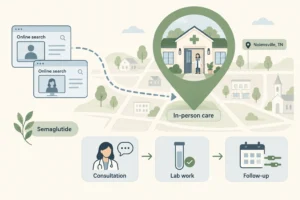
Semaglutide in Nolensville, TN: Availability and How to Start
Searching for semaglutide in a town the size of Nolensville turns up a strange gap: national telehealth ads everywhere, but almost nothing about a real
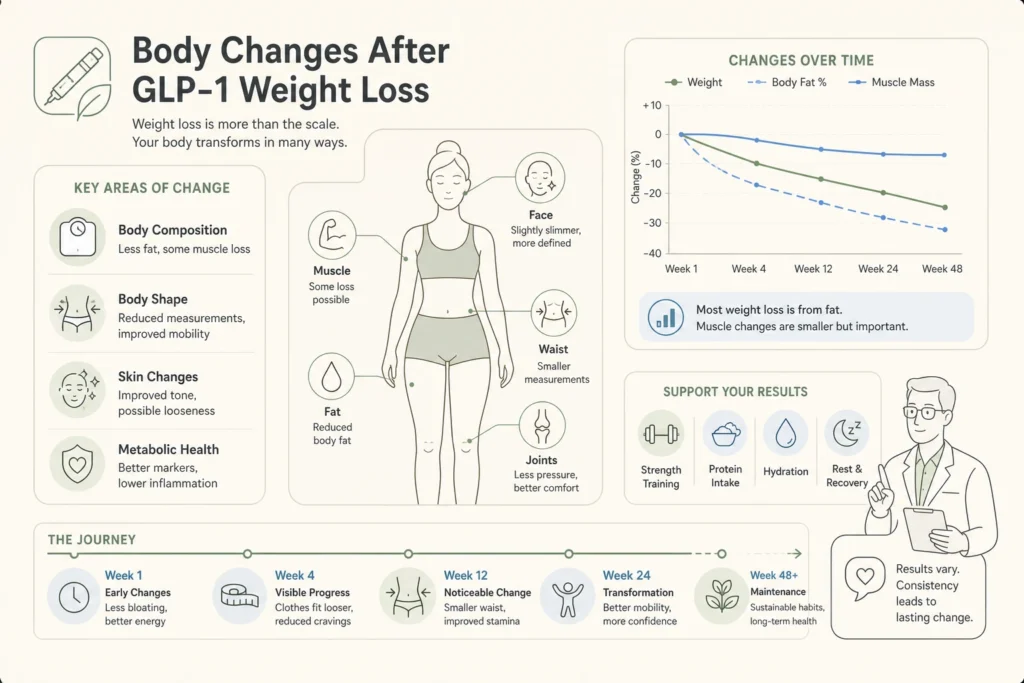
If you have lost a significant amount of weight on a GLP-1 medication, you have probably noticed that the scale is not the only thing that changed. Your face may look thinner or more drawn. Your skin might feel looser. Your clothes fit differently in ways that are not only about size. The short answer is that rapid weight loss changes fat, skin, and muscle all at once, and each of those tissues responds on its own timeline. Most of what people call the “Ozempic body” is the visible result of losing fat faster than your skin and muscle can adapt. The good news is that much of it is manageable, and some of it is preventable when you plan for it from the start.
This guide is the survey map for everything that changes. It covers what happens to your face, skin, muscle, and shape after weight loss with semaglutide or tirzepatide, why each change happens, and what actually helps. For any single topic, you will find a link to a deeper guide that answers that one question in full. Body Works helps patients across Franklin, TN and Nolensville, TN manage the whole picture, not just the dose, through our medical weight loss program.
According to the Cleveland Clinic on facial volume loss during rapid weight loss, the sunken look people notice in the face is not caused by the medication itself. It comes from losing facial fat quickly, the same way you lose fat everywhere else. That single idea, that the drug reveals fat loss rather than causing a special kind of aging, is the key to understanding almost every change on this page.
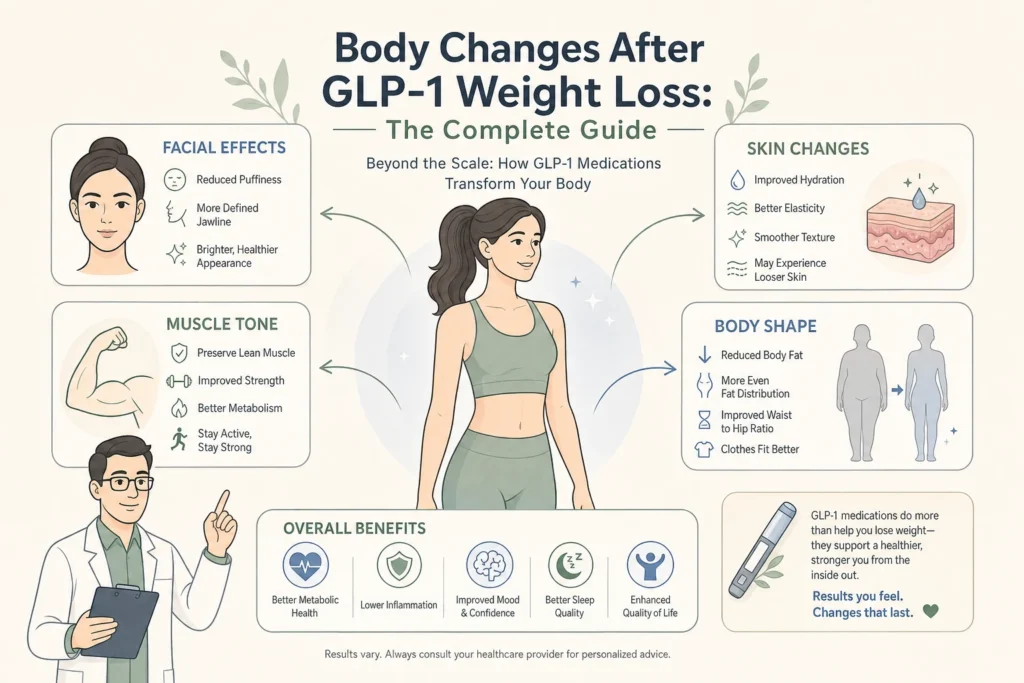
Rapid weight loss changes more than the scale because your body is not made of one uniform material. When you lose weight quickly, you lose fat from under the skin across your whole body, including the face, arms, and buttocks. At the same time, skin that stretched to cover a larger body does not instantly shrink back, and some lean muscle is lost along with the fat unless you actively protect it. The result is a mix of thinner features, looser skin, and shifts in shape that all arrive around the same time.
The speed matters. Skin and muscle adapt slowly, so the faster the fat leaves, the more likely these tissues fall behind. This is why two people who lose the same amount of weight can look very different: age, genetics, how much weight was lost, how long it was carried, and how the weight came off all play a role. The National Institute of Diabetes and Digestive and Kidney Diseases weight management guidance notes that gradual, steady weight loss paired with muscle-preserving habits tends to produce more durable results than crash approaches. Understanding that framework, fat down fast, skin and muscle lagging behind, makes the rest of this guide easier to follow.
“Ozempic face” is the popular nickname for the thinner, more hollow, sometimes older-looking appearance that can follow rapid weight loss on a GLP-1 medication. It is not a unique medical condition and it is not damage from the drug. It is facial fat loss. The cheeks, temples, and area under the eyes hold fat pads that give the face a youthful fullness, and when you lose weight everywhere, you lose some of that cushion too. Less underlying volume plus skin that has lost some elasticity can read as gaunt or aged.
Because the face is where change is hardest to hide, this is the concern we hear about most. The reassuring part is that the face has several levers you can pull, from prevention to volume replacement. For the full picture of why it happens and what to do, see our guide to why Ozempic face happens and how it is treated. If you have not started losing yet or are early in the process, the more useful read is how to avoid Ozempic face before it starts, which focuses on pacing and muscle-sparing habits. And if you are asking whether the changes can be reversed, what fillers and collagen can and cannot do for Ozempic face walks through the realistic options.
Loose skin after weight loss happens because skin that stretched to cover a larger body loses some of its ability to snap back. Skin gets its stretch and recoil from collagen and elastin, and when skin is stretched for a long time or over a large volume, those fibers can be permanently altered. When the fat underneath leaves, the skin envelope that remains may hang, most often on the belly, upper arms, inner thighs, and neck. How much loose skin you end up with depends on your age, how much weight you lost, how long you carried it, sun exposure over the years, and genetics.
Not all skin change is permanent, and mild laxity often improves over months as skin slowly remodels. The distinction between “will tighten on its own” and “will need help” is the whole subject of a dedicated guide: start with the causes, prevention, and treatment of loose skin after weight loss. For the do-it-yourself side, how to tighten skin after weight loss naturally covers hydration, protein, strength training, and pacing, and is honest about where natural methods stop. When skin laxity is beyond what habits can fix, non-surgical skin tightening options compared lays out the professional treatments to discuss with a provider. Skin also responds to signaling molecules, which is why some patients ask about peptides for skin versus skincare creams.
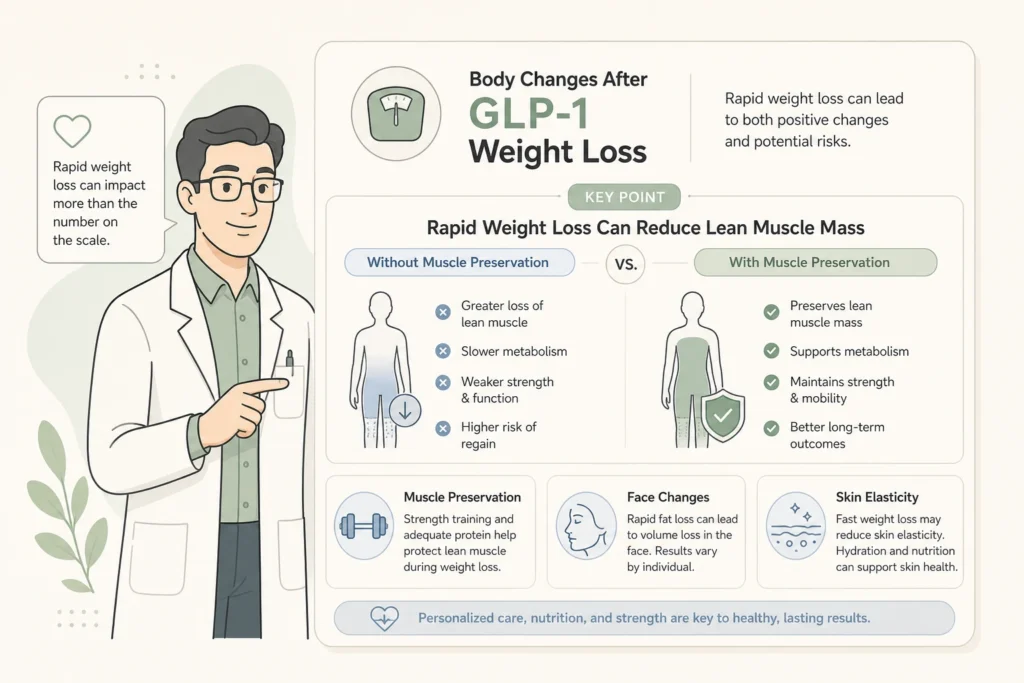
When you lose weight on a GLP-1 medication, some of that loss is muscle, not just fat, unless you take steps to protect it. Muscle is what keeps your metabolism up, your body strong, and your shape looking healthy rather than deflated. Studies of rapid weight loss consistently show that a portion of the weight lost is lean mass, and appetite suppression can make it harder to eat enough protein to defend that muscle. Losing muscle also makes weight regain more likely later, because a lower-muscle body burns fewer calories at rest.
The fix is not complicated, but it does take intention. Resistance training and adequate protein are the two biggest levers, and the Mayo Clinic notes that strength training helps preserve lean muscle and resting metabolism during weight loss. We go deep on the protocol in our guide to preventing muscle loss on GLP-1 medications. Protecting muscle is also central to keeping your results after you taper off, which we cover in what happens when you stop semaglutide or tirzepatide.
“Ozempic butt” is the nickname for the flatter, softer, or more deflated look the buttocks can take on after rapid weight loss. Like the face, the buttocks hold fat, and when you lose fat everywhere, that area loses volume too. If muscle is also lost from the glutes and legs, the area can look both smaller and less firm. It is the same underlying story as the face, just lower on the body: fat down fast, plus some muscle loss, plus skin that may not fully recoil.
Shape change is not limited to the buttocks. Some patients notice softer arms, a less defined jawline, or a different silhouette as their body composition shifts. The encouraging part is that shape responds well to muscle, which is one of the few tissues you can actively rebuild. Our guide to the “Ozempic butt” and body shape changes on GLP-1 medications explains what is fat, what is muscle, and how targeted strength work changes the outcome.
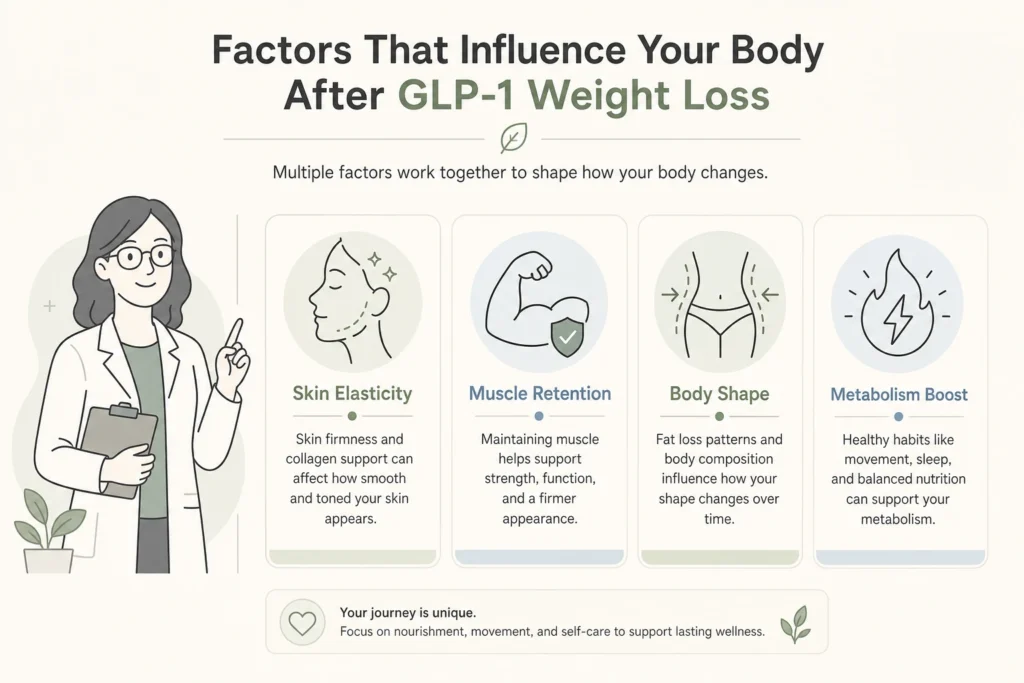
The single best way to limit unwanted body changes is to protect skin, muscle, and facial volume while you are still losing, not after. Four habits do most of the work:
None of these guarantee a perfect outcome, but together they meaningfully reduce loose skin, muscle loss, and facial hollowing.
Some patients also ask about supplements, especially collagen, and about signaling peptides that target skin. The honest answer is that these are supporting players, not replacements for the four habits above. We sort the evidence in collagen and supplements for skin during weight loss, and we compare in-clinic peptide therapy to over-the-counter products in peptides for skin. What we see in patients at Body Works is that the people who plan for these changes early, from the first appointment, consistently end up happier with how they look at the finish line than those who wait until the skin is already loose.
When habits are not enough, several treatment categories can address body changes after weight loss, and the right choice depends on which tissue is involved and how much change you want to correct. For facial volume, replacement approaches can restore fullness. For loose skin, non-surgical tightening treatments can help mild to moderate laxity, while significant excess skin may be a surgical conversation. For muscle and shape, structured strength training is still the foundation, sometimes supported by clinical peptides. No single treatment fixes everything, which is why a provider who can see the whole picture is more useful than chasing one fix at a time.
| Change type | Why it happens | What helps | Which guide covers it |
|---|---|---|---|
| Facial hollowing (“Ozempic face”) | Loss of facial fat pads plus reduced skin elasticity | Steady pacing, muscle-sparing habits, volume replacement options | Ozempic face causes and treatment and fillers for Ozempic face |
| Loose or sagging skin | Skin stretched over a larger body cannot fully recoil | Protein, strength training, time, and professional tightening when needed | Loose skin after weight loss and skin tightening options |
| Muscle and metabolism loss | Lean mass is lost with fat, worsened by low protein intake | Resistance training and adequate daily protein | Preventing muscle loss on GLP-1s |
| Shape and buttock changes (“Ozempic butt”) | Fat loss plus muscle loss in the glutes and legs | Targeted strength work to rebuild volume and firmness | Ozempic butt and body shape changes |
| Skin quality and elasticity | Collagen and elastin decline with age and rapid change | Hydration, sun protection, collagen support, clinical peptides | Tighten skin naturally, peptides for skin, and collagen and supplements |
The one thing every treatment decision has in common is that it should follow an honest assessment, not a sales pitch. Some changes will settle on their own, some respond to habits, and only some need a procedure. A good provider will tell you which is which before recommending anything.
At Body Works, we treat body changes as part of the weight loss plan, not an afterthought. The clinic that adjusts your dose is also the right place to talk about what the weight loss is doing to your skin, face, and muscle, because those things are connected. From the first appointment, we talk about pace, protein, and strength training so that skin and muscle keep up as the fat comes off. When a change needs more than habits, we walk through the realistic options and route you to the right treatment rather than overpromising a reversal.
Patients at our Franklin and Nolensville offices work with providers who manage both the medication and the whole-body picture in one place. If you are early in your weight loss and want to prevent problems, or you are further along and want to address a change that has already appeared, the best next step is a conversation. Learn more about our medical weight loss services, or Schedule a Free Consultation to build a plan that protects how you look as well as how much you weigh.
Our full medical weight loss program is available at both the weight loss clinic in Franklin and weight loss clinic in Nolensville.
Medically reviewed by Dr. Donald Vollmer, MD
Managing Physician, Body Works TN
Searching for semaglutide in a town the size of Nolensville turns up a strange gap: national telehealth ads everywhere, but almost nothing about a real

If you have been researching semaglutide for weight loss, you have probably hit the same wall everyone else does: a telehealth app that ships a
The needle is the easy part. Most people who quit a GLP-1 medication early do not quit because of the injection itself, they quit because
Patients starting tirzepatide often expect the first injection to feel like the start of real treatment. It isn’t. The 2.5 mg starting dose is a
The dose on a semaglutide prescription rarely matches the dose a patient ends up taking, and that gap confuses people every week. Someone reads that
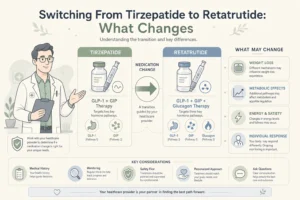
Switching from tirzepatide to retatrutide is a supervised medication change, not a milligram match. Retatrutide (GLP-3) adds the glucagon receptor and produced 24.2% weight loss
See Body Works first in your Google results.